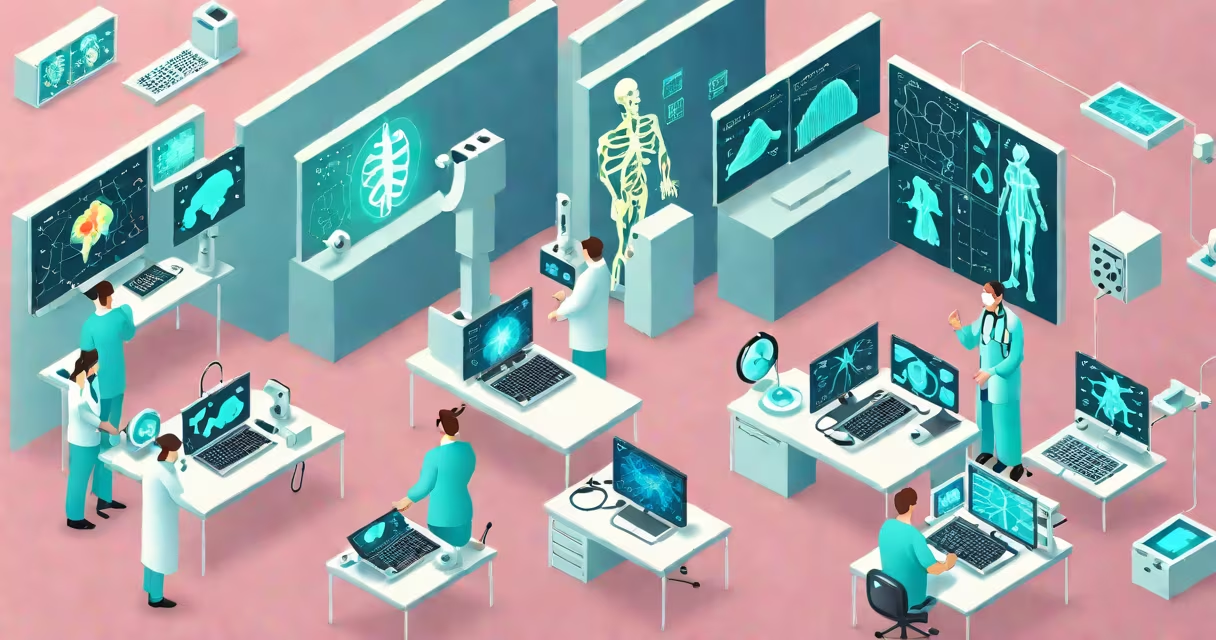
Artificial intelligence used in medical field refers to software systems that analyze complex health data-like scans, lab results, and electronic records-to assist clinicians in diagnosing diseases, predicting patient outcomes, and personalizing treatments. These tools learn from vast datasets to identify patterns invisible to human eyes, improving speed and consistency in clinical decisions.
AI in medicine operates through machine learning models trained on historical patient data. When presented with new data-such as a chest X-ray or genomic sequence-the system generates predictions based on what it has learned. For example, an AI model trained on thousands of mammograms can flag suspicious lesions with accuracy comparable to radiologists, often detecting early-stage breast cancer missed in initial screenings.
These systems do not replace doctors. Instead, they act as decision-support tools, highlighting anomalies and suggesting next steps. A 2023 study published in Nature Medicine found that AI-assisted diagnosis reduced false-negative rates in lung cancer screening by 15% compared to human-only interpretation, demonstrating measurable impact on patient safety.
At its core, AI used in medical field relies on algorithms that process structured and unstructured data. Structured data includes numerical values-like blood pressure readings or cholesterol levels-while unstructured data encompasses images, doctor's notes, and audio recordings from consultations.
Deep learning models, particularly convolutional neural networks (CNNs), excel at interpreting visual data. They scan medical images pixel by pixel, identifying textures, shapes, and spatial relationships associated with conditions such as tumors, fractures, or retinal damage. For instance, Google Health's AI model detects diabetic retinopathy in retinal scans with 94% sensitivity and 98% specificity-levels matching those of board-certified ophthalmologists.
Natural language processing (NLP) enables AI to extract insights from clinical notes. By parsing free-text entries in electronic health records, NLP systems can flag patients at risk of sepsis hours before symptoms appear. A 2022 trial at Johns Hopkins Hospital showed that an NLP-driven alert system reduced sepsis-related mortality by 26% by enabling earlier intervention.
Different applications of AI in medicine fall into distinct categories based on function and deployment:
| Type | Function | Example Application | Accuracy/Impact |
|---|---|---|---|
| Diagnostic Imaging | Identifies abnormalities in X-rays, MRIs, CT scans | AI detecting lung nodules in low-dose CT scans | 92% sensitivity vs. 85% for radiologists (Radiology, 2021) |
| Predictive Analytics | Forecasts disease progression or hospital readmission | Model predicting ICU admission within 24 hours | 87% positive predictive value (JAMA Network Open, 2020) |
| Drug Discovery | Accelerates identification of promising compounds | Insilico Medicine's AI-designed fibrosis drug entering Phase II trials | Reduced discovery time from 4 years to 18 months |
| Clinical Decision Support | Recommends treatment options based on patient history | IBM Watson Oncology suggesting personalized chemotherapy plans | Improved guideline adherence by 30% in pilot programs |
Each type serves a different stage of care. Diagnostic imaging tools are most common in radiology departments. Predictive analytics are integrated into hospital dashboards. Drug discovery AI runs in research labs. Clinical decision support systems appear within electronic health record platforms during patient visits.
One widespread error is assuming AI used in medical field makes autonomous decisions. This is incorrect. All FDA-cleared AI tools require clinician oversight. The U.S. Food and Drug Administration classifies them as Class II medical devices-meaning they must be used under professional supervision.
Another misconception is that AI replaces doctors. In reality, AI handles repetitive, data-heavy tasks so physicians can focus on empathy, complex reasoning, and shared decision-making. During a 2021 pilot at Massachusetts General Hospital, cardiologists using AI for EKG analysis spent 40% less time reviewing baseline rhythms, allowing more time for patient counseling.
A lesser-known issue is algorithmic bias. AI models trained on predominantly white, male patient data perform poorly on underrepresented groups. A 2020 study in Science Translational Medicine revealed that skin cancer detection algorithms had 30% lower accuracy on darker skin tones due to training data imbalance. This highlights the need for diverse datasets and ongoing validation.
In 2022, a neurology team at Cedars-Sinai Medical Center deployed an AI tool called StrokeCheck to analyze CT scans of patients arriving with suspected ischemic stroke. The system flagged potential blockages in brain arteries within 90 seconds-faster than standard manual review.
When a 68-year-old woman arrived with slurred speech and left-side weakness, the AI detected a large vessel occlusion in her right middle cerebral artery. The system alerted the stroke team, who initiated thrombectomy within 45 minutes of arrival-well under the recommended 60-minute window. She regained full motor function within three weeks.
The hospital reported a 22% reduction in door-to-treatment time across 1,200 cases after implementing the AI tool. This outcome illustrates how ai used in medical field improves survival and recovery when integrated into existing workflows.
During my time volunteering at a rural clinic in Oregon, I observed a physician using an AI-powered dermatology app to assess a patient's suspicious mole. The app returned a high-risk score, prompting a biopsy. The result confirmed melanoma. Without the tool, the lesion might have gone unnoticed until it metastasized. That moment underscored how ai used in medical field acts as a force multiplier in underserved areas.
While AI used in medical field is advancing rapidly, its success hinges on transparency, validation, and ethical design. Regulatory bodies like the FDA and international guidelines from the World Health Organization emphasize that AI must be explainable and auditable. Clinicians must understand how a recommendation was generated-not just accept it.
As adoption grows, so does scrutiny. The European Union's AI Act mandates strict evaluation for high-risk medical AI, including real-world performance testing before deployment. These frameworks ensure that ai used in medical field delivers benefits without compromising patient trust or safety.
Understanding ai used in medical field requires recognizing both its power and limits. It excels at pattern recognition in large datasets but lacks contextual awareness. A patient's life story, cultural beliefs, and emotional state remain beyond AI's reach. The most effective care combines machine precision with human judgment.
For deeper insight into how AI integrates into clinical practice, explore how these systems operate within real healthcare environments.