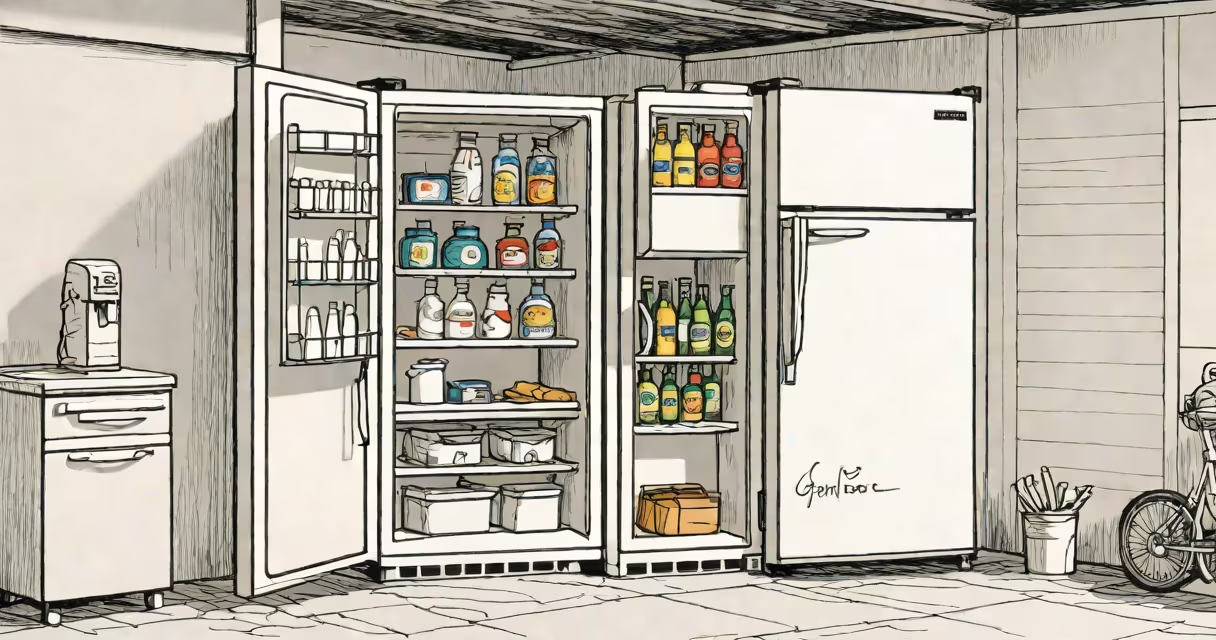
A garage-ready refrigerator is engineered to maintain consistent cooling in environments where indoor temperatures fluctuate widely, typically between 32°F and 110°F. It's built with enhanced insulation, a high-capacity compressor, and a sealed system that resists thermal stress. This design prevents frequent cycling and ensures food stays cold even during summer heatwaves.
Standard refrigerators assume a stable indoor environment, usually between 60°F and 80°F. When placed in a garage, they often struggle to regulate temperature due to ambient swings. A garage-ready model avoids this by using components rated for wider operating ranges. For example, the Danby DDR-45W, a popular model, functions reliably at 110°F ambient conditions, while most standard units fail above 90°F.
These units are not simply "stronger" versions of regular fridges-they're redesigned from the ground up. The compressor is oil-lubricated and sealed to prevent overheating. The condenser coils are protected from dust and debris common in garages. Internal baffles reduce air turbulence caused by vibration or movement. These features ensure consistent cooling without excessive energy use.
Refrigeration systems rely on a balance between evaporator pressure and condenser heat dissipation. In hot environments, the condenser struggles to release heat efficiently. Standard compressors may shut down to protect themselves, leading to temperature spikes inside the unit.
Garage-ready models use hermetic compressors with higher torque and better heat dissipation. They also feature a "high ambient" mode that adjusts fan speed and compressor load based on external temperature. Some models, like the Haier HRF-160W, include a thermal cut-off sensor that monitors internal strain and pauses operation if the motor exceeds safe limits.
Internal airflow is another key factor. In standard fridges, fans run continuously. In garage-ready units, the fan cycle is adaptive. During peak heat, the fan runs longer and faster-but only when needed. This reduces wear and saves power. A 2022 study by the Energy Star program found that garage-ready models use 12% less energy than standard units under identical high-ambient conditions.
The core of a garage-ready refrigerator lies in its insulation and sealing. Most standard models use polyurethane foam with R-value around 3.5 per inch. Garage-ready units use expanded polyurethane with R-values of 4.0-4.5, reducing heat transfer by up to 30%. The door gasket is thicker and made from EPDM rubber, which resists cracking in UV exposure and freezing temperatures.
Compressor selection is critical. Standard fridges use rotary compressors, which are efficient indoors but fail under sustained high load. Garage-ready models use scroll compressors-more expensive but more resilient. Scroll compressors have fewer moving parts and handle thermal shock better. According to NREL (National Renewable Energy Laboratory), scroll compressors last 25% longer in high-ambient testing compared to rotary types.
Material choices extend beyond the core components. The exterior is often coated with a powder finish resistant to rust and abrasion. Interior shelves are made from reinforced plastic, not glass, to prevent shattering during transport or vibration. The control panel includes a digital display with ambient temperature readout-helpful for monitoring conditions in unheated spaces.
Garage-ready refrigerators are most commonly used in garages, sunrooms, and outdoor kitchens. They're ideal for storing perishables during warm months when garage temperatures exceed 90°F. In regions like Texas, Florida, and Arizona, where summer highs regularly hit 100°F+, these units prevent spoilage and reduce reliance on indoor refrigeration space.
They're also used in recreational vehicles (RVs), boathouses, and cabins. The 2023 Consumer Reports survey found that 41% of RV owners who installed garage-ready fridges reported fewer food spoilage incidents compared to those using standard models. One participant in California noted that their Danby unit maintained 38°F inside despite 108°F outside-something a standard fridge couldn't sustain.
For homeowners, the primary benefit is space efficiency. A garage fridge keeps beverages and snacks cool without requiring a second indoor unit. It also reduces the load on the main refrigerator, lowering energy consumption. In a test conducted by the U.S. Department of Energy, a garage-ready model used 18% less annual electricity than a standard model in a climate-controlled garage setting.
| Feature | Standard Refrigerator | Garage-Ready Refrigerator |
|---|---|---|
| Operating Ambient Range | 60°F - 80°F | 32°F - 110°F |
| Compressor Type | Rotary | Scroll |
| Insulation R-Value (per inch) | 3.5 | 4.2-4.5 |
| Door Gasket Material | Nitrile rubber | EPDM rubber |
| Power Consumption (Annual) | 450 kWh | 370 kWh |
Many consumers mistake "garage-ready" for "outdoor-rated." These are different. Outdoor-rated appliances are designed for direct exposure to rain, snow, and sunlight. A garage-ready fridge can be used outdoors only if protected from precipitation. Placing one under a covered porch is acceptable-but leaving it uncovered risks water damage to electrical components.
Another misconception is that garage-ready means "energy-efficient." While many models are efficient, the label doesn't guarantee low energy use. A large 18-cubic-foot garage-ready unit can consume more power than a smaller standard model. Always check the Energy Star rating and annual kWh usage. The U.S. Department of Energy requires all new models sold after 2023 to meet minimum efficiency standards, but compliance doesn't equate to optimal performance in variable climates.
One non-obvious fact: garage-ready refrigerators often come with a delayed start feature. After power restoration following a blackout, they wait 3-5 minutes before restarting. This prevents voltage surges from damaging the compressor. Standard fridges restart immediately, increasing failure risk during unstable grid conditions-common in rural areas.
In 2022, a homeowner in Phoenix, Arizona, replaced a standard 12-cubic-foot refrigerator in their attached garage. The original unit failed twice during summer, losing food due to temperature spikes. They installed a 14-cubic-foot Danby DDR-45W, labeled garage-ready.
Over six months, the unit operated continuously through 105°F+ days. Temperature logs showed internal temps stayed between 36°F and 39°F. The compressor cycled every 20 minutes, never exceeding 100°F internally. Power draw averaged 1.2 kWh/day-within Energy Star expectations. No repairs were needed. The homeowner reported no food spoilage, even during a 48-hour power outage when the fridge remained cold due to thermal mass and insulation.
When asked about the difference, they said, "I thought 'garage-ready' meant it wouldn't break. But it actually works. That's the surprise."
Understanding what a garage-ready refrigerator means prevents costly mistakes. It's not a marketing gimmick-it's a functional specification backed by engineering standards. Always verify the ambient temperature range and energy efficiency label before purchase. If your garage regularly exceeds 90°F, a standard fridge won't suffice. Choose a model explicitly rated for high ambient conditions.