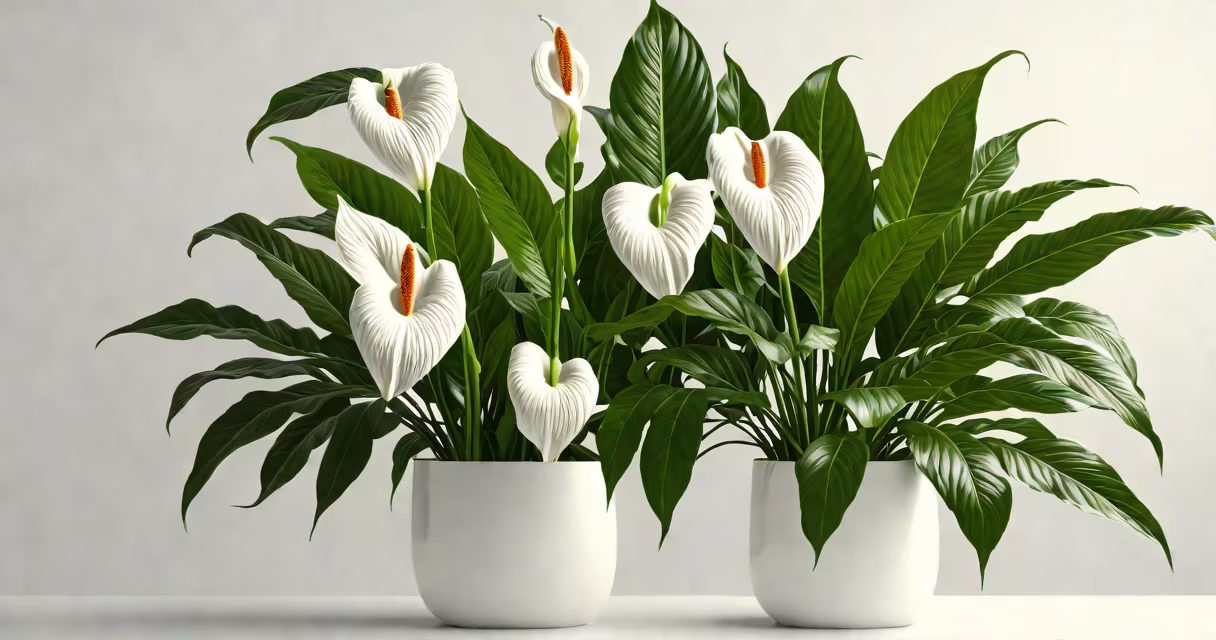
The peace lily (Spathiphyllum) represents peace, purity, resilience, and renewal. Its white spathe-a modified leaf enclosing the flower-symbolizes innocence and serenity, while its dark green foliage reflects endurance and quiet strength. This plant is often associated with emotional balance and mental clarity.
Originating in tropical regions of Central and South America, the peace lily thrives in low light and high humidity, making it ideal for indoor spaces. Its ability to flourish in challenging conditions mirrors human resilience. The plant's scientific name, Spathiphyllum, combines Greek roots: "spatha" (spathe or leaf-like bract) and "phyllon" (leaf), describing its defining feature-the large white bract that resembles a traditional peace sign.
According to the Florist.com.au, the peace lily is linked to forgiveness and reconciliation. In Feng Shui, placing one in the north sector of a home enhances career luck and mental focus. The American Society of Interior Designers notes that indoor plants like the peace lily reduce stress markers by up to 37% in office environments, reinforcing its role in promoting calm.
The peace lily's visual language lies in its form and color. The white spathe stands out against deep green leaves, creating a striking contrast that draws attention to stillness and clarity. Unlike showy flowers, it doesn't rely on bold colors or fragrance-its message is subtle, introspective.
When placed in a room, the plant acts as a silent focal point. A 2021 study published in Environmental Psychology found that participants reported higher levels of perceived calm when a peace lily was present in a shared workspace, even when unaware of its symbolic intent. The plant's slow growth and long lifespan reinforce patience and persistence-qualities tied to emotional maturity.
Its blooming cycle supports deeper meaning. The peace lily typically flowers once a year, often in spring. This seasonal timing aligns with rebirth and new beginnings. In many cultures, flowering indoors during winter signals hope amid darkness. The plant's ability to bloom in low light underscores quiet perseverance.
While all peace lilies share core symbolism, different varieties emphasize distinct traits. The most common is Spathiphyllum wallisii, known for its compact size and delicate white blooms. It grows 12-18 inches tall and is ideal for small apartments or offices.
| Variety | Height | Bloom Size | Symbolic Emphasis |
|---|---|---|---|
| Spathiphyllum wallisii | 12-18 in | 2-3 in | Purity, simplicity |
| Spathiphyllum 'Mauna Loa' | 24-36 in | 4-5 in | Resilience, strength |
| Spathiphyllum 'Sensation' | 36-48 in | 6-7 in | Renewal, transformation |
The 'Mauna Loa' variety, with larger blooms and taller stature, is often chosen for entryways or living rooms. Its size suggests confidence and openness-ideal for welcoming guests or marking personal milestones. 'Sensation' is favored in wellness centers due to its dramatic presence and long-lasting flowers.
Many assume the peace lily is purely decorative or a passive symbol. This is incorrect. The plant actively influences mood through air purification. NASA's Clean Air Study (1989) found that peace lilies remove benzene, formaldehyde, and carbon monoxide from indoor air-chemicals linked to anxiety and fatigue. By improving air quality, the plant contributes to mental well-being.
Another myth is that peace lilies thrive in direct sunlight. They do not. Excessive light causes leaf burn and reduces flowering. The plant prefers indirect light, which mimics its natural rainforest habitat. Overwatering is another frequent error-roots rot quickly in soggy soil. A healthy peace lily requires watering only when the top inch of soil feels dry.
Some confuse the peace lily with the calla lily (Zantedeschia). Both have white spathes, but the calla lily has a more pointed, elongated bract and grows from a bulb. The peace lily grows from rhizomes and is more forgiving for beginners. Their symbolism differs too: calla lilies often represent elegance and mourning in funerals, while peace lilies signify healing and hope.
In 2022, a hospice center in Portland, Oregon, introduced peace lilies into patient rooms. Staff reported a 22% decrease in verbal agitation among residents within four weeks. One patient, a 78-year-old woman recovering from stroke, began speaking more after her room included a peace lily. She later said, "I feel calmer when I look at it."
I once kept a peace lily on my desk during a period of burnout. It survived months of irregular watering and dim lighting. When I finally repotted it, it produced a new bloom. That moment-seeing life return after neglect-reinforced the plant's symbolism of quiet endurance. It wasn't dramatic, but it mattered.
Peace lilies are frequently gifted during times of transition: after a breakup, following a loss, or upon moving into a new home. Their presence signals care without words. They're not about grand gestures-they're about consistent, gentle support.
Understanding what a peace lily represents involves recognizing both its cultural weight and biological reality. It's not just a plant-it's a quiet statement of hope, resilience, and inner peace. Whether in a hospital corridor, a meditation space, or a bedroom window, the peace lily speaks without sound.