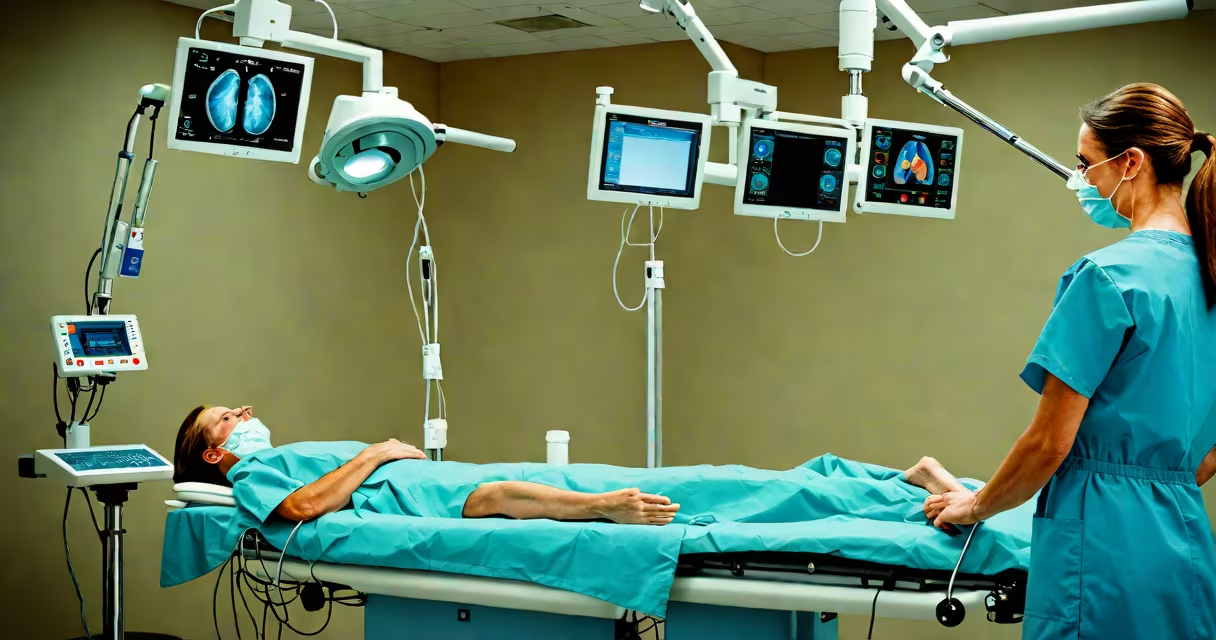
An interventional radiology nurse (IR nurse) is a specialized registered nurse who supports physicians during minimally invasive, image-guided procedures using X-ray, CT, or ultrasound. These nurses manage patient safety, administer medications, monitor important signs, and assist with equipment during treatments such as angioplasty, embolization, and stent placement. Their role requires advanced training beyond standard nursing due to the complexity of the procedures and high-risk environments.
Interventional radiology procedures are performed under real-time imaging guidance. The nurse stands in the sterile field beside the radiologist, often wearing lead shielding to protect against radiation exposure. They prepare the patient, verify consent forms, insert IV lines, and administer sedatives or anesthesia as directed. During the procedure, they continuously assess the patient's hemodynamic stability and respond to changes in blood pressure, heart rate, or oxygen saturation.
After the procedure, the IR nurse monitors recovery, manages pain, checks for bleeding at access sites, and educates patients on post-procedure care. They document everything in the electronic health record, including medication dosages, complications, and patient responses. Their work ensures continuity between pre-op, intra-op, and post-op phases.
Each IR procedure begins with a detailed pre-procedure assessment. The nurse reviews the patient's history, lab results, allergies, and imaging reports. For example, a patient scheduled for a uterine artery embolization to treat fibroids must have a recent MRI and normal coagulation panel. The nurse confirms the procedure site, explains risks, and obtains informed consent.
During the procedure, the nurse maintains a sterile environment and handles instruments such as catheters, guidewires, and contrast agents. They calculate fluid volumes based on patient weight and renal function. A 70 kg adult receiving a 100 mL iodinated contrast injection for a coronary angiogram requires precise timing and hydration protocols to prevent contrast-induced nephropathy.
Post-procedure, the nurse checks for complications like hematoma formation at the femoral puncture site. If a patient develops sudden hypotension during a liver biopsy, the nurse initiates rapid response protocols-administering fluids, calling for help, and preparing for possible transfusion. Their ability to act quickly prevents serious outcomes.
Interventional radiology nurses frequently assist in these common procedures:
| Procedure | Use Case | Equipment Involved |
|---|---|---|
| Peripheral vascular intervention | Treatment of blocked leg arteries | Catheter, balloon, stent, angiographic system |
| Embolization | Stopping internal bleeding or shrinking tumors | Microcatheters, coils, particles |
| Central line placement | Long-term IV access for chemotherapy | Ultrasound probe, needle, guidewire |
| Nephrostomy tube insertion | Relieving kidney obstruction | Fluoroscope, drainage catheter |
Each piece of equipment demands specific handling. For instance, a detachable coil used in brain aneurysm embolization must be loaded into a microcatheter with precision. The nurse verifies the device's size and compatibility with the patient's anatomy before deployment.
A non-obvious fact: IR nurses often perform the initial patient positioning and skin preparation. This includes marking the entry site with a sterile marker under live imaging. A misaligned mark can result in a failed access attempt, prolonging procedure time and increasing radiation exposure.
Interventional radiology units exist in major hospitals, outpatient imaging centers, and academic medical centers. The largest programs are at institutions like Johns Hopkins Hospital and Massachusetts General Hospital, where IR teams handle over 10,000 procedures annually.
These nurses are essential because many interventional procedures replace open surgery. For example, a patient with a symptomatic abdominal aortic aneurysm may undergo endovascular repair instead of a laparotomy. The IR nurse reduces surgical risk by ensuring accurate medication administration and timely complication detection.
They also serve as patient advocates. When a patient expresses anxiety about a procedure, the nurse provides clear explanations and reassurance. One nurse reported calming a 68-year-old man before a carotid stenting by walking him through each step and confirming his understanding. That moment reduced his stress and improved cooperation during sedation.
Many assume IR nurses are simply "assistants" to radiologists. This is incorrect. They are licensed professionals with independent responsibilities. According to the American Society of Radiologic Technologists (ASRT), IR nurses must complete 1,000 hours of clinical experience in vascular access and imaging safety before certification.
Another misconception is that all nurses in radiology are the same. IR nurses differ from diagnostic radiology technologists. While both work in imaging suites, technologists operate scanners and produce images. IR nurses focus on patient care during therapeutic interventions.
Some confuse IR nursing with critical care or emergency nursing. Though both involve acute monitoring, IR nurses specialize in procedural sedation, anticoagulation management, and vascular access. Their skill set is tailored to image-guided interventions, not general ICU care.
To become an IR nurse, one must hold a valid RN license and typically gain 2-3 years of experience in critical care, emergency medicine, or perioperative nursing. Many pursue certification through the National Board of Certification in Medical-Surgical Nursing (NBC-MSN) or the American Registry of Radiologic Technologists (ARRT) with a focus on vascular access.
Advanced training includes learning how to interpret fluoroscopic images in real time, understand contrast agent pharmacokinetics, and manage airway emergencies during sedation. A nurse working in a cardiac cath lab must recognize early signs of contrast extravasation-a condition where dye leaks into tissue, causing swelling and potential necrosis.
One nurse shared that her first embolization case involved a patient with a ruptured splenic artery aneurysm. She noticed a drop in systolic blood pressure from 120 mmHg to 85 mmHg within minutes. She alerted the team, initiated fluid resuscitation, and prepared for possible surgical conversion. The patient stabilized after 15 minutes. That experience underscored how critical real-time decision-making is in IR nursing.
For those interested in advancing, roles include clinical educator, nurse practitioner in vascular medicine, or director of interventional services. Some transition into research or policy development focused on patient safety in procedural settings.
Understanding the role of an interventional radiology nurse reveals a high-stakes, technically demanding profession. These nurses are not peripheral staff-they are integral to successful outcomes in complex, life-saving procedures. Their expertise bridges imaging, pharmacology, and patient advocacy in ways that directly impact survival rates and recovery times.
For more on nursing roles, is an lvn a nurse offers insight into different levels of nursing licensure and responsibilities.