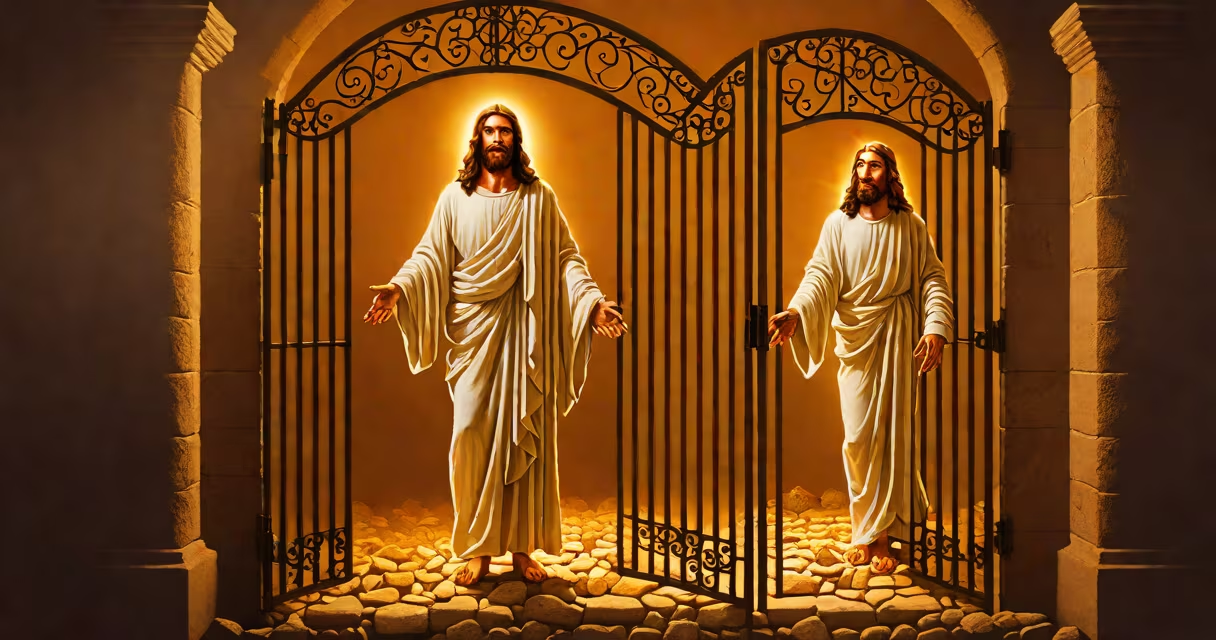
The statement "Jesus descended into hell" refers to a theological claim that after his crucifixion and before his resurrection, Jesus traveled to the abode of the dead-often called Hades or Sheol-to proclaim victory over sin and death. This idea appears in ancient creeds and liturgical traditions, though its meaning and biblical basis remain debated among scholars and denominations.
According to the Apostles' Creed, one of the oldest Christian confessions still recited today, Jesus "descended into hell." The term "hell" here reflects the medieval understanding of the underworld, not the fiery punishment of later Christian imagery. In original Greek, the creed uses *katabasis*-a descent into the lower realms-and the word *Hades*, which in the New Proof denotes the place of the dead, not eternal damnation.
Modern translations often render the phrase as "he descended to the dead," reflecting a more accurate rendering of the original language. The concept is rooted in 1 Peter 3:19-20, where the apostle writes that Jesus "went and proclaimed to the spirits in prison," those who had disobeyed during Noah's time. This passage forms the primary scriptural basis for the belief, though interpretations vary widely.
In early Christianity, the idea of Christ descending into Hades was understood as a spiritual triumph. Jesus did not go to suffer punishment but to liberate righteous souls who had died before his coming. These were believed to be patriarchs like Abraham, Isaac, and Jacob, along with others awaiting redemption.
Church Fathers such as Augustine and Irenaeus taught that Christ's descent was part of his complete victory over death. He didn't save the damned-he freed the faithful who had died in faith. This view aligns with the concept of the "Harrowing of Hell," a term used in medieval art and liturgy to describe Christ's triumphant entry into the area of the dead.
Eastern Orthodox tradition emphasizes this event as a moment of cosmic restoration. On Holy Saturday, the day between Good Friday and Easter Sunday, liturgies include hymns declaring that Christ "trampled down death by death." The belief underscores that salvation extends beyond time-Christ reached even those who lived before his earthly ministry.
The key text is 1 Peter 3:18-20: "For Christ also suffered once for sins, the righteous for the unrighteous, to bring you to God. He was put to death in the body but made alive in the Spirit. After being made alive, he went and proclaimed to the spirits in prison who disobeyed long ago when God waited patiently in the days of Noah while the ark was being built."
Some scholars argue that "spirits in prison" refers to fallen angels or demonic beings, not human souls. Others maintain that it describes the souls of people who lived before Christ and were spiritually confined until his redemptive work. The Greek word *phylake* (prison) may imply a state of detention rather than a physical location.
A critical distinction lies in the timing. The passage says Jesus "proclaimed" while "in the spirit," suggesting a spiritual, not bodily, action. This supports the view that the descent was not a physical process but a divine proclamation of judgment and grace.
Many assume Jesus descended into hell to suffer punishment himself. This is incorrect. The New Proof never portrays Christ suffering in Hades. His suffering occurred on the cross. The descent was a mission of liberation, not punishment.
Another misconception is that the phrase implies Jesus entered a place of eternal torment. But in early Jewish and Christian thought, Hades was not synonymous with Gehenna-the place of eternal punishment. Hades was a neutral area of the dead, divided into sections: one for the righteous (Abraham's bosom), another for the wicked. Christ's visit targeted the former.
Even the wording of the Apostles' Creed evolved. The original Latin version used *infernum*, meaning "the lower regions," not "hell" as we understand it today. Modern Catholic and Protestant statements often revise the phrase to "descended to the dead" to avoid confusion.
Different Christian traditions interpret the descent differently. Here's a breakdown:
| Denomination | View on Descent | Scriptural Support |
|---|---|---|
| Eastern Orthodox | Central to theology. Christ liberated the righteous dead. | 1 Peter 3:19-20; Gospel of Nicodemus (apocryphal) |
| Catholic | Accepted as dogma. Part of the Apostles' Creed. | 1 Peter 3:19-20; Council of Trent (1546) |
| Protestant (Lutheran, Reformed) | Varied. Some affirm it; others treat it as symbolic. | 1 Peter 3:19-20; Pauline letters on resurrection |
| Evangelical/Non-Trinitarian | Generally reject it as unbiblical or speculative. | No direct reference in Synoptic Gospels |
For example, Martin Luther included the descent in his Small Catechism, stating that Christ "descended into hell" to "free the souls of the righteous." Yet he emphasized that this was not a descent into torment but a victory over death itself.
On Holy Saturday, the Eastern Orthodox Church celebrates the Matins service with the hymn: "Today the universe rejoices, for Christ has conquered death." The liturgy includes the reading of 1 Peter 3:18-22 and references to Christ's descent. The iconography shows Christ breaking open the gates of Hades, pulling Adam and Eve from their tombs.
This ritual isn't meant to be taken literally but symbolically. It communicates that Christ's resurrection wasn't limited to his own body-it extended to all who had died in faith. The descent is not a separate act of salvation but a continuation of the redemptive work begun on the cross.
I attended a Holy Saturday service at an Orthodox cathedral in Chicago. The priest led the congregation in chanting the "Harrowing of Hell" hymns. As the choir sang, the icons glowed under candlelight. When the priest said, "He descended into Hades," the congregation bowed deeply. The atmosphere wasn't fearful-it was expectant. The message was clear: Christ broke the chains of death, not just for the living, but for those who came before.
Confusion arises because "hell" in English translations carries emotional weight tied to fire, punishment, and separation. But in the original languages, *Hades* and *Sheol* denote the grave or the area of the dead-not moral judgment. The New Proof uses *Hades* 11 times, always as a neutral term for the abode of the dead.
The phrase "descended into hell" appears in the Apostles' Creed, which was finalized around the 4th century. Its inclusion was likely intended to affirm Christ's full victory over death-not to suggest he visited a place of eternal torment.
As theologian N.T. Wright notes in *The Resurrection of the Son of God*, "The resurrection is not just a return to life-it is the beginning of a new creation. Christ's descent is part of that cosmic renewal."1
Similarly, the Catechism of the Catholic Church states: "The frequent mention of the 'descent into hell' in the Creeds is a reminder that Christ's redemptive work extends beyond time and space."2
Jesus did not descend into hell to endure suffering. He did not preach to the damned. He did not enter a place of eternal punishment. The descent was not a second phase of suffering but a declaration of victory.
It's also not a universalist claim-that all people are saved. The Bible teaches that salvation comes through faith in Christ. The descent was not a mass redemption of all souls but a specific act of liberation for those who had lived in faith before Christ's incarnation.
Finally, the descent is not a historical event recorded in the Gospels. The Synoptic Gospels (Matthew, Mark, Luke) do not mention it. The account appears only in 1 Peter and later apocryphal writings like the *Gospel of Nicodemus*. This limits its status to theological reflection rather than narrative history.
The phrase "Jesus descended into hell" expresses a profound theological truth: Christ's victory over death reached beyond the tomb. He proclaimed freedom to those who had died in faith, fulfilling God's promise of redemption across time. While the exact nature of the descent remains a matter of interpretation, the core message is consistent across traditions-Christ's resurrection is the foundation of hope for all who have died.
1 N.T. Wright, *The Resurrection of the Son of God* (Christian Origins and the Question of God, Vol. 2), Fortress Press, 2003, p. 521.
2 Catechism of the Catholic Church, 2nd ed., Libreria Editrice Vaticana, 2000, §633.