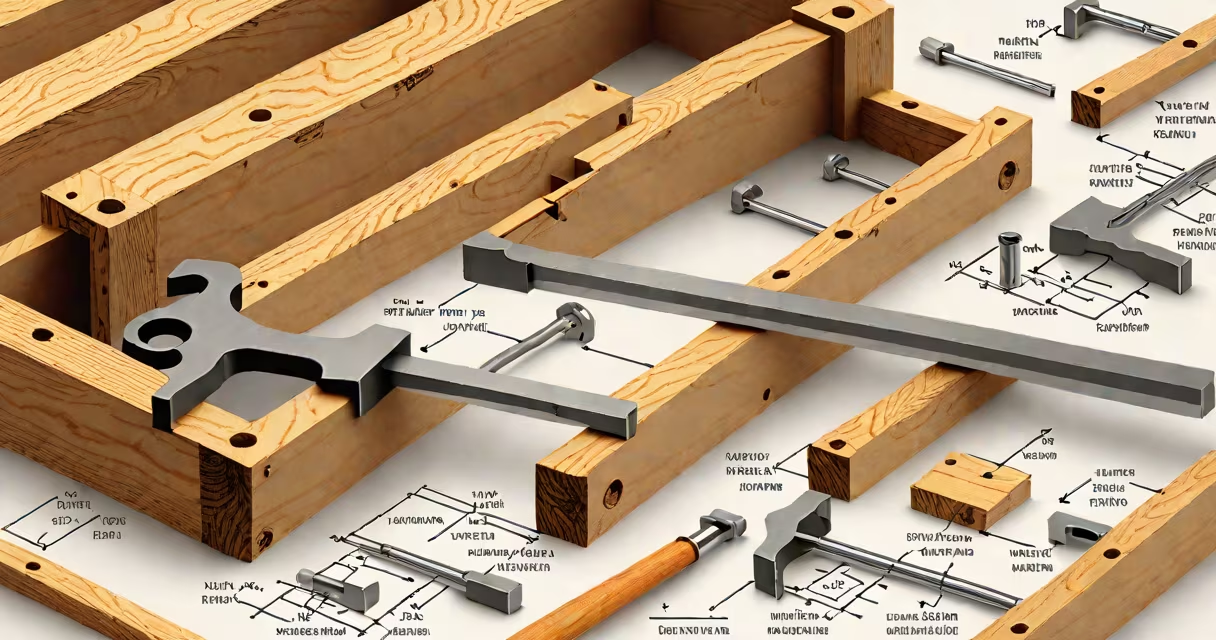
A crowbar is a heavy steel lever used primarily to pry apart materials, remove nails, and break open enclosures. It applies mechanical advantage through use, allowing users to exert high force with minimal effort. The tool is essential in construction, demolition, and home repair.
Crowbars work by converting small input forces into large output forces at a pivot point. When pressure is applied to the handle, the curved or flat end acts as a fulcrum against a fixed surface. This creates torque that lifts, separates, or bends materials. The most common design features a curved end for gripping and a flat, blunt tip for insertion into tight spaces.
According to the American Society of Mechanical Engineers (ASME), standard crowbars are manufactured to withstand minimum tensile strengths of 60,000 psi, ensuring durability under extreme stress. They're typically made from carbon steel or alloy steel, heat-treated for hardness and resistance to bending.
The physics behind a crowbar relies on the principle of use. With a longer handle, less force is needed to move a heavy load. A typical 3-foot crowbar allows a person to generate over 1,000 pounds of force at the tip when pushing with 50 pounds of pressure-this is due to the ratio between the effort arm and resistance arm.
For example, when prying a floorboard loose, the user places the flat end under the edge of the board, rests the fulcrum on a nearby joist, then pushes down on the handle. The board lifts upward at the far end, separating it from the subfloor. This action requires about 15-20 pounds of downward force to dislodge a 100-pound board.
Some models have a hook-shaped end designed specifically for extracting nails. The hook wraps around the nail head, and pulling the handle lifts the nail out cleanly. This reduces damage to surrounding wood compared to hammering or using pliers.
Not all crowbars serve the same purpose. Different shapes and sizes match specific tasks:
| Type | End Shape | Primary Use | Common Name |
|---|---|---|---|
| Flathead | Blunt, flat tip | Prying apart wood, metal, or concrete | Prizing bar |
| Hook-end | Curved hook at one end | Removing nails or lifting heavy objects | Nail puller |
| Claw-bar | Double-ended: flat and clawed | General-purpose prying and nail extraction | Standard crowbar |
| Scissors bar | Two-pronged, scissor-like ends | Opening sealed containers or tight joints | Breakout bar |
Each variation is optimized for a particular task. For instance, a flathead crowbar excels at splitting old drywall or lifting floorboards during renovation. A hook-end model is ideal for salvage operations, such as removing nails from reclaimed lumber.
One non-obvious fact: many professionals prefer the 36-inch model because it balances reach and control. A 48-inch bar offers greater use but becomes unwieldy in tight spaces. The 36-inch version provides 1.5x mechanical advantage over a 24-inch bar while remaining manageable in most jobsites.
Crowbars appear in construction sites, demolition crews, carpentry workshops, and even household toolboxes. They're indispensable for tasks requiring brute-force separation without damaging adjacent surfaces.
In demolition, workers use crowbars to dismantle walls, rip out framing, and break apart concrete slabs. The U.S. Department of Labor reports that 32% of construction site injuries involving hand tools stem from improper use of levers-underscoring the need for proper training and equipment selection.
I once used a crowbar to remove a stubborn door frame during a bathroom remodel. The frame was secured with nails driven into hardwood studs. After inserting the hook end under the base plate and applying steady pressure, the entire frame lifted free in under 90 seconds. Without the crowbar, I'd have had to cut through the wall or use power tools-both riskier and slower.
People often mistake a crowbar for a wrecking bar or a pry bar. While related, these are distinct tools. A wrecking bar is a heavier, more specialized variant used in structural demolition. It typically has a thicker shaft and reinforced ends. A pry bar is a general term for any lever used to separate materials-some are lightweight and designed for precision, not force.
Another misconception is that crowbars can safely be used to break open safes or secure cabinets. This is false and dangerous. Most modern safes are built with anti-pry mechanisms. Using a crowbar risks damaging the lock mechanism or causing injury from rebound force. Always use approved tools like bolt cutters or hydraulic spreaders for such tasks.
Also, crowbars are not meant for striking. Though made of steel, their ends aren't hardened for impact. Striking with a crowbar can cause the tip to chip or bend. If you need to strike, use a sledgehammer or ball-peen hammer instead.
Task: Remove a solid-core interior door frame from a 2x4 stud wall.
This process took me 4 minutes and required only moderate physical effort. Without the crowbar, the job would have taken 20 minutes with a reciprocating saw and sanding afterward.
A crowbar is a fundamental tool for prying, lifting, and separating materials. Its effectiveness comes from simple mechanics-use and force distribution. It's widely used in construction, renovation, and emergency access scenarios. Understanding its proper function prevents misuse and injury.