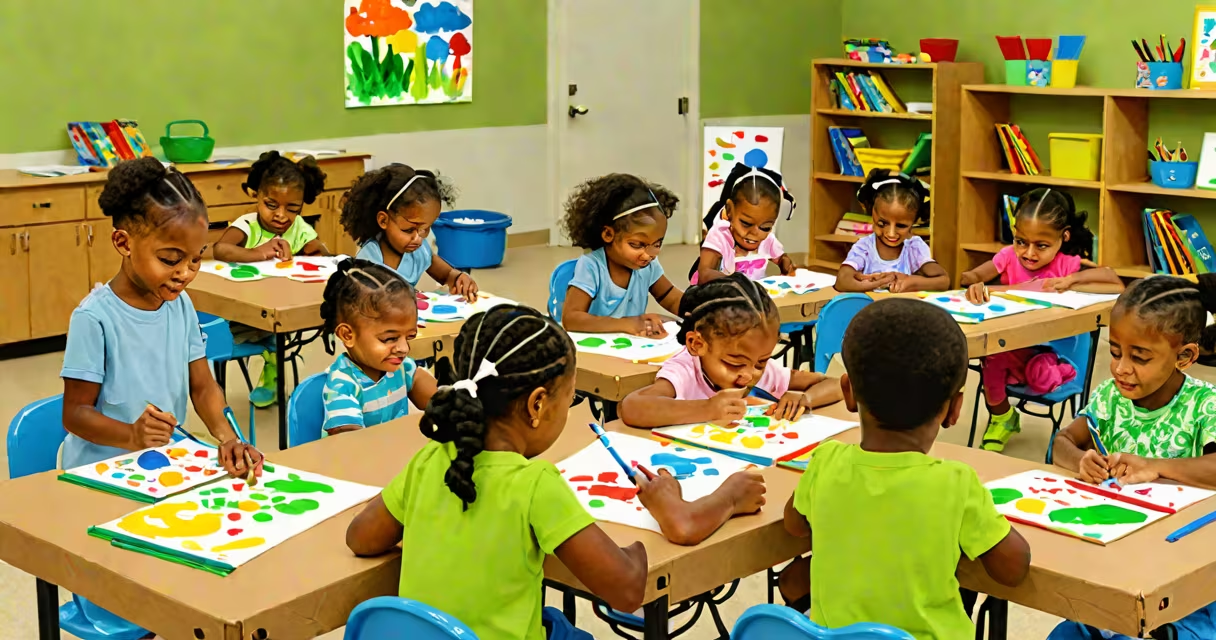
VPK stands for Voluntary Prekindergarten Education Program, a state-funded early childhood education initiative in Florida that provides free, full-day instruction to eligible 4-year-olds to promote school readiness.
Launched in 2005 under Florida's Education Quality Reform Act, VPK serves as a foundational step in the state's early education system. It is not mandatory but is offered at public schools, licensed private centers, and accredited home-based programs. The program focuses on literacy, numeracy, social-emotional development, and physical skills essential for success in kindergarten and beyond.
Eligibility requires children to turn four by September 1 of the academic year and meet income thresholds or qualify through special education referrals. Families may choose between in-person or virtual delivery models, depending on provider availability. Participation is voluntary, but enrollment rates exceed 90% among eligible children due to widespread outreach and accessibility.
VPK follows a state-approved curriculum aligned with Florida's Early Learning Standards. Each day includes structured time for language arts, math, science, social studies, creative expression, and physical activity. Teachers use play-based learning and guided discovery to engage young minds.
Instruction occurs over a minimum of 540 hours per year, typically spread across 180 days. Programs must meet specific accreditation criteria set by the Florida Department of Education. Class sizes are capped at 20 students with at least one certified early childhood educator per classroom.
A 2022 study by the University of South Florida found that children who completed VPK scored 12% higher on kindergarten readiness assessments than peers who did not attend. This improvement was most pronounced in vocabulary acquisition and fine motor coordination.
VPK programs operate under three primary models:
| Model | Provider Type | Enrollment Requirements | Example |
|---|---|---|---|
| Public School-Based | Local school districts | Residency required; income-based eligibility | Orlando Public Schools VPK Center |
| Private Licensed | State-accredited childcare centers | Must meet safety and staffing standards | ABC Learning Academy (Tampa) |
| Home-Based | Approved caregivers with training | Parent must complete 16 hours of training | Family VPK Network (Miami-Dade) |
Each model must submit annual reports to the Florida Department of Education detailing student progress, attendance, and staff qualifications. Programs that fail to meet benchmarks face corrective action or loss of funding.
VPK is often mistaken for universal kindergarten or daycare. It is neither. Unlike daycare, which prioritizes supervision and basic care, VPK emphasizes developmental milestones tied to formal school readiness. Unlike kindergarten, VPK does not assign grades or track academic performance beyond developmental checklists.
Another misconception is that VPK replaces parental responsibility. The program aims to complement family engagement, not substitute it. Research from the Florida State University Center for Children and Families shows that children whose parents participated in weekly home learning activities had 23% greater gains in letter recognition compared to those whose families were less involved.
Some assume VPK is only for low-income families. While income eligibility applies to about 60% of slots, the remaining 40% are reserved for children with disabilities or those referred by school districts. All participants receive the same curriculum regardless of funding source.
In a typical morning at the Miami Beach VPK center, a group of 18 four-year-olds gathers around a carpet. The teacher begins with a circle time routine: singing the alphabet song, practicing handwashing steps, and discussing the day's theme-"The Water Cycle."
Children then rotate through stations: one group uses magnetic letters to build simple words ("cat," "run"), another mixes blue and yellow paint to explore color blending, and a third builds towers using wooden blocks while counting aloud. The teacher circulates, asking open-ended questions like "What happens when water gets hot?" and "How many blocks do you think it takes to reach the ceiling?"
By noon, children have completed a shared storybook about a raindrop's process. The teacher records observations: "Maria identified 8 out of 10 letters in her name," "Jamal used spatial language like 'above' and 'beside' during building." These notes feed into individualized learning plans.
This structure reflects the Florida Department of Education's requirement that 70% of instructional time be devoted to child-directed, inquiry-based activities. The focus is not on test scores but on observable growth in communication, problem-solving, and emotional regulation.
VPK is sometimes confused with RBT (Registered Behavior Technician), a credential in applied behavior analysis used in autism therapy. While both support early development, they serve different purposes. RBTs work with children diagnosed with developmental disorders, often in clinical settings. VPK is a broad-based educational program for typically developing children preparing for formal schooling.
Another frequent mix-up is equating VPK with "stand-up" initiatives. Some educators misinterpret the term "stand-up" as a reference to posture or classroom management. However, "stand-up" refers to a movement in education reform focused on accountability and transparency in public institutions. It is unrelated to VPK's mission or structure.
For clarity: VPK is a state-run early education program. RBT is a certification for behavioral health professionals. "Stand-up" is a policy movement. These are distinct concepts with different goals and oversight bodies.
I observed a VPK class in Jacksonville during a district-wide evaluation. The teacher used a simple checklist to track whether each child could identify colors, count to 10, and take turns during group games. One child struggled with sharing toys. The teacher responded by introducing a "waiting wheel" - a visual timer that helped the child understand turn-taking. Within three weeks, the child's participation improved. This moment highlighted how VPK balances structure with responsive teaching.
VPK stands for Voluntary Prekindergarten Education Program, a Florida-specific initiative that prepares 4-year-olds for academic success through developmentally appropriate, state-mandated instruction. It is not daycare, not kindergarten, and not a substitute for family involvement. Its impact is measurable: children who complete VPK enter kindergarten with stronger foundational skills. For families seeking early education options, understanding what VPK stands for in education clarifies access, expectations, and long-term benefits.