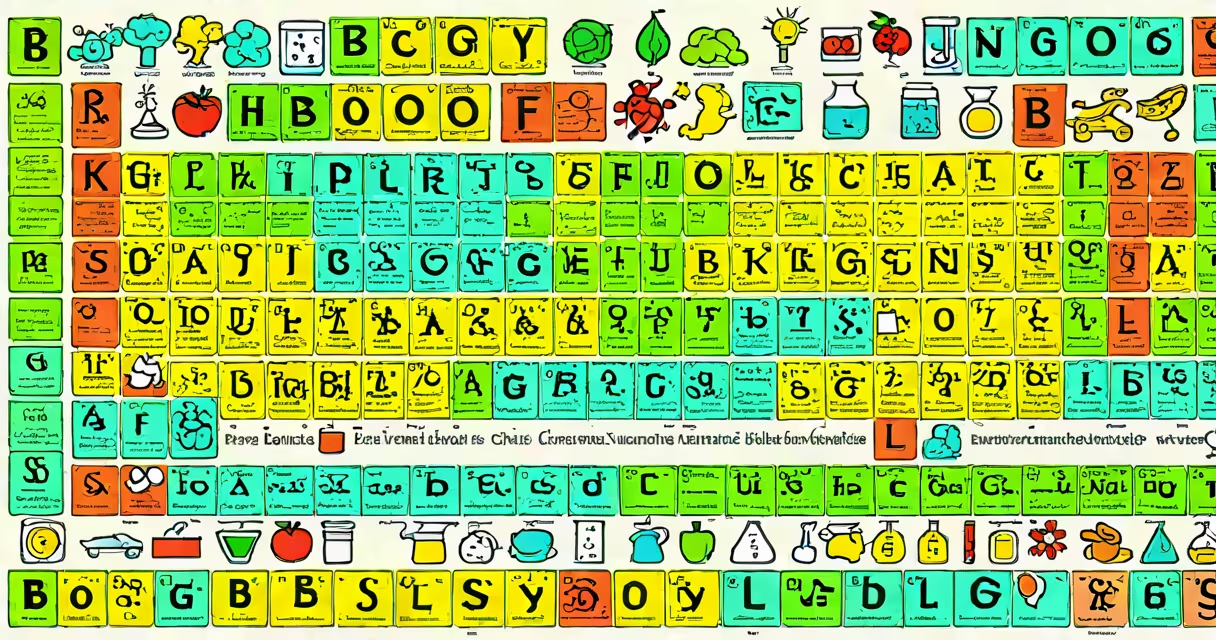
The periodic table of biology is a conceptual structure that maps the chemical elements essential to life, emphasizing their roles in biological systems rather than their physical properties. It highlights elements like carbon, hydrogen, oxygen, nitrogen, phosphorus, and sulfur as foundational to organic molecules such as proteins, DNA, and lipids.
This model isn't a standard scientific table like the one used in chemistry classrooms. Instead, it's a curated representation focused on biological relevance. Elements are grouped not by atomic number or electron configuration alone, but by their frequency in living systems, their involvement in metabolic pathways, and their structural roles in cells and tissues.
For example, calcium appears frequently in bone mineralization and neural signaling, while iron is central to oxygen transport in hemoglobin. The periodic table of biology places these elements in context-showing how their abundance and reactivity shape the chemistry of life.
The periodic table of biology functions by filtering the 118 known elements to those that appear in measurable quantities in biological systems. Of these, only about 25 are consistently found in significant amounts across diverse organisms-from bacteria to humans.
Elements are ranked by their mass contribution to living matter. Carbon makes up about 18% of the dry weight of a human body, oxygen 65%, hydrogen 10%, and nitrogen 3%. These four elements account for nearly 96% of all atoms in the human body. Phosphorus and sulfur each contribute around 1%.
Biological utility determines placement more than atomic number. For instance, potassium and sodium are important for nerve impulse transmission and cellular osmotic balance. Though they're alkali metals, their role in ion gradients earns them prominence in the biological version of the table.
There is no single standardized periodic table of biology. Different versions exist based on purpose-some emphasize elemental abundance, others focus on biochemical function or evolutionary conservation.
One common structure divides elements into categories:
| Type | Key Elements | Role in Biology |
|---|---|---|
| Core Building Blocks | C, H, O, N, P, S | Form proteins, nucleic acids, carbohydrates, lipids |
| Electrolytes & Signaling | Na, K, Ca, Cl | Maintain membrane potential, regulate muscle contraction |
| Trace Elements | Fe, Zn, Cu, Mn, Se, I | Act as cofactors in enzymes; essential for metabolism |
| Structural & Storage | Ca, Mg, Si | Build bones, cell walls, and shells |
Some models assign colors or symbols to indicate biological significance. A red dot might mark an element critical for enzyme function, while a green outline denotes high abundance in plant biomass.
A notable variation uses relative abundance across species. In marine sponges, silicon is more prevalent than in mammals. This reflects ecological adaptation-not just elemental availability, but evolutionary uptake.
Many assume the periodic table of biology is a formal scientific tool akin to the IUPAC-standard periodic table. It is not. It lacks universal acceptance and standardized layout. There is no official governing body defining its structure.
Another error is equating biological importance with abundance. Iron is essential for hemoglobin, yet it makes up less than 0.004% of human body mass. Its impact far exceeds its quantity. Conversely, aluminum is abundant in soil but toxic to most plants and animals-it plays no known biological role.
Even more misleading is the idea that all life is based on carbon. While carbon-based life dominates Earth, scientists have explored silicon-based alternatives in theory. No known organism uses silicon as a primary structural element. But this doesn't mean silicon is irrelevant-diatoms rely heavily on silica for their cell walls.
In 2018, researchers at the University of California, San Diego, developed a visual periodic table of biology tailored to human physiology. They mapped 14 elements (including carbon, nitrogen, and zinc) onto a modified periodic table, using heat maps to show tissue concentration levels.
For instance, iodine was highlighted in the thyroid gland region due to its role in hormone synthesis. Iron concentrated in the liver and blood cells. This version helped medical students grasp nutrient distribution and deficiency risks.
When diagnosing a patient with fatigue and low hemoglobin, clinicians use this kind of elemental mapping. Low iron levels correlate with anemia. High lead levels suggest environmental exposure. The periodic table of biology provides a mental model linking elemental presence to physiological outcome.
I once used a printed version of this table during a lab course on microbial nutrition. We analyzed bacterial growth under varying trace metal conditions. When we added copper, growth stopped. The table showed copper's role as a potent enzyme inhibitor-its presence disrupts respiratory chains. That moment turned abstract chemistry into visible biological effect.
The standard periodic table arranges elements by atomic number and recurring chemical properties. The periodic table of biology prioritizes function over form. It doesn't follow Mendeleev's original logic. Instead, it follows biological necessity.
For example, lithium is listed in group 1 of the standard table but is not biologically essential. Yet it's used in psychiatry to treat bipolar disorder. Its inclusion in a biological table stems from clinical effect, not natural abundance.
Similarly, selenium appears in group 16 but is rare in nature. Still, it's important for glutathione peroxidase, an antioxidant enzyme. Without selenium, certain tissues suffer oxidative damage. The biological table elevates such elements based on functional impact, not elemental rarity.
According to the National Center for Biotechnology Information, over 90% of the mass in a typical eukaryotic cell comes from just six elements: C, H, O, N, P, and S. This supports the idea that biological systems are highly selective in their elemental choices.
As noted in ScienceDirect, the elemental composition of life reflects both thermodynamic constraints and evolutionary history. Elements like calcium were selected not because they're the most reactive, but because they form stable precipitates in extracellular matrices-ideal for structural support.
The periodic table of biology is not a replacement for the standard periodic table. It is a specialized interpretation focused on the elements that sustain life. It reveals how chemistry shapes biology-and how life adapts to elemental availability.
Understanding this structure helps explain why certain nutrients are essential, why deficiencies cause disease, and how ecosystems depend on elemental cycles. It's a tool for connecting atomic behavior to organismal function.