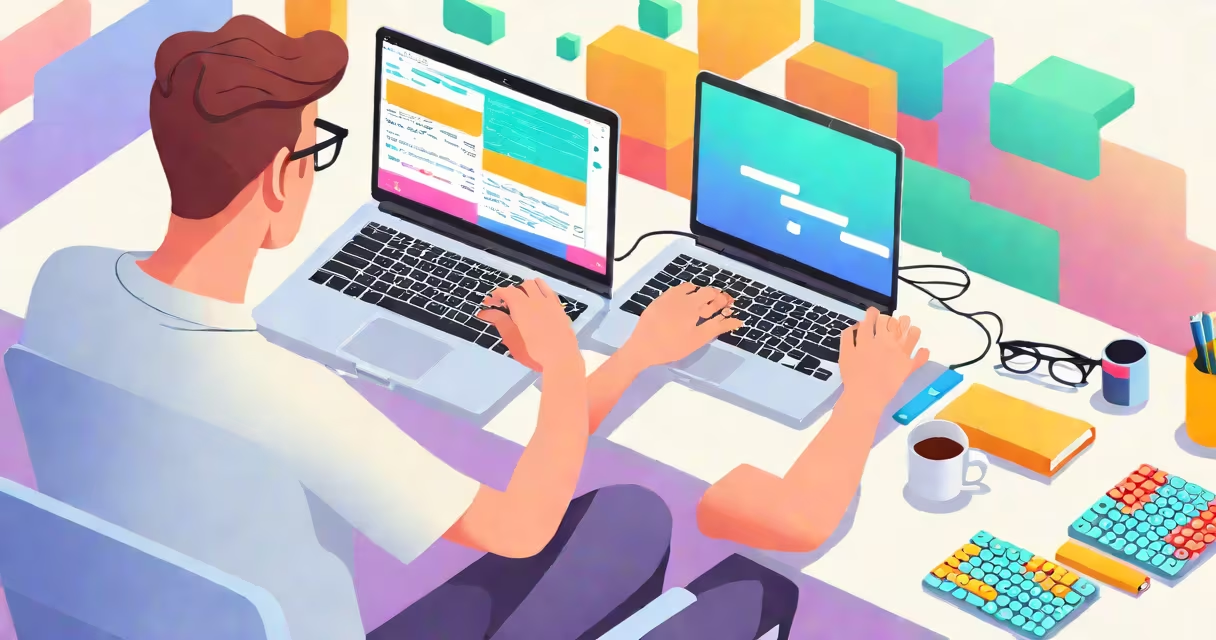
Learn coding for beginners means systematically acquiring the fundamentals of computer programming through structured practice, starting with basic syntax and progressing to functional projects. This process teaches logic, problem-solving, and how to instruct computers using precise instructions in languages like Python, JavaScript, or HTML/CSS.
Coding begins with understanding variables, loops, conditionals, and functions-core building blocks shared across most programming languages. A beginner starts by writing simple programs, such as a calculator or a to-do list, then gradually adds complexity. Platforms like freeCodeCamp, Codecademy, and Khan Academy offer interactive lessons that validate progress in real time.
Most people who learn coding for beginners do so in 6-12 weeks with consistent daily practice. The key is not memorizing commands but developing the habit of breaking problems into small steps. For example, a beginner might start by writing a program that prints "Hello, World!"-a standard first exercise-but within a month, they can build a weather app that pulls data from an API.
Learning coding for beginners follows a progression from passive observation to active creation. You begin by watching short video tutorials or reading guided exercises. Next, you modify existing code-changing colors, adding features, or fixing errors. Finally, you write original programs from scratch.
Each step reinforces cognitive patterns. When you see a loop structure, you learn to recognize repetition. When you debug a missing parenthesis, you internalize syntax rules. These mental models grow stronger with repetition. After 20 hours of practice, most beginners can write a function that calculates averages or sorts a list of numbers.
For example, a student learning to code might spend one hour creating a Python script that asks users for their name and age, then responds with "You are X years old." They then extend it to check if the user is old enough to vote. This project introduces input handling, conditionals, and string formatting-all core concepts taught early in beginner courses.
Beginner-friendly languages prioritize readability and immediate feedback. Python leads in popularity for newcomers due to its clean syntax and vast library support. JavaScript powers web pages and is essential for front-end development. HTML and CSS, while not full programming languages, are foundational for website structure and design.
| Language | Best For | Time to Basic Proficiency | Example Project |
|---|---|---|---|
| Python | Data analysis, automation, AI basics | 4-6 weeks | Automated email sender |
| JavaScript | Web interactivity, browser apps | 5-8 weeks | Interactive quiz game |
| HTML/CSS | Website layout, visual design | 2-3 weeks | Personal portfolio page |
Many learners assume all coding requires advanced math. That's incorrect. Most beginner projects involve logic, not calculus. Writing a script to sort a list of names uses comparison operators and loops-not algebra. Even machine learning frameworks like TensorFlow offer beginner modules that run with minimal mathematical background.
A common misconception is that coding is only for engineers or math geniuses. The reality is that anyone with consistent effort can learn to code. According to the National Center for Education Statistics, over 60% of adults who completed introductory coding courses reported confidence in building simple applications after eight weeks.
Learn coding for beginners applies to careers in software development, web design, data entry, and automation. But it also supports everyday tasks. Automating file renaming, scheduling emails, or scraping prices from websites are practical outcomes of basic coding skills.
Businesses increasingly value employees who can write scripts to simplify workflows. A marketing assistant who learns to automate social media posting saves 10 hours per month. A teacher who codes a grade tracker reduces grading time by half. These aren't hypotheticals-real users report saving 5-10 hours weekly after mastering basic scripting.
Even creative fields benefit. Graphic designers use JavaScript to animate layouts. Writers use Python to parse large documents and extract themes. Musicians use code to generate algorithmic compositions. The skill set is interdisciplinary.
People often confuse coding with computer literacy. Computer literacy involves using software-like Word or Excel. Coding is about instructing machines to perform specific sequences of actions. You don't need to know how a computer works internally to write code, just how to communicate with it.
Another error is assuming that learning coding for beginners requires expensive tools. Most beginner projects run in free web-based environments like Replit or JSFiddle. You don't need a high-end laptop. A Chromebook with a stable internet connection suffices.
Some believe they must master one language before moving to another. This slows progress. Switching between languages early builds adaptability. A learner who writes a simple game in Python and then recreates it in JavaScript gains insight into both syntax and logic flow.
I built my first full program-a task manager using HTML, CSS, and JavaScript-on a $200 used laptop during college. It had no database, just local storage. It worked. That moment of seeing code execute correctly was the turning point. I didn't need a degree or a fancy setup. Just clarity, persistence, and access to free resources.
Once comfortable with basics, apply your skills to real-world problems. Track your expenses with a script. Build a personal blog. Contribute to open-source projects on GitHub. These actions turn theory into fluency.
Remember: learning coding for beginners isn't about becoming a professional overnight. It's about gaining the ability to solve small problems independently. With consistent effort, even complex systems become understandable-one line at a time.