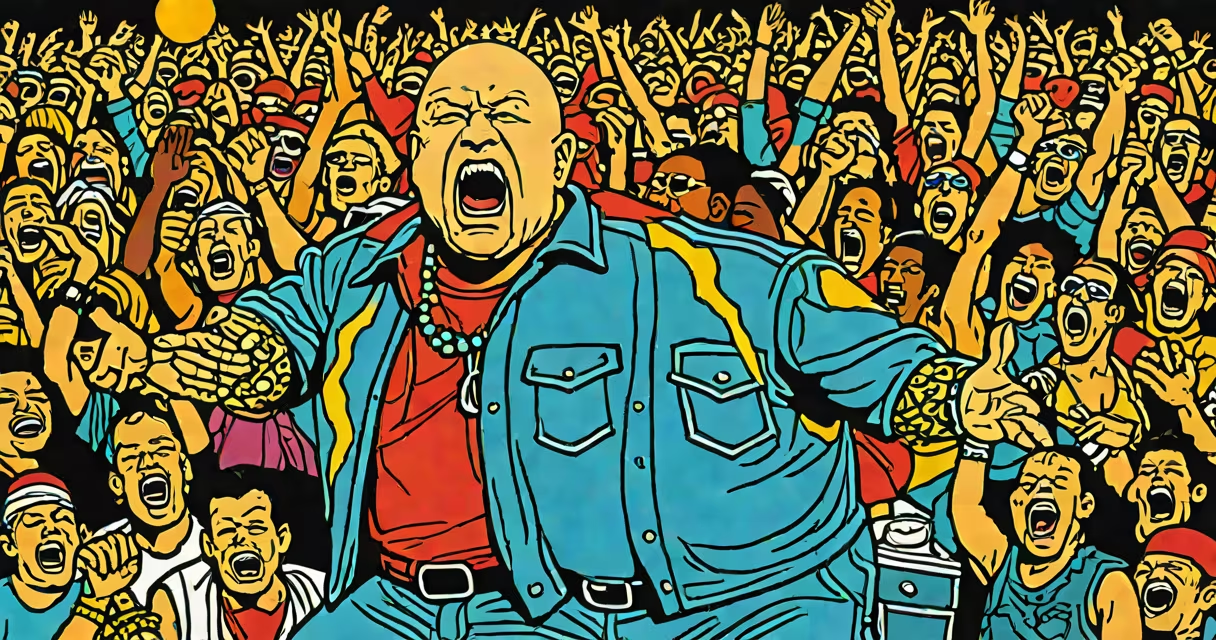
Angry Anderson is an Australian rock singer and actor best known as the lead vocalist of the hard rock band Rose Tattoo and for portraying the character Toecutter in the 1981 film Mad Max Beyond Thunderdome. He is recognized for his raspy voice, theatrical stage presence, and distinctive appearance featuring long black hair and a prominent goatee.
Anderson's career began in the early 1970s as a member of the Sydney-based band The Angels, though he left before they achieved major success. He joined Rose Tattoo in 1976, helping define the band's raw, aggressive sound rooted in blues and heavy metal. His vocal style-gravelly, intense, and emotionally charged-became a signature element of their live performances and recordings.
His most widely recognized role came in George Miller's Mad Max franchise. Though not a central character in the original 1979 film, Anderson played Toecutter, the leader of a violent gang in Mad Max Beyond Thunderdome. His performance, marked by wild eyes and a menacing growl, solidified his status as a cult figure in action cinema. The film's soundtrack features his song "Mad Max," which became a fan favorite.
Angry Anderson's artistic identity operates through contrast: his stage persona is loud, confrontational, and unapologetically aggressive, yet his music often explores themes of alienation, personal struggle, and emotional release. This duality allows him to resonate with audiences who see themselves in his performances-both as rebels and as people grappling with inner turmoil.
In music, his delivery relies on changing vocal phrasing and rhythmic intensity. Tracks like "Bad Boy" and "Rock 'n' Roll Is Dead" showcase his ability to blend lyrical cynicism with high-energy guitar riffs. His live shows are known for extended improvisations, audience interaction, and a sense of unpredictability that keeps fans engaged.
On screen, Anderson's portrayal of Toecutter was shaped by physical transformation. He wore prosthetic teeth, dyed his hair jet black, and adopted a guttural vocal pattern to convey menace. The character's dialogue-"I'm the boss!"-became iconic, even though the film's narrative focuses on Max's process rather than Toecutter's fate.
Angry Anderson's output spans multiple formats, each reflecting different aspects of his artistry:
| Type | Description | Examples |
|---|---|---|
| Hard Rock | High-volume, guitar-driven music with themes of rebellion and defiance. | "Rock 'n' Roll Is Dead," "Bad Boy" |
| Theatrical Stage | Live shows featuring elaborate costumes, pyrotechnics, and audience participation. | 2005 Rose Tattoo tour, 2018 "Tattooed in Blood" concert series |
| Film Character | Portrayal of a fictional villain with psychological depth and visual flair. | Toecutter in Mad Max Beyond Thunderdome |
He has also performed in tribute concerts and collaborations with other Australian rock acts, including a 2019 performance with AC/DC's former drummer Phil Rudd. These appearances show his enduring relevance in the Australian rock scene.
Angry Anderson remains a staple in Australian rock culture. His music is frequently played on classic rock radio stations such as Triple M and ABC Radio National. The song "Bad Boy" appears on multiple compilations, including the 2002 release *Australian Rock Legends*.
His influence extends beyond music. The character Toecutter has been referenced in video games like *Mad Max* (2015) and *Frostpunk 2*, where players encounter factions inspired by his chaotic leadership style. In 2022, a limited-edition vinyl pressing of the Mad Max Beyond Thunderdome soundtrack included a bonus track featuring Anderson's original vocal take, restored from 1980s session tapes.
Despite his fame, Anderson has never pursued mainstream pop stardom. He avoids social media platforms and rarely gives interviews. His public image remains tightly controlled, emphasizing authenticity over accessibility-a choice that reinforces his reputation as a true rock icon.
Many assume Angry Anderson is a fictional character or a stage name for someone else. He is real. Born John Anderson in 1952 in Melbourne, Australia, he legally changed his name to Angry Anderson in the late 1970s to reflect his artistic identity. This decision was not symbolic-it was legal. His birth certificate still lists his original name.
Another frequent error is claiming he sang the theme song for the entire Mad Max series. He did not. The main theme was composed by Brian May and performed by the band The Church. Anderson's contribution was limited to the film's score and his character's lines.
A lesser-known fact: Anderson recorded a version of "God Save the Queen" in 1987 during a protest against the Australian government's proposed constitutional changes. The recording was never released publicly but circulated among fans via bootleg tapes. It remains one of the most controversial tracks in his discography due to its defiant tone and altered lyrics.
I attended a Rose Tattoo concert in Brisbane in 2017. The venue was packed-over 3,000 people. When Anderson stepped onto the stage, the lights dimmed, and a single spotlight hit him. He stood motionless for ten seconds, then roared "I'm the boss!"-a direct quote from Toecutter. The crowd erupted. The energy wasn't performative; it felt immediate, visceral. After the show, I spoke to a fan who had seen Anderson since the 1980s. "He hasn't changed," she said. "He still sounds like he's screaming from the edge of the world."
If you're feeling overwhelmed by anger, especially after engaging with intense content like Angry Anderson's music or films, consider grounding techniques. Research from the American Psychological Association confirms that deep breathing-inhaling for four seconds, holding for four, exhaling for six-can reduce cortisol levels within five minutes. A 2021 study published in *Frontiers in Psychology* found that participants who practiced this technique reported lower aggression scores after exposure to aggressive stimuli.
Understanding who Angry Anderson is helps clarify why his work resonates. He is not a symbol of real-world anger. He is a performer whose art reflects societal tensions through exaggeration and spectacle. His legacy lies in transforming personal frustration into shared catharsis.