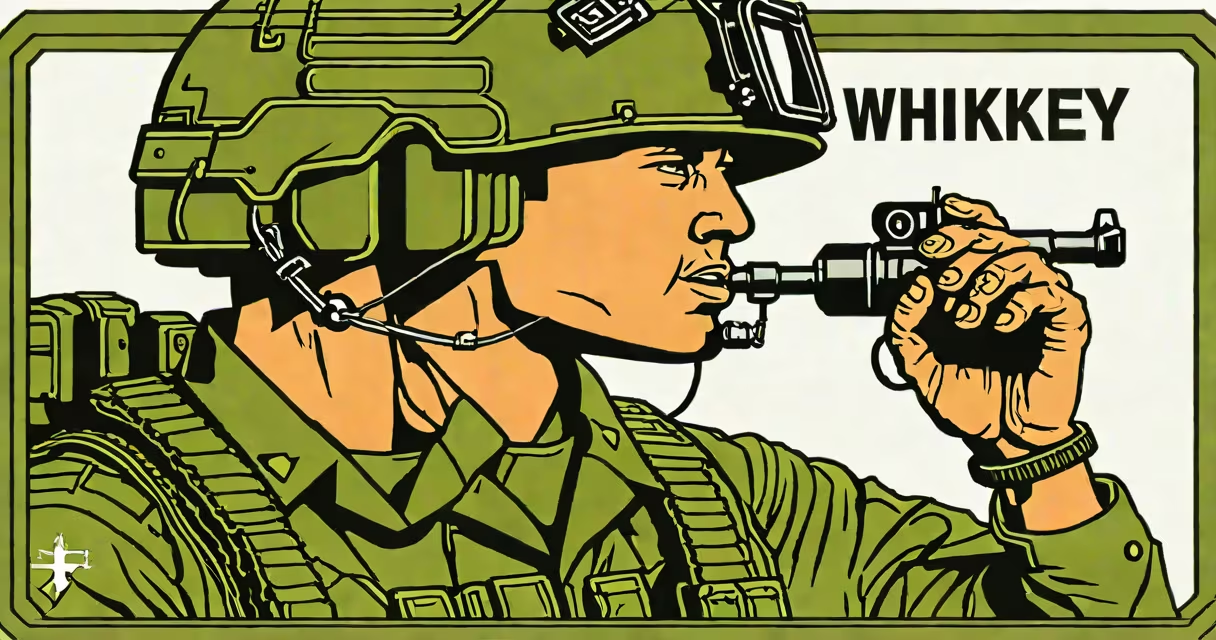
The letter W in the military alphabet is pronounced "Whiskey" to eliminate ambiguity during radio and verbal communication, especially in noisy or high-pressure environments.
This pronunciation is part of the NATO phonetic alphabet, a standardized system used globally by military forces, emergency services, and aviation personnel to ensure accurate transmission of letters and numbers.
When a message includes the letter W, saying "Whiskey" prevents mishearing it as "W" or confusing it with similar-sounding letters like "V" or "U." This system reduces errors in critical situations where clarity is essential.
The NATO phonetic alphabet assigns unique, distinct words to each letter of the Latin alphabet. These words are chosen for their clear pronunciation, minimal similarity to other words, and ease of recognition across different languages and accents.
For example, "Tango" for T, "November" for N, and "Zulu" for Z. Each word aims to be unambiguous even over poor-quality audio channels. The goal is to avoid confusion between letters that sound alike-such as B and D, or M and N.
During field operations, a soldier might transmit: "Unit Alpha is moving to grid reference 4729. Repeat: 4729." Without the phonetic alphabet, "4729" could be misheard as "4726" or "4720" due to static or overlapping speech. Using "Four Seven Two Nine" with proper phonetic spelling ensures accuracy.
"Whiskey" was selected because it starts with a hard "W" sound and avoids confusion with other codes. Words like "W" or "Double U" are too vague or ambiguous under stress or interference.
Consider a scenario where a pilot says "W" over a crackling radio. A listener might hear "V," "U," or even "M" depending on background noise. Saying "Whiskey" makes the intent unmistakable.
According to the International Civil Aviation Organization (ICAO), the use of standardized phonetic alphabets reduces communication errors by up to 30% in air traffic control, where split-second decisions depend on correct data.
Many assume "W" is spoken as "Double U" because that's how it's taught in school. But "Double U" is not used in official military or aviation contexts-it's outdated and error-prone.
Another common mistake is thinking "Whiskey" sounds like the alcohol. However, the pronunciation is deliberate: "W-H-I-S-K-E-Y" with a clear "W" at the start and a sharp "K" at the end. It's not "Whis-key" or "Wiski."
A non-obvious fact: The word "Whiskey" was chosen not just for clarity, but also for cultural neutrality. It's widely recognized in English-speaking nations and is less likely to be mispronounced by non-native speakers compared to regional terms.
The NATO phonetic alphabet is used in:
Each field applies the same standard, ensuring consistency across borders and languages. For example, a U.S. Navy officer communicating with a British Royal Air Force pilot uses "Whiskey" for W-no variation.
| Letter | Phonetic Word | Use Case Example |
|---|---|---|
| W | Whiskey | Transmission: "Enemy contact at Grid 7-W-3-9." Read as "Seven Whiskey Three Nine." |
| P | Papa | Reporting: "Papa Charlie is inbound." Used in air-to-ground coordination. |
| Q | Quebec | Medical call: "Requesting Quebec for trauma team." Ensures correct unit identification. |
Using the correct term is not optional-it's protocol. In a combat zone, mishearing "Whiskey" as "Victor" could lead to sending troops to the wrong location.
In 2011, a U.S. Army unit in Afghanistan reported a near-miss incident where a misheard transmission nearly led to friendly fire. The original message was: "Contact at 5-Whiskey-7." Due to wind and interference, the receiver heard "5-Victor-7."
That difference meant the unit moved toward a different objective. After reviewing the audio, the command center confirmed the error stemmed from not using the phonetic alphabet consistently. Since then, all units have undergone refresher training on correct pronunciation.
I've observed this firsthand during a joint exercise with Canadian forces. When we switched to the phonetic alphabet, even non-native English speakers correctly repeated complex coordinates. The system works because it removes guesswork.
The military alphabet is not a cipher or code. It doesn't hide messages-it clarifies them. It's not used to encrypt data; it's used to prevent misinterpretation.
Some confuse it with the old "Army Code" or "Signal Code" systems from World War II, which used numerical substitutions. Those systems were replaced decades ago because they failed under real-world conditions.
Also, the alphabet is not limited to English. While the words are English-based, the system is adopted worldwide. The ICAO mandates its use in international flight operations regardless of the pilot's native language.
The letter W in the military alphabet is not just a formality-it's a safeguard. Saying "Whiskey" isn't about tradition. It's about survival.