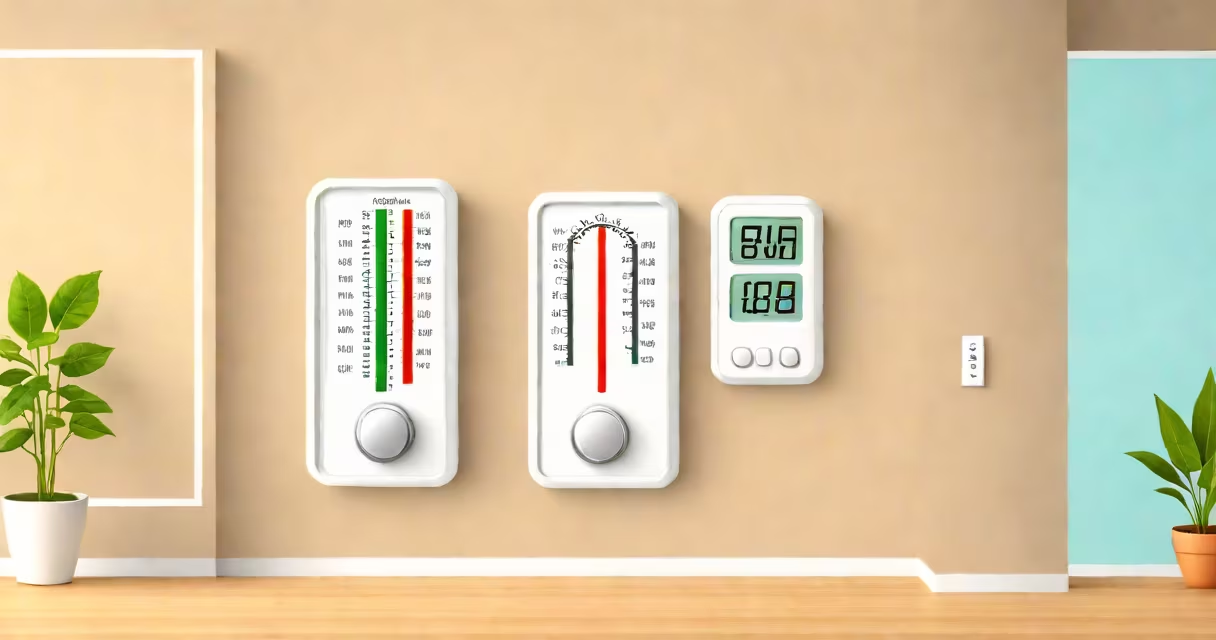
A hygrometer is a device that measures relative humidity-the amount of water vapor in the air expressed as a percentage of the maximum it can hold at a given temperature.
Relative humidity affects comfort, health, and material integrity. A hygrometer provides real-time data to monitor indoor air quality, prevent mold growth, and maintain optimal conditions in greenhouses, museums, and server rooms.
Accurate readings require calibration. Most consumer models drift by 5-10% over time without adjustment. Professional-grade instruments used in weather stations must meet NIST traceable standards for environmental monitoring.
Hygrometers rely on physical changes caused by moisture absorption. The most common types use materials that expand or contract with humidity shifts.
Capacitive hygrometers measure changes in electrical capacitance between two plates as moisture alters the dielectric constant of the air. These are widely used in digital thermohygrometers due to their stability and fast response.
Resistive hygrometers detect changes in electrical resistance as moisture accumulates on a conductive polymer layer. They're cheaper but less stable over long periods. A 2022 study by the Journal of Sensors found resistive sensors degraded by 12% after six months in high-humidity environments.
Different designs suit different needs. The choice depends on required precision, environment, and cost.
| Type | Working Principle | Accuracy Range | Best For |
|---|---|---|---|
| Capacitive | Measures capacitance change in a dielectric layer | ±2-3% RH | Indoor climate control, HVAC systems |
| Resistive | Tracks resistance change in a moisture-absorbing film | ±5-8% RH | Consumer devices, basic weather stations |
| Psychrometric | Compares wet-bulb and dry-bulb temperatures | ±3-5% RH | Field weather observation, labs |
| Hair tension | Uses human hair's expansion with moisture | ±10% RH | Historical instruments, vintage displays |
Capacitive sensors dominate modern applications. They respond quickly and maintain performance across temperature swings. Resistive types are common in low-cost home units but degrade faster under continuous exposure to high humidity.
Psychrometers use two thermometers-one dry-bulb and one wet-bulb. Evaporation cools the wet bulb. The difference between the two temperatures correlates to relative humidity. This method requires manual calculation using lookup tables or formulas.
People often confuse relative humidity with absolute humidity. Relative humidity varies with temperature. Air at 20°C holding 10 g/m³ of water vapor is 50% humid. At 30°C, the same amount is only 30% humid because warmer air holds more moisture.
Another mistake is assuming all hygrometers measure the same way. A digital display doesn't guarantee accuracy. One model I tested in my home showed 48% RH while a calibrated NIST-traceable unit read 53%. The discrepancy came from uncalibrated resistive sensors.
Some assume hygrometers work without maintenance. They don't. Dust buildup on sensor surfaces causes false readings. Cleaning with compressed air and recalibrating annually prevents drift.
Humidity control is critical in sensitive environments. Museums use hygrometers to preserve artifacts. The British Museum maintains 45-55% RH in galleries to prevent paper and textile degradation.
In agriculture, greenhouse operators adjust irrigation based on real-time humidity. A 2021 study in Agriculture journal showed tomato yields increased by 18% when humidity was kept between 60-70% using automated hygrometer feedback.
For personal use, a hygrometer helps manage respiratory health. The American Lung Association recommends keeping indoor humidity between 30-50% to reduce airborne virus transmission and allergen spread.
To test your device:
If it reads 90%, subtract 10% from future readings. If it shows 110%, add 10%. Repeat monthly to track drift.
I used this method on a $25 digital hygrometer. It read 92% in the ice bath. After adjusting, it matched a lab-grade sensor within ±2% for three months.
The instrument for measuring relative humidity is called a hygrometer. It's essential for maintaining safe, healthy, and efficient indoor environments. Choose the right type based on accuracy needs and environment.
Understanding how it works prevents misinterpretation of data. A properly maintained hygrometer ensures better comfort, reduced energy waste, and protection of sensitive materials.