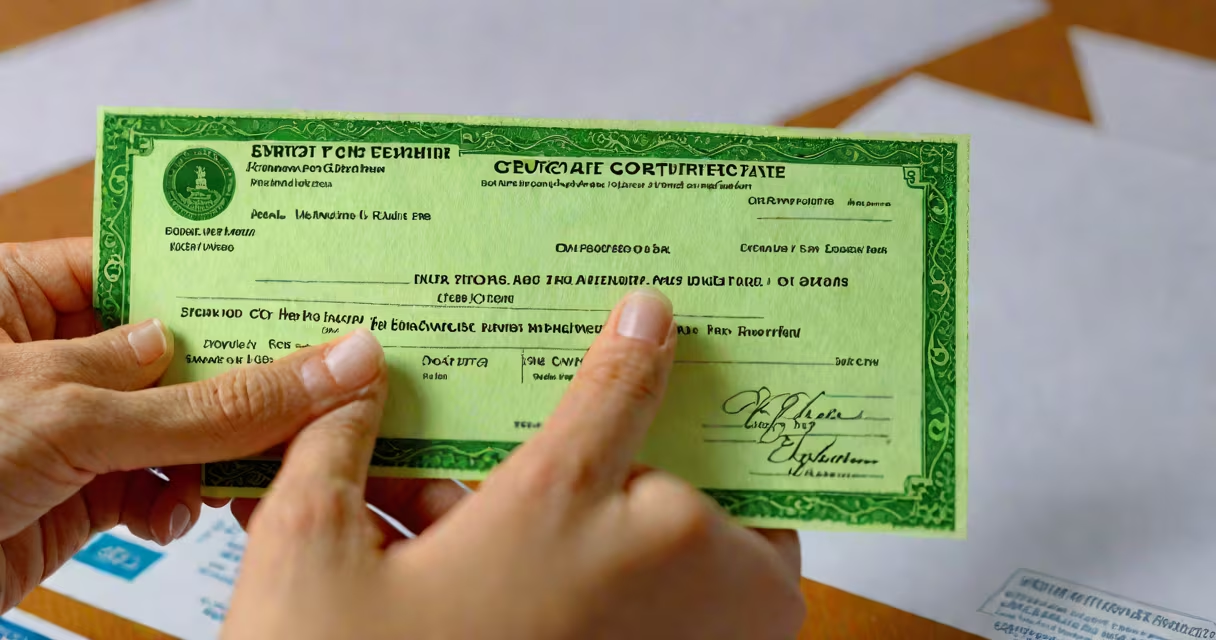
To obtain a birth certificate in the United States, you must present valid government-issued photo identification, proof of your relationship to the person listed on the record (if applying for someone else), and the correct application form. The required documents vary slightly by state, but most jurisdictions require a completed application, a valid ID, and payment for processing.
Each state's important records office sets its own rules for who can request a birth certificate and what documentation proves eligibility. For example, California allows parents, legal guardians, and individuals named on the record to apply. New York permits adult children and spouses to apply under certain conditions. Always confirm the rules with your local health department or state important records office before visiting.
Some states require notarized affidavits for applicants who aren't immediate family members. Others accept third-party requests only with court orders or power of attorney. Failure to provide the correct documents leads to delays or rejection. The Centers for Disease Control and Prevention (CDC) reports that nearly 15% of initial applications are returned due to missing or invalid documentation.
The core requirement is a government-issued photo ID. Acceptable forms include a driver's license, state-issued ID card, passport, or military ID. The name on the ID must match the name on the application. If your name has changed, you may need to submit a marriage certificate or court order showing the change.
Proof of relationship is mandatory when requesting a certificate for someone other than yourself. Parents must show a child's birth certificate or adoption decree. Adult children must provide evidence of parentage, such as a copy of their own birth certificate listing the parent. Spouses may need to submit a marriage license or joint tax return.
Most states require a completed application form. These are available online through the state's important records website or in person at county health departments. Forms typically ask for the full name at birth, date and place of birth, and parents' names. Submitting an incomplete form causes processing delays. The National Association for Public Health Statistics notes that 30% of applicants complete forms incorrectly, leading to resubmission.
Applicants often assume that a utility bill or school ID suffices as proof of identity. This is incorrect. Only government-issued photo IDs are accepted. A student ID from a university is not valid unless it includes a photo and official seal.
Another frequent error is submitting a photocopy of an ID instead of the original. Most offices require the original document to be presented in person. Some states allow certified copies of the ID, but only if they're issued by the issuing authority (e.g., DMV or passport office).
When applying for a minor's certificate, some parents try to use a birth certificate from another state. This doesn't work. The certificate must be issued by the state where the person was born. If you don't know the state of birth, contact the state's Department of Health or use the CDC's National Center for Health Statistics database to search for records.
There are two main types: short-form and long-form. A short-form birth certificate contains basic details-name, date and place of birth, parents' names-and is used for travel, employment, and school enrollment. A long-form birth certificate includes additional information such as the hospital of birth, attending physician, and sometimes the time of birth. It's required for immigration, citizenship applications, and genealogical research.
For international travel, many countries require a long-form birth certificate with an apostille. The Hague Apostille Convention governs this process. To get an apostille, you must first obtain a certified copy from the state important records office, then submit it to the state's secretary of state for authentication. The process takes 5-10 business days and costs $25-$50 per document.
| Type | Information Included | Common Uses | Processing Time |
|---|---|---|---|
| Short-form | Name, date/place of birth, parents' names | Passport, driver's license, school registration | 1-3 business days |
| Long-form | Additional details: hospital, time of birth, physician | Immigration, citizenship, DNA testing, genealogy | 3-7 business days |
Many people confuse a birth certificate with a birth affidavit or a baptismal certificate. These are not official records. A birth affidavit is a sworn statement used when a birth certificate is lost or never issued. A baptismal certificate is religious documentation and holds no legal weight for government purposes.
In Texas, applicants must visit the Texas Department of State Health Services (DSHS) regional office or a designated county clerk. Required documents include:
After submission, the applicant receives a receipt. Processing takes 5-7 business days. The certificate is mailed to the address on the form. If the applicant wants expedited service, they can pay an extra $50 for 24-hour turnaround. This option is available only in Austin and Houston offices.
I once applied for my sister's birth certificate in Florida during a family emergency. I brought her original birth certificate (which I had kept since childhood), my own driver's license, and a notarized letter stating our relationship. The clerk rejected the application because the notarization wasn't done by a Florida-licensed notary. I had to return the next day with a properly notarized document. This taught me that even small procedural errors cause delays.
If you were born abroad, you must apply through the U.S. Department of State. The process requires Form DS-1350 (Application for Consular Report of Birth Abroad) and supporting documents like a foreign birth certificate, parental passports, and proof of U.S. citizenship (e.g., naturalization certificate).
For individuals born in U.S. territories like Puerto Rico or Guam, the process varies. Puerto Rico issues certificates through the Office of Important Records, while Guam uses the Division of Public Health. Both require in-person application and may have different fees and wait times.
Non-U.S. citizens can apply for a birth certificate only if they were born in the United States. Foreign-born individuals cannot obtain a U.S. birth certificate. Instead, they must rely on foreign records or apply for a U.S. passport through consular services.
Before visiting the office, verify the following:
Always double-check the state's official website for updates. For example, in 2023, Illinois introduced a new online portal for birth certificate requests, reducing wait times from 10 days to 3. The system accepts e-signatures and digital payments.