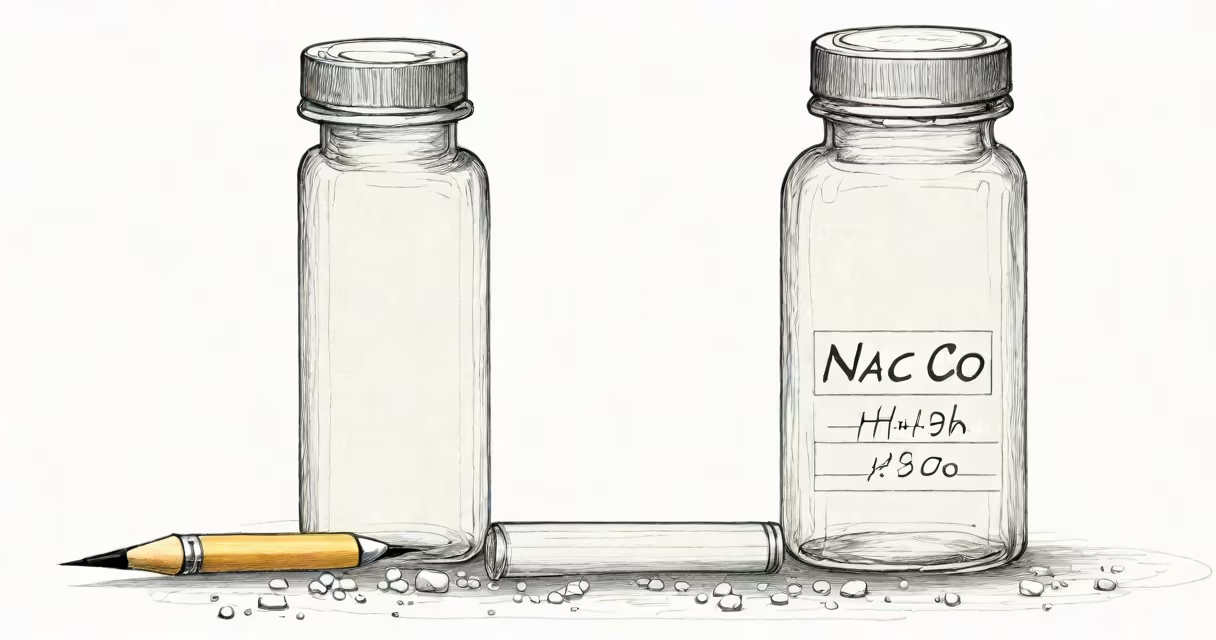
The compound NaC₂H₃O₂ is known as sodium acetate. It is the sodium salt of acetic acid, formed when acetic acid reacts with sodium hydroxide or sodium carbonate. This colorless, water-soluble solid is widely used in food preservation, laboratory experiments, and industrial applications.
Sodium acetate forms when the hydrogen ion in acetic acid (CH₃COOH) is replaced by a sodium ion (Na⁺). The resulting ionic compound dissociates completely in water, producing sodium cations (Na⁺) and acetate anions (CH₃COO⁻). This behavior makes it useful in buffering solutions and maintaining stable pH levels.
It appears as a white crystalline powder or colorless crystals. The most common form is sodium acetate trihydrate (NaC₂H₃O₂·3H₂O), which contains three water molecules per formula unit. This hydrated form is often used in heating pads due to its ability to release heat during crystallization-a process called exothermic phase change.
Sodium acetate functions as a weak base in aqueous solution. When dissolved, the acetate ion (CH₃COO⁻) can accept protons (H⁺), making it effective in resisting pH changes. This property allows it to serve as a buffer in biochemical systems, especially in enzyme assays and cell culture media.
In food, sodium acetate acts as a preservative and flavor enhancer. It is approved by the FDA under the GRAS (Generally Recognized As Safe) designation for use in vinegar-based products, cured meats, and baked goods. It contributes a mild sour taste and helps inhibit microbial growth.
A notable application is in reusable hand warmers. These devices contain a supersaturated solution of sodium acetate trihydrate. When a metal disc inside is clicked, it triggers nucleation, causing rapid crystallization. The phase transition releases about 260 J/g of energy as heat-enough to warm hands for 15-20 minutes.
Sodium acetate exists in several forms, differing by hydration level:
| Form | Chemical Formula | Appearance | Common Uses |
|---|---|---|---|
| Sodium acetate (anhydrous) | NaC₂H₃O₂ | White powder | Laboratory buffers, industrial synthesis |
| Sodium acetate trihydrate | NaC₂H₃O₂·3H₂O | Colorless crystals | Reusable hand warmers, pH control |
| Sodium acetate monohydrate | NaC₂H₃O₂·H₂O | White granules | Food processing, pharmaceuticals |
The trihydrate form is the most commercially available variant. Its stability and predictable crystallization behavior make it ideal for thermal applications. Anhydrous sodium acetate is preferred in dry lab settings where moisture absorption must be minimized.
In laboratories, sodium acetate is a key component in buffer solutions such as acetate buffer (pH 4.5-5.5). It maintains consistent acidity during experiments involving enzymes like amylase or proteases, which are sensitive to pH shifts.
Industrial uses include textile dyeing, where it stabilizes dyes and prevents color fading. It is also used in leather tanning to adjust pH and improve fiber binding. In the pharmaceutical industry, it serves as a pH modifier in injectable formulations.
One non-obvious fact: sodium acetate is produced industrially via the reaction of acetic acid with sodium hydroxide or sodium carbonate. The process yields high-purity material suitable for medical and food-grade applications. According to the American Chemical Society, over 100,000 tons are manufactured annually worldwide, primarily in North America and Western Europe.
Sodium acetate is frequently mistaken for sodium chloride (table salt) due to similar appearance and solubility. However, sodium acetate tastes sour, not salty. It is also distinct from sodium bicarbonate (baking soda), despite both being sodium salts. Bicarbonate decomposes upon heating to release CO₂; sodium acetate does not.
Another misconception is that sodium acetate is toxic. It is not. The U.S. National Library of Medicine lists its LD50 (lethal dose in rodents) at over 5,000 mg/kg, placing it in the low-toxicity category. Regulatory agencies classify it as safe for human consumption in amounts typically found in food.
I once used sodium acetate trihydrate in a classroom demonstration to show supercooling. After heating a solution to dissolve the salt, I cooled it slowly in ice water. The liquid remained liquid below its freezing point until a seed crystal was added. Instant crystallization occurred, releasing visible heat-enough to warm the container to 50°C within seconds. The effect was dramatic and memorable.
When handling sodium acetate, always store it in a sealed container away from moisture. Hygroscopic materials absorb water from air, potentially altering concentration or triggering premature crystallization. Use gloves and eye protection when working with large quantities in lab settings.
Final clarification: the correct name for NaC₂H₃O₂ is sodium acetate. The term "acetate" refers to the anion CH₃COO⁻, derived from acetic acid. The "sodium" prefix indicates the cation. This naming follows IUPAC conventions for inorganic salts.