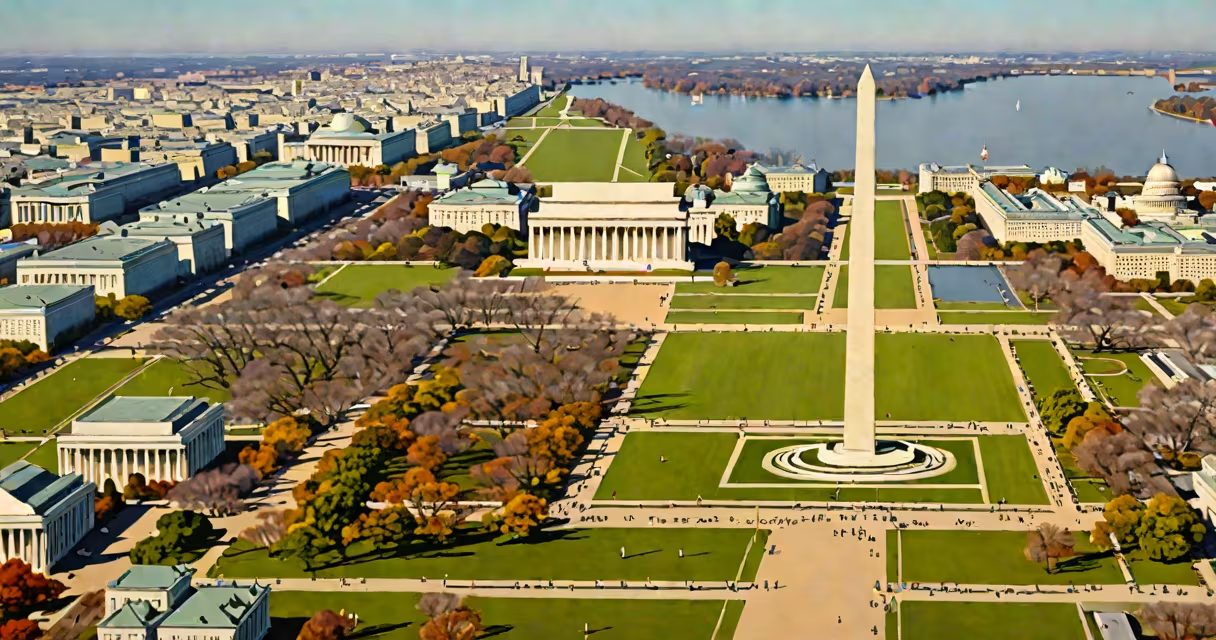
Washington DC's most visited sites center on its monumental core: the National Mall, home to the Lincoln Memorial, Washington Monument, and U.S. Capitol. These landmarks form a deliberate urban design tied to American ideals and history.
The city's layout, planned by Pierre Charles L'Enfant in 1791, positions major structures along grand axes. The National Mall stretches from the Capitol to the Lincoln Memorial, with the Reflecting Pool serving as a visual connector. This alignment isn't coincidental-it reflects Enlightenment principles of symmetry and civic virtue.
Visitors often begin at the National Gallery of Art, located between the Capitol and the White House. Its West Building houses European masterpieces, including works by Van Gogh and Rembrandt. The East Building, designed by I.M. Pei, features modern and contemporary art. Entry is free, and the building's glass pyramid entrance creates a striking contrast with the classical architecture nearby.
More than a dozen Smithsonian museums operate on the National Mall, all free to enter. They include the National Museum of American History, which displays the Star-Spangled Banner and the original 19th-century sewing machine used by inventor Elias Howe.
The National Museum of African American History and Culture opened in 2016 and quickly became one of the most visited museums in the world. It holds over 30,000 artifacts, including the dress worn by Rosa Parks during the Montgomery Bus Boycott and the personal effects of Frederick Douglass. The museum's exterior-a bronze-colored corona inspired by Yoruba metalwork-symbolizes resilience and cultural depth.
For science and space enthusiasts, the National Air and Space Museum features the Wright Flyer, the Apollo 11 command module, and the Spirit of St. Louis. The museum's collection includes over 6,000 aircraft and spacecraft, with exhibits updated annually based on new discoveries.
| Museum | Key Exhibit | Entry Cost |
|---|---|---|
| National Museum of American History | Star-Spangled Banner | Free |
| National Museum of African American History and Culture | Rosa Parks' bus seat | Free |
| National Air and Space Museum | Apollo 11 capsule | Free |
Despite their popularity, many visitors overlook the National Museum of Natural History's Hall of Fossils, which contains a 13-foot-long Tyrannosaurus rex skeleton. The hall also features a life-sized model of a Triceratops and a display on human evolution, including casts of Neanderthal and Homo erectus skulls.
Not all must-see sites lie on the National Mall. The Ford's Theatre, where President Abraham Lincoln was assassinated in 1865, remains preserved as a museum. Visitors can tour the presidential box, the stage, and the theater's original 1865 seating arrangement. The site also hosts annual performances of *Our American Cousin*, the play being performed that night.
Mount Vernon, George Washington's estate, lies 15 miles south of downtown. It includes his home, gardens, and a working farm. The estate maintains over 200 original artifacts from Washington's lifetime, including his personal writing desk and military uniform. Admission is $25 per adult, but tickets sell out weeks in advance during peak season.
For a quieter alternative, the Dumbarton Oaks Gardens offer a peaceful retreat. Located in the Georgetown neighborhood, the gardens feature formal French landscaping, a sunken garden, and a collection of rare azaleas. The site also houses a research library focused on Byzantine studies, with holdings dating back to the 12th century.
Many travelers assume all federal buildings are open to the public. The U.S. Supreme Court, while accessible via guided tours, requires advance reservations through the Senate's website. Security checks are strict-no bags larger than 12x12 inches are permitted inside.
Another frequent error: believing the National Mall is a single park. It spans nearly 1 mile from the Capitol to the Lincoln Memorial and includes 14 separate monuments and memorials. Walking the entire stretch takes about 45 minutes at a steady pace. Most visitors only cover the central 300 yards.
Some tourists also confuse the Jefferson Memorial with the Thomas Jefferson Memorial. The former is a circular structure dedicated to the third president, featuring a 19-foot statue of Jefferson and excerpts from his writings. The latter is a misnomer-there is no "Thomas Jefferson Memorial" as a standalone site. The correct name is the Jefferson Memorial.
I spent a summer afternoon at the National Mall in July 2022. Arriving at 7:30 a.m., I secured a spot near the Lincoln Memorial before crowds arrived. By 9 a.m., the area filled with tour groups and photographers. I returned at 8 p.m. to see the monument lit in golden light-fewer people, better photos.
Evenings at the National Mall offer a different atmosphere. The reflecting pool becomes a mirror for the illuminated monuments. The Lincoln Memorial's interior is dimly lit, with only the statue's face catching the glow. This lighting effect was intentionally designed by architect Henry Bacon to emphasize Lincoln's solemnity.
When planning your trip, consider the weather. Summer temperatures average 85°F (29°C), with high humidity. Winter days can drop below freezing. The National Park Service recommends wearing layers and bringing water, especially for walking tours.
What to see in Washington DC goes beyond famous landmarks. It includes the quiet moments-reading a plaque at the Martin Luther King Jr. Memorial, watching the changing of the guard at the Tomb of the Unknown Soldier, or sitting on the steps of the Library of Congress during a rainstorm. These experiences reveal the city's layered identity: political, cultural, and deeply human.