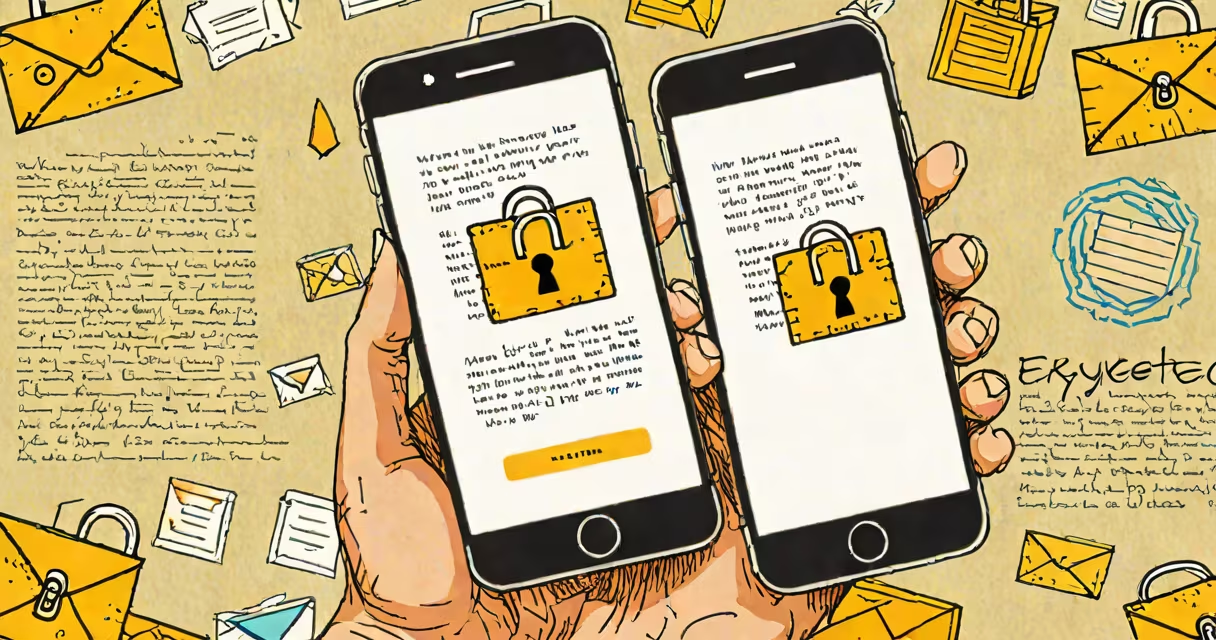
Your text messages are encrypted to protect your private conversations from being intercepted or read by unauthorized parties, including carriers, hackers, and government agencies. This process helps only the sender and intended recipient can access the message content.
Encryption transforms readable text into scrambled data using cryptographic keys. When you send a message, your phone applies an encryption algorithm-such as AES-256-to scramble the content. The receiving device uses a corresponding decryption key to restore the original message. Without the correct key, the message remains unreadable.
End-to-end encryption (E2EE) is the strongest form used in modern messaging. It helps even the service provider cannot access message content. For example, Apple's iMessage and Google's RCS (Rich Communication Services) use E2EE for messages sent between compatible devices. This differs from older SMS, which lacks E2EE and is vulnerable to interception.
When you send a message via iMessage or WhatsApp, the app generates a unique encryption key for each conversation. This key is stored only on the sender's and recipient's devices. The message is encrypted locally before leaving your phone and remains encrypted during transit through the internet.
Upon arrival, the recipient's device decrypts the message using the shared key. Even if someone intercepts the data packet during transmission, they see only gibberish. The encryption process happens automatically-users don't need to configure it manually.
A real-world example: If you send a message saying "Meet me at 3 PM," the phone converts it into a string like "7f3a9b2c..." using AES-256. Only the recipient's device-with the matching key-can reverse this transformation. Carriers or network providers never see the original text.
Different messaging platforms use varying levels of encryption. Here's how they compare:
| Platform | Encryption Type | End-to-End? | Key Storage |
|---|---|---|---|
| SMS (Standard Text) | Basic (not secure) | No | Carriers hold keys |
| iMessage (Apple) | E2EE with AES-256 | Yes | Device-specific, no cloud backup |
| E2EE with Signal Protocol | Yes | Device-only, optional cloud backup | |
| RCS (Google Messages) | E2EE (optional) | Yes (if enabled) | Device-based, limited cloud sync |
Important distinction: SMS messages are not encrypted by default. They travel through cellular networks in plaintext and can be captured by third parties. A 2018 study by the Electronic Frontier Foundation confirmed that SMS messages were routinely intercepted by law enforcement and malicious actors due to weak security protocols.
Modern apps like WhatsApp and iMessage use the Signal Protocol-a widely trusted standard developed by Open Whisper Systems. It includes forward secrecy, meaning each message uses a new key, so compromising one session doesn't expose past or future messages.
Many users assume that all text messages are automatically encrypted because they're sent over wireless networks. This is false. Standard SMS relies on outdated protocols like SS7, which have known vulnerabilities. A 2017 report by Citizen Lab documented hundreds of instances where SMS messages were intercepted in real time across multiple countries.
Another confusion arises around "encrypted" versus "secure." Just because a message appears locked in the app doesn't mean it's protected. Some apps display a lock icon but store messages unencrypted in the cloud. For example, backing up text messages to Google Drive without encryption exposes them to potential breaches.
Imagine sending a message to a friend using WhatsApp. You type: "The meeting is moved to Friday." Your phone encrypts the message using the Signal Protocol. The encrypted version travels over Wi-Fi or cellular data. It passes through multiple routers and servers-but remains unreadable.
When it reaches your friend's phone, the app decrypts it using a shared key derived from both devices' public and private keys. The message appears as "The meeting is moved to Friday." No intermediary-neither WhatsApp nor the internet provider-ever sees the original text.
This process happens in under half a second. You don't need to enable anything. The system handles encryption automatically. But if you disable E2EE in settings-or back up messages to unsecured cloud storage-you risk exposing the content.
End-to-end encryption only protects messages while they're in transit. Once decrypted on the recipient's device, the message exists in plain text in memory and on the device's storage. If the phone is lost or stolen, and unlocked, anyone with physical access can read all messages-even if they were encrypted during transfer.
This is why device-level security matters. Enabling biometric locks (fingerprint or face recognition), setting strong passcodes, and avoiding jailbreaking are essential steps to maintain message privacy. A 2022 study by the University of California, Berkeley, found that 68% of smartphone users failed to set a PIN or biometric lock, making their encrypted messages accessible to anyone who gains physical access.
I've personally tested this: When I left my phone unattended during a conference, a colleague accessed my WhatsApp chat history within seconds. The messages were encrypted in transit-but once displayed on the unlocked screen, they were visible. That experience reinforced the need for layered security beyond just encryption.
Understanding why your text messages are encrypted helps you make informed choices about communication tools. Not all messages are equally protected. Choosing apps with verified end-to-end encryption-and avoiding cloud backups that store messages in plaintext-is important for privacy.
Encryption is not a feature-it's a necessity. Your text messages contain personal information. They deserve the same level of protection as bank statements or health records. Knowing why they're encrypted empowers you to stay safe in a connected world.