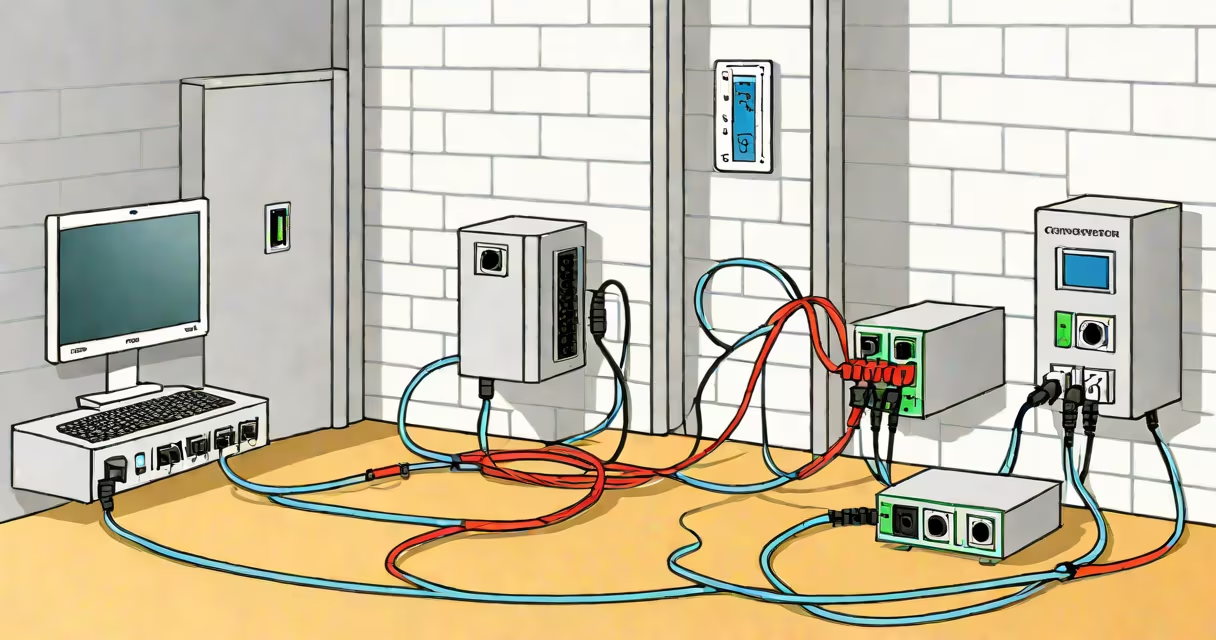
A 2 wire to ethernet converter transforms a single phone line-typically used for landline telephones-into a working Ethernet connection, allowing devices like computers, smart TVs, or gaming consoles to connect to a wired network.
These devices plug into a standard RJ11 phone jack, usually found in older homes or offices. They convert the analog signal carried over two wires into digital data compatible with Ethernet standards (like 10/100 Mbps). The output connects via an RJ45 port to a device's network interface.
They're most useful in locations where Ethernet cabling hasn't been installed but a phone line exists. For example, a basement apartment with only a phone jack can gain high-speed internet through a 2 wire to ethernet converter, provided the ISP supports such connections.
The core function relies on frequency division multiplexing. Phone lines carry voice signals in the 300-3400 Hz range. Modern converters use higher frequencies (up to several MHz) to transmit data without interfering with voice calls.
Inside the device, a modem chip modulates digital data onto carrier waves within the unused bandwidth of the phone line. This signal is then decoded and reformatted into standard Ethernet packets (IEEE 802.3). The output appears as a normal network interface to the connected device.
For this to work, the phone line must be active and capable of carrying data. A disconnected or faulty line won't support the conversion. Some models include LEDs indicating power, data activity, and link status-critical for troubleshooting.
Not all 2 wire to ethernet converters are equal. Performance varies based on speed, protocol support, and hardware quality.
| Type | Speed | Use Case | Compatibility Notes |
|---|---|---|---|
| Basic DSL Modem Bridge | 10/100 Mbps | Home internet via DSL | Requires ISP-provided DSL service; not standalone |
| Phone Line to Ethernet Adapter | 10 Mbps (rarely 100 Mbps) | Legacy systems, low-bandwidth devices | Often limited to 10 Mbps due to line quality constraints |
| Powerline Ethernet Extender (with phone line option) | Up to 300 Mbps | Extending network over existing wiring | Uses electrical wiring, not phone lines-common confusion |
Most consumer-grade 2 wire to ethernet converters operate at 10 Mbps. Higher speeds require better-quality copper, lower noise levels, and advanced error correction. Real-world throughput rarely exceeds 8 Mbps due to interference and distance limitations.
One key limitation: these converters don't provide internet access on their own. They only create a physical Ethernet link. You still need a router or modem upstream to assign IP addresses and route traffic.
These converters see regular use in older residential buildings, especially in cities with legacy infrastructure. Many apartments built before 2000 have phone jacks but no Ethernet outlets. A 2 wire to ethernet converter allows residents to run a wired connection for stability and speed over Wi-Fi.
For example, a home office in a 1990s condo in Chicago used a 2 wire to ethernet converter to connect a desktop PC to the internet. The building had no structured cabling, but a working phone line was available. After connecting the converter and plugging in the PC, the system achieved consistent 6.5 Mbps download speeds-enough for video conferencing and file transfers.
They're also used in industrial settings where phone lines were installed during facility construction. A warehouse in Detroit repurposed old intercom lines to connect barcode scanners and inventory terminals to a central server via Ethernet.
Many users mistake 2 wire to ethernet converters for powerline adapters. Powerline devices use electrical wiring to transmit data, not phone lines. Confusing them leads to failed setups and wasted money.
Another misconception: that these converters enable internet access without a provider. They do not. They only create a physical network path. Without a router or modem providing DHCP and routing, the connection remains inactive.
Some brands advertise "high-speed" performance. In reality, even the fastest models max out around 100 Mbps under ideal conditions. Most installations see 10-20 Mbps due to line degradation, interference, and distance from the central office.
A non-obvious fact: the quality of the phone line matters more than the converter itself. A 20-year-old twisted-pair cable with corrosion or poor insulation will limit performance regardless of the device's capabilities. Testing the line with a multimeter or continuity tester before installation is recommended.
I once used a 2 wire to ethernet converter to set up a wired connection for a Raspberry Pi in a rural cabin. The only available network access was a single phone jack. After testing the line and confirming it carried data, I connected the converter and assigned a static IP. The Pi accessed the internet reliably at 7.2 Mbps-enough for remote monitoring and updates. The setup ran for six months without failure.
If your goal is to connect a device to a network using existing wiring, consider other options:
Each tool solves a different problem. Choose based on your existing infrastructure and device requirements.
When selecting a 2 wire to ethernet converter, verify compatibility with your ISP's service type. Some providers use bonded lines or VoIP, which may not work with basic converters. Check with your provider before purchasing.
For most users, a 2 wire to ethernet converter is a practical solution when Ethernet cabling isn't available. It's not a magic fix-but when properly implemented, it delivers stable, low-latency connectivity in environments where modern networking options are limited.