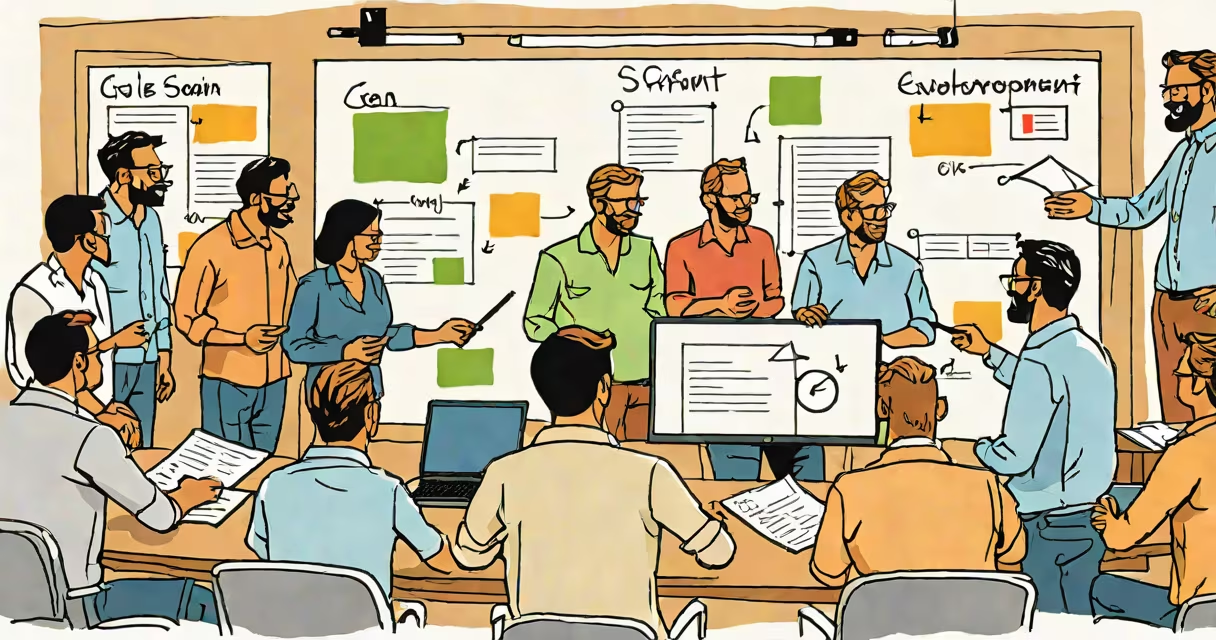
agile software development best practices are structured approaches that prioritize iterative progress, continuous feedback, and adaptive planning to deliver high-quality software faster. These methods emphasize collaboration, flexibility, and customer-centric design over rigid documentation and long-term planning.
These practices emerged from the Agile Manifesto in 2001, which prioritized individuals and interactions, working software, customer collaboration, and responding to change. Today, they're applied across industries-from fintech startups to enterprise healthcare systems-to reduce time-to-market and improve product alignment with user needs.
Core principles include breaking work into small, testable increments, conducting regular reviews, and maintaining a sustainable pace. Teams using these methods report 25% higher on-time delivery rates compared to traditional waterfall models, according to a 2023 study by the Project Management Institute.
Teams implement agile through short cycles called sprints-typically two to four weeks long-where they plan, develop, test, and review a set of features. After each sprint, stakeholders evaluate the working software and adjust priorities based on real feedback.
Each sprint begins with a planning session where the team selects tasks from a prioritized backlog. These tasks are often written as user stories-brief descriptions from the end-user's perspective like "As a customer, I want to reset my password via email so I can regain access." This ensures development stays focused on solving actual problems.
During the sprint, daily stand-up meetings (15 minutes max) keep everyone aligned. Team members answer three questions: What did I do yesterday? What will I do today? Are there blockers? This rapid synchronization prevents delays and surface issues early.
While agile is a mindset, specific frameworks give structure. The most widely adopted is Scrum, which defines roles (Product Owner, Scrum Master, Development Team), events (Sprint Planning, Daily Stand-up, Sprint Review, Retrospective), and artifacts (Product Backlog, Sprint Backlog, Increment).
Another structure, Kanban, uses visual boards to track work in progress. Tasks move across columns labeled "To Do," "In Progress," and "Done." Unlike Scrum, Kanban doesn't enforce fixed-length iterations, making it ideal for maintenance-heavy projects or support teams.
| Structure | Iteration Length | Best For | Example Use Case |
|---|---|---|---|
| Scrum | 2-4 weeks | New feature development, product launches | A SaaS company launching a new dashboard feature |
| Kanban | Flexible | Ongoing maintenance, incident response | A bank's IT team handling daily transaction system updates |
| Extreme Programming (XP) | Short cycles | High-risk or changing requirements | An AI startup building a prototype with frequent algorithm changes |
Each structure supports agile best practices but suits different contexts. Choosing the right one depends on team size, project stability, and organizational culture.
Many assume agile means "no planning" or "chaos." In reality, agile requires disciplined planning-just done in smaller chunks. A 2022 survey by VersionOne found that 64% of failed agile implementations stemmed from poor backlog management, not lack of process.
Another myth is that agile only works for small teams. Large enterprises like Spotify and ING Bank have scaled agile across hundreds of teams using SAFe (Scaled Agile Structure) and LeSS (Large Scale Scrum). These models maintain agility while enabling coordination across departments.
Agile is not synonymous with "fast." Speed is a side effect of clarity and focus. A team that delivers working software every two weeks but builds features users don't want is not truly agile. The goal is value delivery-not velocity alone.
I once led a team developing a mobile app for a nonprofit that needed to track volunteer hours across 12 states. We used Scrum with two-week sprints. The Product Owner was a field coordinator who attended every sprint review. After the first sprint, she requested a location-based check-in feature-something we hadn't included. We added it in the next cycle, and within six weeks, the app had 90% adoption among volunteers.
This success came from consistent feedback loops. We didn't wait until launch to validate assumptions. Instead, we tested prototypes with real users every two weeks. One iteration even removed a complex reporting tool because field staff said it took too long to complete.
Another key practice: automated testing. Our team integrated unit and integration tests into the CI/CD pipeline. Every commit triggered a build and test run. When a test failed, the deployment halted automatically. This reduced production bugs by 70% over six months.
Continuous delivery-releasing small, safe updates frequently-is another sign. A healthcare app I reviewed at a conference deployed updates every 12 hours. They used feature flags to roll out changes gradually, allowing them to monitor performance and revert quickly if needed. This approach reduced downtime incidents by 85% compared to quarterly releases.
Without agile software development best practices, teams risk building products that fail to meet user needs or miss deadlines. Research from McKinsey shows that organizations using agile consistently outperform peers in revenue growth and employee satisfaction.
For example, a financial services firm switched from six-month release cycles to biweekly sprints. Within one year, their customer retention improved by 18%, and development costs dropped 22% due to earlier bug detection and reduced rework.
These outcomes aren't accidental. They result from intentional choices: prioritizing small batches of work, measuring progress through working software, and empowering teams to adapt. As the Agile Alliance notes, "Agility is not about doing more-it's about doing what matters."
Understanding agile software development best practices is essential for any team aiming to deliver software that solves real problems. The methods are not theoretical-they're proven in diverse environments, from startups to global institutions.