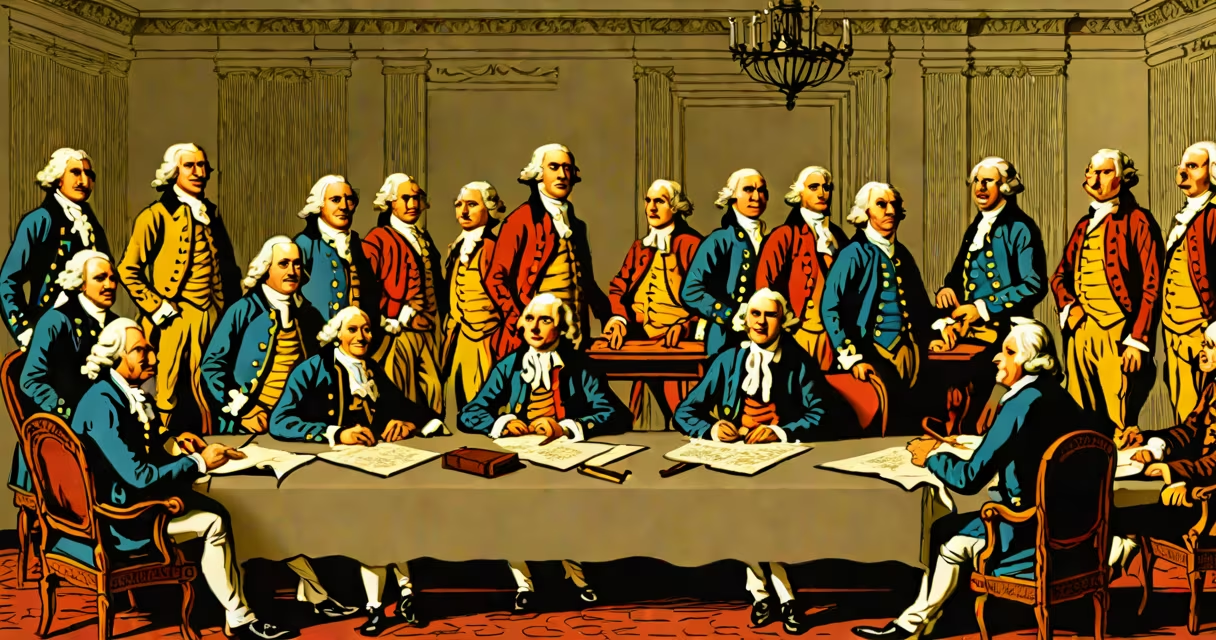
The Articles of Confederation history traces the first written constitution of the United States, adopted in 1781 and replaced by the current U.S. Constitution in 1789. It created a loose alliance of sovereign states with a weak central government, lacking authority to tax, regulate trade, or enforce laws.
Formally ratified on March 1, 1781, after initial approval by the Second Continental Congress in November 1777, the Articles established a unicameral Congress with limited powers. Each state had one vote regardless of size, and decisions required unanimous consent-a design flaw that paralyzed action. The federal government could not raise revenue, leading to unpaid war debts and reliance on voluntary state contributions.
Under the Articles, the national government had no executive branch or judiciary. Foreign policy was managed by Congress, but enforcement relied on state cooperation. When Britain refused to evacuate western forts in 1783, Congress lacked funds to pay troops or negotiate effectively. This failure exposed the system's fragility during peacetime.
The Articles structured power around state sovereignty. Congress convened in Philadelphia and handled foreign affairs, war, and disputes between states. However, it could not draft laws that bound individuals directly-only recommend actions to state legislatures.
Each state sent between two and seven delegates, chosen by their legislature. Delegates served at the pleasure of their state and could not be removed by Congress. This arrangement led to frequent turnover and inconsistent representation. For example, New York sent five delegates in 1781, but only two attended sessions regularly.
Decisions required nine of thirteen states to approve major measures. Amendments needed unanimous consent-an impossible standard. In 1783, Congress proposed a plan to fund the national debt through a 5% import duty, but New Jersey blocked it. Without a mechanism to override state objections, reform stalled.
The Articles granted Congress authority to declare war, make treaties, and manage relations with Native American tribes. It also oversaw westward expansion through the Northwest Ordinance of 1787, which banned slavery in the Northwest Territory and laid out a path to statehood.
Despite this, Congress lacked the power to enforce agreements. When Spain closed the Mississippi River to American trade in 1784, Congress could not retaliate. The U.S. had no standing army, navy, or customs service. Revenue came solely from state requisitions, which were often ignored.
A 1786 report from the Committee on Trade showed that Congress had received only $1.5 million in payments from states since 1781, despite requesting $10 million. By 1786, the national debt stood at $40 million, with interest payments defaulting in 1787.
| Feature | Power under Articles | Limitation |
|---|---|---|
| Legislative Authority | Unicameral Congress with equal state votes | No majority rule; unanimous consent needed for amendments |
| Fiscal Power | Could request funds, not collect taxes | States frequently ignored requests |
| Enforcement | Could issue proclamations, not laws | No courts or executive to enforce rulings |
| Foreign Affairs | Could sign treaties and alliances | States could ignore treaty obligations |
Shays' Rebellion in 1786 exposed the Articles' inability to maintain order. Farmers in Massachusetts revolted against high taxes and foreclosures, seizing a federal arsenal. The national government could not raise troops to suppress the uprising-Congress had to rely on Massachusetts militia funded by private donations.
This event galvanized leaders like James Madison and Alexander Hamilton. They argued that a stronger central government was essential. At the Constitutional Convention in 1787, delegates drafted a new structure that gave Congress power to tax, regulate commerce, and establish federal courts.
Under the new Constitution, the federal government could levy direct taxes, control interstate trade, and appoint a president with executive authority. The Articles were formally superseded when New Hampshire ratified the Constitution in June 1788, and it took effect in March 1789.
Many assume the Articles were abandoned because they were "bad." But they were designed for wartime unity, not long-term governance. The Founders expected them to evolve. As historian Gordon Wood notes in The Radicalism of the American Revolution, the Articles were "a practical compromise" meant to preserve state autonomy while managing common defense.
Another myth is that the Articles prevented the U.S. from existing. In reality, the nation functioned under them for eight years. The federal government negotiated the Treaty of Paris (1783), ending the Revolutionary War, and administered the Northwest Territory. The Articles were not a failure of identity-they were a failure of structure.
Even the term "Articles of Confederation" is misleading. The document never used the word "confederacy" in its title. It called itself "The Articles of Confederation and Perpetual Union." The name "Confederation" emerged later, popularized by historians and political opponents.
In 2018, I visited the National Archives in Washington, D.C., and viewed the original Articles of Confederation manuscript. The parchment, yellowed and brittle, bore the signatures of 13 states. Delaware's signature appears in ink that faded unevenly-likely from a quill pen worn down during the final days of ratification.
One detail stood out: the document's preamble stated that the union was "perpetual," yet it contained no mechanism for amendment beyond unanimous consent. That contradiction-declaring permanence while blocking change-was the root of its collapse.
The Articles of Confederation history remains relevant for understanding constitutional design. The U.S. Constitution's framers studied its failures closely. Article I, Section 8 of the Constitution explicitly grants Congress the power to "lay and collect Taxes," a direct response to the Articles' fiscal weakness.
Today, scholars reference the Articles when discussing federal-state balance. The Supreme Court cited the Articles in United States v. Lopez (1995), affirming Congress's authority under the Commerce Clause. The Court noted that the absence of such power in the Articles "demonstrated the necessity of a stronger federal structure."
For comparison, the European Union operates under a similar model of intergovernmental cooperation. Yet unlike the Articles, EU treaties allow qualified majority voting and binding legislation. The U.S. avoided this path by adopting a federal system with centralized authority.
Understanding the Articles of Confederation history clarifies why the U.S. Constitution includes checks and balances, separation of powers, and a clear hierarchy of law. The failure of the Articles proved that sovereignty cannot be shared without mechanisms to resolve conflict.
Modern debates about federal power-such as those over state rights in immigration or climate policy-echo the tensions that plagued the Articles era. The solution was not to eliminate federal authority, but to define it.