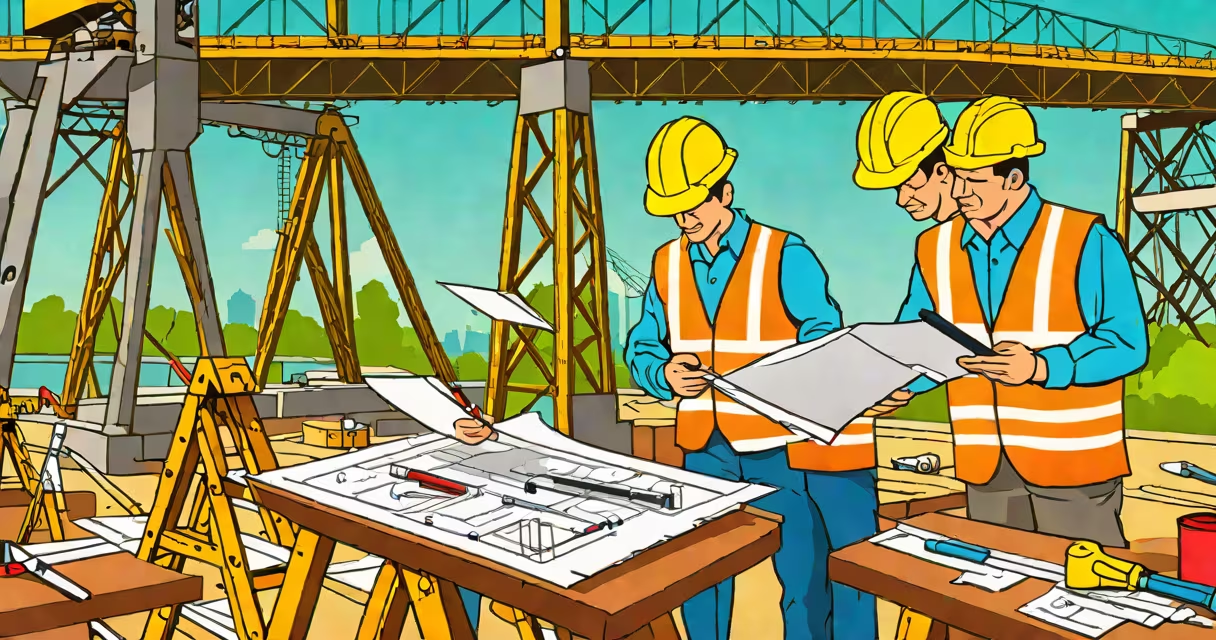
Civil engineers plan, design, and oversee the construction of infrastructure like roads, bridges, buildings, and water systems. Their daily work blends technical analysis, field visits, and coordination with contractors and clients.
On any given day, a civil engineer may review structural calculations, walk a construction site to verify compliance with safety standards, or attend meetings to adjust project timelines. They ensure that designs meet local regulations, environmental requirements, and material specifications.
According to the U.S. Bureau of Labor Statistics, civil engineers typically work in offices and on-site locations, spending about 60% of their time in the field during active construction phases. Their role spans multiple stages of a project-from initial concept to final inspection.
Civil engineers begin each day by assessing ongoing project status. This includes checking progress reports, reviewing changes in weather or supply chains, and confirming that materials arrive on schedule. A delay in concrete delivery, for example, can push back foundation work by two days.
They use computer-aided design (CAD) software and building information modeling (BIM) tools to create detailed drawings. These models simulate load distribution, drainage patterns, and seismic resistance. A bridge design must account for wind loads exceeding 100 mph in coastal zones, which requires precise stress calculations.
Fieldwork is central to the job. Engineers visit sites to verify that excavation depths match approved plans, that reinforcement bars are properly placed, and that safety barriers are installed. During one project in Houston, a civil engineer caught a misaligned retaining wall early-preventing a $120,000 repair later.
Work is structured around four key areas: design, documentation, site oversight, and stakeholder communication.
Each task follows strict industry standards. For example, the American Society of Civil Engineers (ASCE) sets guidelines for soil compaction tests-engineers must verify that fill material achieves at least 95% Proctor density to prevent future settlement.
Civil engineers are not primarily responsible for building structures themselves. That role belongs to construction managers and tradespeople. Instead, civil engineers ensure that the structure can withstand expected loads and environmental conditions.
A frequent misunderstanding is that civil engineers only work on large public projects. While they do lead major infrastructure efforts-such as the reconstruction of the I-35W Bridge in Minneapolis after its 2007 collapse-they also manage smaller developments like stormwater drainage for suburban subdivisions.
Another error is assuming all civil engineers focus on transportation. The field includes sub-disciplines such as geotechnical (soil and foundation behavior), environmental (wastewater treatment), and structural engineering (building frames). A civil engineer working on a landfill must analyze leachate flow rates and liner integrity-not just road alignment.
Tasks vary depending on whether a project is in planning, design, construction, or closeout.
| Project Phase | Daily Responsibilities | Example Output |
|---|---|---|
| Planning | Site feasibility studies, zoning compliance checks | Environmental impact assessment report |
| Design | Load calculations, material selection, CAD drafting | Reinforced concrete beam detail drawing |
| Construction | Inspection logs, safety audits, contractor coordination | As-built survey sketch with GPS coordinates |
| Closeout | Final inspection sign-offs, maintenance manuals | Project completion certificate |
For instance, during the construction phase of a new school in Denver, a civil engineer spent mornings reviewing daily progress photos against the construction schedule and afternoons resolving conflicts between plumbing trenches and underground utility lines.
In 2022, a team of civil engineers managed the expansion of State Route 99 in California. The goal was to widen a 12-mile stretch from four to six lanes to reduce congestion.
Each morning, the lead engineer reviewed traffic simulation data showing peak delays of 27 minutes during rush hour. They adjusted lane configurations in the design model to minimize disruption during construction.
Midday, they walked the site to check that asphalt layers were laid at 140°F-critical for proper bonding. When a subcontractor used lower-grade aggregate, the engineer halted work until replacement material met ASTM C33 standards.
Ultimately, they updated the project management dashboard with revised milestones. The entire process took 18 months, with 14 weekly coordination meetings involving Caltrans, local agencies, and community representatives.
I once observed a civil engineer in Oregon halt a culvert installation after noticing a 3-inch discrepancy in elevation. The error would have caused water backup during heavy rains. Correcting it required reshaping the trench and re-pouring concrete-costing $8,000 but preventing potential flooding damage to nearby homes.
This moment underscored that precision isn't optional-it's built into every measurement, calculation, and inspection. Small oversights compound into system failures.
Civil engineers do not operate heavy machinery or lay bricks. They don't perform electrical wiring or install HVAC systems. Those roles fall under other disciplines-mechanical, electrical, or construction trade workers.
They also aren't responsible for marketing a project or securing funding. Budget approval comes from government agencies or private investors. Engineers provide cost estimates based on material quantities and labor hours-but they don't approve budgets.
Understanding this boundary prevents confusion about roles. A civil engineer may recommend a tunnel over a bridge due to terrain, but they don't decide whether to fund it.
Infrastructure failure costs the U.S. economy an estimated $3.9 trillion annually in lost productivity and repairs, according to the ASCE's 2021 Infrastructure Report Card. Civil engineers reduce risk through rigorous daily checks and adherence to codes.
For example, a bridge in New York City failed in 2013 due to corrosion in steel reinforcements. Post-incident analysis revealed that routine inspections had been skipped for three years. Today, civil engineers follow strict protocols-inspections every 18 months, with digital logs stored in cloud-based platforms.
Every day, they balance innovation with safety. A new composite material might offer 20% greater strength, but it must pass 10,000 fatigue cycles in testing before being approved for use.
Civil engineers spend their days ensuring that roads, dams, and buildings function safely and efficiently. Their work involves technical problem-solving, site verification, and collaboration across teams. Understanding what civil engineers do on a daily basis reveals how foundational their role is to public safety and economic stability.
For insight into another STEM profession, explore what do biologists do on a daily basis.