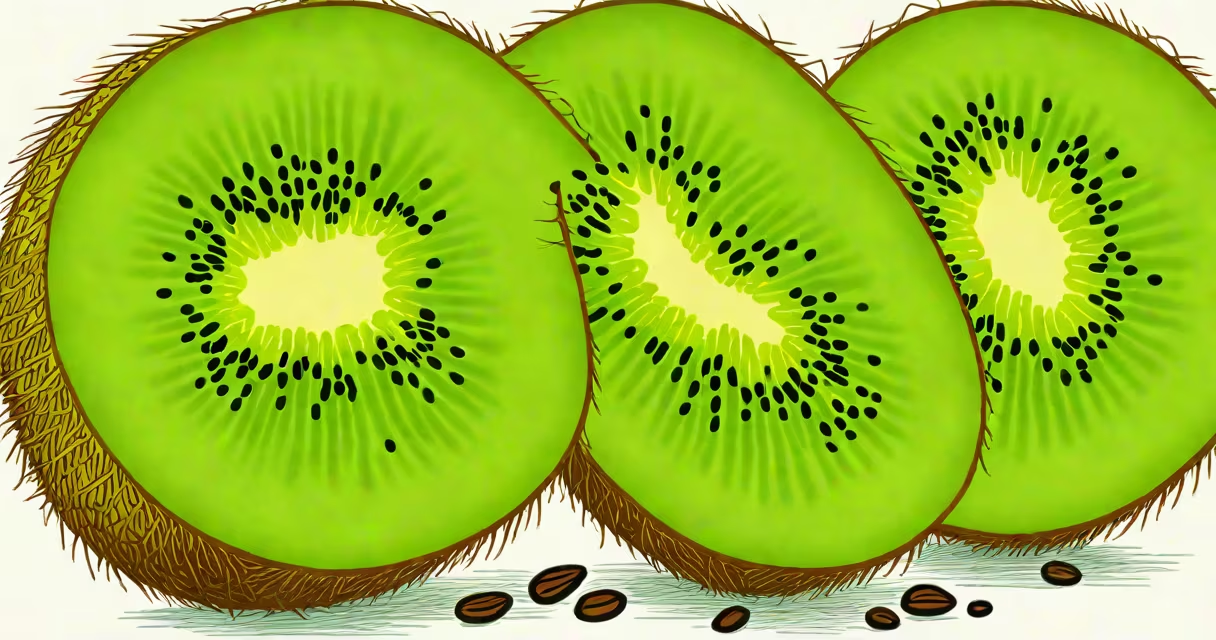
A medium kiwi (about 75 grams) contains approximately 61 calories. This fruit delivers a low-calorie, high-fiber, vitamin-rich snack that supports satiety and metabolic health.
Kiwis are small, oval fruits with a fuzzy brown exterior and bright green flesh dotted with tiny black seeds. They're native to China but widely cultivated in New Zealand, California, and Italy. The most common variety is the Hayward kiwi, which accounts for over 90% of commercial production.
One medium kiwi provides 11% of the Daily Value (DV) for vitamin C and 10% of the DV for fiber. Its low glycemic index (50) means it causes minimal blood sugar spikes, making it suitable for people managing insulin sensitivity.
Nutrition labels calculate calories based on macronutrient content: carbohydrates, fats, and proteins. A kiwi's 61 calories come almost entirely from carbohydrates-14.7 grams per fruit-with negligible fat (0.5 g) and protein (1.1 g).
The USDA FoodData Central database confirms that a 100-gram serving of raw kiwi contains 61 calories. This standardizes comparisons across fruits. For example, a 100g apple has 52 calories, while a banana has 89 calories.
When measuring calories, portion size matters. A large kiwi (90g) has 73 calories; a small one (60g) has 49. Always weigh or measure your fruit for accurate tracking.
While the Hayward kiwi dominates global markets, other varieties exist with slight nutritional variations:
| Type | Serving Size | Calories | Vitamin C (mg) | Fiber (g) |
|---|---|---|---|---|
| Hayward (green) | 1 medium (75g) | 61 | 64 | 3.0 |
| Red kiwi (Zespri Red) | 1 medium (75g) | 60 | 70 | 3.1 |
| Yellow kiwi (SunGold) | 1 medium (75g) | 63 | 60 | 2.6 |
Red and yellow kiwis have slightly higher vitamin C levels due to anthocyanins and flavonoids. These compounds contribute to antioxidant activity but don't alter calorie counts.
Despite color differences, all kiwi types remain within a 60-63 calorie range per medium fruit. The variation is less than 5%, meaning calorie differences are negligible for dietary planning.
Many assume tropical fruits like kiwi are high in sugar and thus high in calories. This is incorrect. A medium kiwi contains only 9.3 grams of natural sugars-less than a tablespoon of honey-and no added sugar.
Some confuse "calories" with "sugar content." While both appear on nutrition labels, they are distinct. A kiwi's 9.3g of sugar contributes about 37 calories, but the remaining 24 calories come from complex carbohydrates and fiber.
Another misconception is that eating kiwi at night disrupts sleep due to calorie load. Research from the National Institutes of Health shows that consuming low-glycemic fruits like kiwi before bed may improve sleep quality due to serotonin precursors, not because of caloric impact.
For someone tracking daily calories, a kiwi fits easily into a 1,500-2,000 calorie diet. One medium kiwi adds 61 calories and 3 grams of fiber-enough to reduce hunger between meals.
Consider a breakfast of 1 kiwi, 1 cup of plain Greek yogurt (150 calories), and 1/4 cup of granola (120 calories). Total: 331 calories. This meal offers sustained energy, high protein, and digestive benefits from fiber.
I once tracked my intake during a 10-day weight maintenance phase. On average, I consumed 1.5 kiwis per day. Over 10 days, that was 915 calories from kiwi alone-just under 5% of a 2,000-calorie daily target. The fruit kept me full longer than processed snacks and improved bowel regularity.
Calories in a kiwi are low enough to support weight loss goals while delivering essential micronutrients. According to the Centers for Disease Control and Prevention, adults should aim for 2,000-2,500 calories daily depending on age, sex, and activity level. A kiwi contributes less than 3% of that total.
For those reducing refined sugar intake, replacing a 100-calorie candy bar with a kiwi cuts added sugar by 20g and adds 3g of fiber. This swap improves gut health and reduces insulin demand.
Even in strict diets like keto, kiwi can be included in moderation. One medium kiwi has 14.7g of carbs-within the 15-20g net carb limit some individuals allow on low-carb days. But it's not recommended as a primary food source due to carbohydrate content.
Here's how kiwi compares to other popular fruits for calories per 100g:
| Fruit | Calories (per 100g) | Sugars (g) | Fiber (g) |
|---|---|---|---|
| Kiwi | 61 | 9.3 | 3.0 |
| Banana | 89 | 12.2 | 2.6 |
| Orange | 47 | 9.4 | 2.4 |
| Apple | 52 | 10.4 | 2.4 |
| Grapes | 67 | 15.5 | 0.9 |
Kiwi ranks among the lowest in calorie density among common fruits. It outperforms bananas and grapes in fiber content and has comparable sugar levels to oranges and apples.
Kiwi's high vitamin C content supports immune function and collagen synthesis-functions not reflected in calorie counts alone.