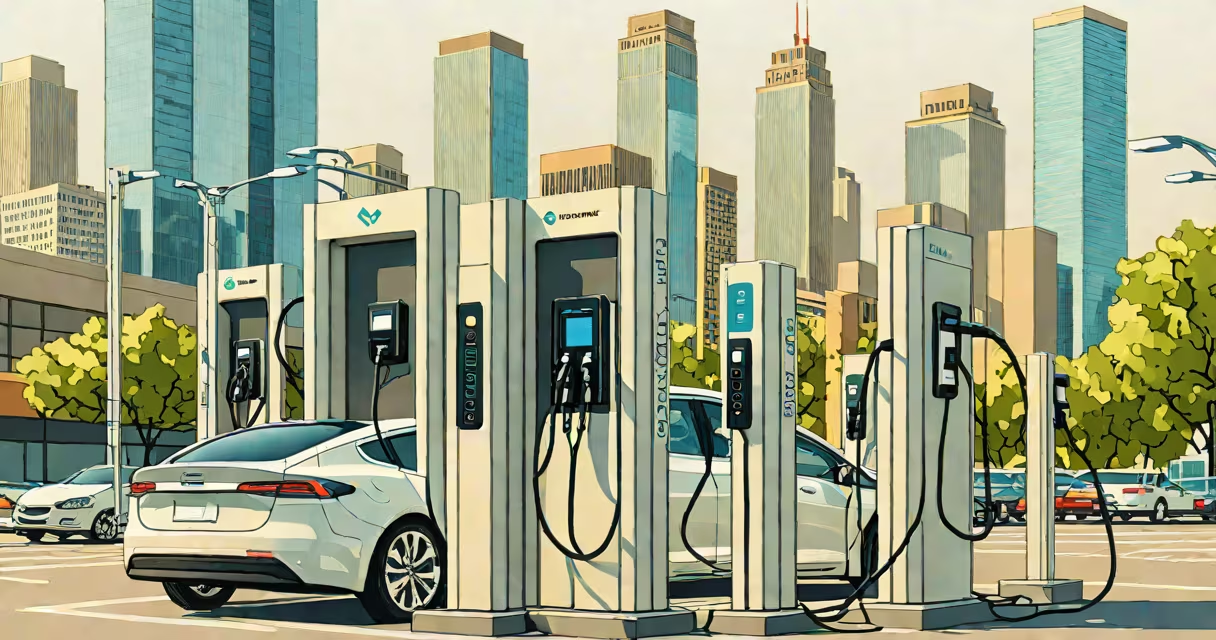
Charging station stocks are shares in companies that design, build, operate, or supply equipment for electric vehicle (EV) charging networks. These firms generate revenue through hardware sales, installation services, and ongoing network operations, often supported by public and private investment in clean transportation.
Electric vehicles require access to reliable charging infrastructure to replace internal combustion engines. Charging station stocks represent ownership in businesses enabling that transition. The sector includes manufacturers of Level 2 and DC fast chargers, operators managing large-scale charging networks, and suppliers of power electronics and software platforms.
According to the U.S. Department of Energy, the nation had over 120,000 public EV charging ports in 2023, with projections indicating a fivefold increase by 2030. This growth underpins demand for companies involved in charging station deployment. Investors track these stocks as part of broader clean energy and transportation transformation.
Companies in this space earn income through multiple channels. Hardware producers sell chargers to utilities, fleet operators, and commercial property owners. Installation firms charge for site assessment, permitting, and electrical upgrades. Operators collect fees per session or offer subscription models for frequent users.
Revenue streams depend on location density, uptime, and integration with grid management systems. For example, ChargePoint's network charges $0.30-$0.60 per kilowatt-hour in urban markets, with additional service fees. Revenue scales with usage volume and geographic expansion.
Some firms operate under government-funded programs. The U.S. Bipartisan Infrastructure Law allocated $7.5 billion for EV infrastructure, including grants for charging stations. Companies receiving such funding may report higher capital inflows and accelerated deployment timelines.
The charging station system includes distinct business models. Below is a breakdown of key player categories:
| Type | Function | Examples | Revenue Model |
|---|---|---|---|
| Hardware Manufacturers | Produce chargers and components | ChargePoint (CHPT), ABB (ABBYY) | Sales of units, parts, software licenses |
| Network Operators | Deploy and manage charging sites | EVgo (EVGO), Electrify America | Per-use fees, subscriptions, maintenance contracts |
| Infrastructure Integrators | Provide grid connection and power solutions | Siemens Energy (SIEGY), Schneider Electric (SBGS) | Engineering services, system integration, long-term support |
| Software & Data Platforms | Manage routing, payments, and usage analytics | Shell Recharge (part of Royal Dutch Shell), Tesla (TSLA) | Licensing, transaction fees, premium features |
Not all charging station stocks are pure plays. Tesla (TSLA) operates Superchargers but also sells vehicles. Its stock reflects both EV manufacturing and charging network performance. Similarly, Siemens Energy supplies components globally but reports across multiple industrial segments.
A common misconception is that charging station stocks are synonymous with EV automakers. While related, they serve different roles. Automakers produce vehicles; charging station companies enable their use. A 2023 study by BloombergNEF found that infrastructure spending lags behind vehicle production by 18 months in most markets-a gap that creates opportunity for charging network developers.
Investors buy charging station stocks to gain exposure to the global shift toward electrified transportation. The International Energy Agency projects that 145 million EVs will be on the road by 2030, requiring approximately 15 million public charging points worldwide.
Geographic focus varies. In Europe, companies like Ionity (backed by BMW, Daimler, Ford, and Volkswagen) dominate high-speed corridor networks. In North America, EVgo and ChargeHub have secured federal grants to expand in underserved rural areas. In China, BYD and NIO operate proprietary charging ecosystems with battery-swapping technology.
For portfolio diversification, investors use charging station stocks to hedge against volatility in traditional auto sectors. According to Morningstar, clean energy infrastructure funds saw average annual returns of 14.2% between 2018 and 2022-outperforming broad market indices during that period.
One non-obvious fact: charging station utilization rates remain below 30% in many regions due to poor siting and inconsistent demand forecasting. A 2022 report from the National Renewable Energy Laboratory found that 40% of installed chargers in U.S. metropolitan zones were inactive for more than 12 hours daily. This inefficiency impacts operator profitability and influences stock valuations.
Many assume that charging station stocks are high-growth with immediate profits. Reality differs. Most firms operate at a loss in early deployment phases due to high upfront costs. ChargePoint reported negative operating cash flow for six consecutive quarters before achieving breakeven in Q3 2023.
Another confusion: all charging stations are fast chargers. Not true. Level 2 chargers (7-22 kW) account for over 80% of public installations. They take 4-8 hours to fully charge a typical EV battery. Fast chargers (50-350 kW) are limited to highways and urban hubs due to grid strain and cost.
During a visit to a regional charging hub in Austin, Texas, I observed that only 12 out of 24 Level 2 ports were in use during peak evening hours. The rest remained idle due to low demand and lack of integration with local transit schedules. This mismatch illustrates why operational efficiency-not just hardware count-drives long-term stock performance.
Finally, some investors mistake government subsidies as permanent revenue drivers. While grants accelerate deployment, they do not guarantee sustained profitability. The U.S. Federal Highway Administration requires grantees to maintain public access for at least ten years, but does not cover ongoing maintenance or electricity costs.
EVgo operates one of the largest publicly available EV charging networks in the U.S., with over 1,000 stations and 2,500 fast chargers. The company went public in 2018 and raised $150 million in initial funding. By 2023, it had expanded to 38 states and received $120 million in federal grants under the NEVI program.
EVgo's stock price rose 210% from 2020 to 2022, driven by increased adoption of EVs and strategic partnerships with automakers. However, net losses reached $42 million in 2022 due to high depreciation and customer acquisition costs. The company achieved positive adjusted EBITDA in Q1 2023, signaling improved unit economics.
Analysts at JPMorgan note that EVgo's success hinges on increasing utilization rates above 40%. As of late 2023, average daily usage stood at 38%, near the threshold for sustainable operations. This metric directly affects investor sentiment and stock valuation.
Charging station stocks are not a single asset class. They span hardware, operations, software, and integration. Understanding the underlying business model is essential to evaluating performance. Investors should assess factors like deployment density, maintenance costs, and regulatory compliance rather than relying solely on headline growth numbers.
Charging station stocks represent ownership in the physical and digital infrastructure enabling the electric vehicle revolution. Their performance depends on deployment scale, usage patterns, and policy continuity-not just innovation or brand recognition.