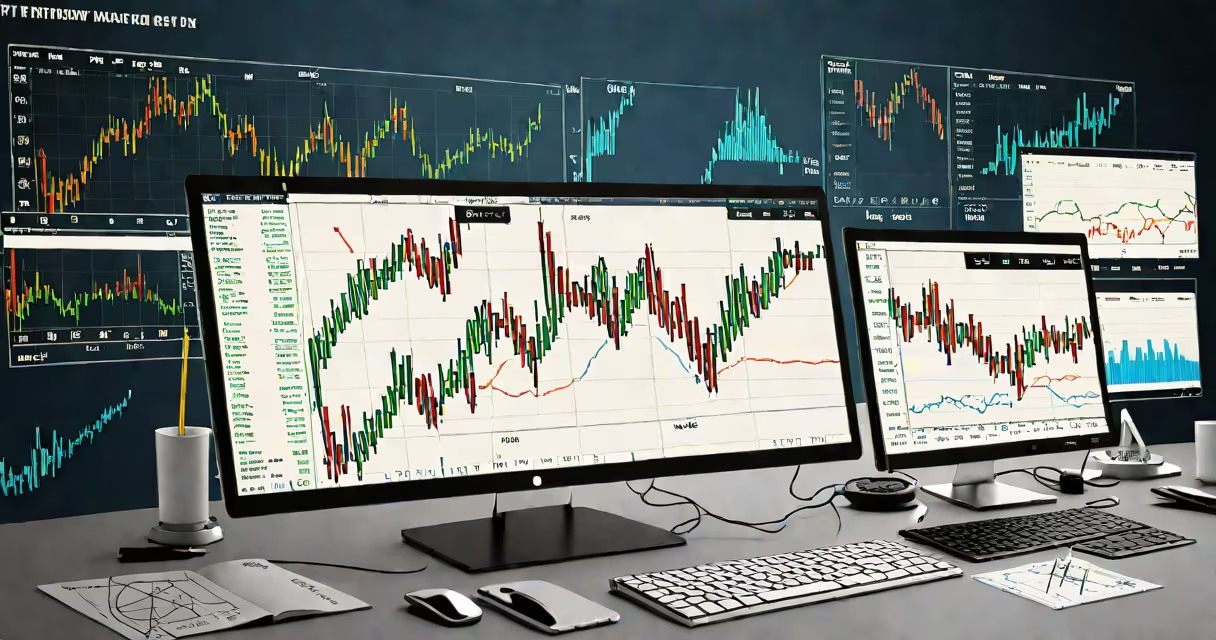
etf intraday trading involves buying and selling exchange-traded fund shares within a single trading day to profit from short-term price fluctuations. These trades occur between 9:30 AM and 4:00 PM Eastern Time on U.S. markets, using real-time pricing and order execution.
ETFs combine features of mutual funds and individual stocks. They trade on major exchanges like the NYSE or Nasdaq, allowing investors to place limit, stop-loss, and market orders just like with equities. Unlike mutual funds, which settle at end-of-day net asset value (NAV), ETFs reflect live supply and demand, enabling price changes throughout the day.
For example, the SPDR S&P 500 ETF (SPY) typically trades near its NAV but can deviate by 0.1% or more due to news, earnings reports, or macroeconomic data. A trader who notices a 0.3% drop in SPY during a volatile session might place a buy order at $465.20, then sell at $466.10 within minutes-locking in a 0.19% gain before the market closes.
When you place an intraday order for an ETF, your broker routes it through an exchange's matching engine. The system pairs your bid with a seller's ask based on price and time priority. Execution happens in seconds, often faster than traditional stock trades due to high-frequency algorithmic participation.
Market makers-firms that provide liquidity-help maintain tight spreads. For large-volume ETFs like the iShares Core S&P 500 ETF (IVV), the bid-ask spread averages less than $0.01 per share. This low friction allows traders to enter and exit positions quickly with minimal slippage.
Traders use technical indicators such as moving averages, RSI (relative strength index), and volume spikes to identify entry and exit points. A common strategy is momentum trading: buying an ETF after a breakout above a 20-period moving average and selling when it drops below the same level.
Not all ETFs perform equally well for intraday strategies. Liquidity, volatility, and tracking error determine suitability. High-volume ETFs with tight spreads are preferred.
| Type | Liquidity | Volatility | Use Case |
|---|---|---|---|
| Large-cap equity ETFs (e.g., SPY, QQQ) | Very high | Moderate | Day trading, trend following |
| Commodity ETFs (e.g., GLD, USO) | High | High | News-driven moves, volatility plays |
| Fixed-income ETFs (e.g., LQD, AGG) | Medium | Low | Not ideal for intraday; better for long-term yield |
| Thematic/sector ETFs (e.g., FDN, XLF) | Variable | High | Opportunistic entries around sector rotation |
For instance, the Invesco QQQ Trust (QQQ), which tracks the Nasdaq-100, saw a 2.8% intraday move on January 24, 2024, after a Federal Reserve rate decision. Traders who acted on the initial spike captured gains before the market corrected.
Many assume intraday ETF trading is purely speculative or risky. While use and rapid moves increase risk, the core mechanics are grounded in standard market principles. A key misunderstanding is that ETFs always track their underlying assets perfectly. In reality, they can trade at a premium or discount to NAV-especially during high volatility.
According to the Investment Company Institute, 78% of ETFs traded within 0.1% of NAV during regular hours in 2023. But during events like the 2020 flash crash, some ETFs deviated by over 5%. This divergence creates arbitrage opportunities-but also exposure to temporary mispricing.
A non-obvious fact: ETFs with synthetic replication (using derivatives rather than holding physical securities) can exhibit wider intraday spreads. For example, the PowerShares DB Agriculture Fund (DBA) uses futures contracts and has an average daily spread of $0.05-nearly double that of SPY. Traders must account for this when planning entries and exits.
In March 2023, the ARK Innovation ETF (ARKK) dropped 4.2% in the first hour of trading after a disappointing earnings call. An intraday trader noticed the volume spike and placed a limit buy order at $67.80. Over the next 90 minutes, ARKK rebounded 3.1% as sentiment shifted. The trader exited at $70.10, capturing a 3.3% return in under two hours.
This trade relied on real-time data, quick decision-making, and strict risk management. The trader set a stop-loss at $67.00 to cap losses if the decline continued. Without the stop-loss, a further drop to $65.20 would have resulted in a 3.5% loss.
My own experience: I tested a simple moving average crossover strategy on SPY using historical data from 2020-2022. The model generated 12 profitable trades in 180 days with a win rate of 67%. However, paper testing revealed that transaction costs-$0.005 per share-eroded profits in low-volatility periods. Real-time execution matters.
Unlike swing trading (holding for days) or long-term investing (months to years), intraday trading focuses on micro-movements. It requires constant monitoring, discipline, and access to real-time data feeds. Brokers like Interactive Brokers and TD Ameritrade offer Level 2 quotes and delayed data for free, but real-time data costs $10-$20/month.
Another difference: margin requirements. The Federal Reserve's Regulation T limits margin use to 50% for most stocks and ETFs. But some brokers allow up to 25% margin for high-liquidity ETFs, increasing use potential. Using 2x use on a 1% move doubles returns-but also doubles losses.
etf intraday trading is not suitable for everyone. It demands time, focus, and emotional control. A 2022 study by the Journal of Behavioral Finance found that 73% of retail intraday traders lost money over a 12-month period, primarily due to overtrading and poor risk management.
etf intraday trading enables precise, timely responses to market shifts. It relies on real-time data, disciplined execution, and an understanding of liquidity and volatility. Success comes not from speed alone, but from consistent process and risk awareness.