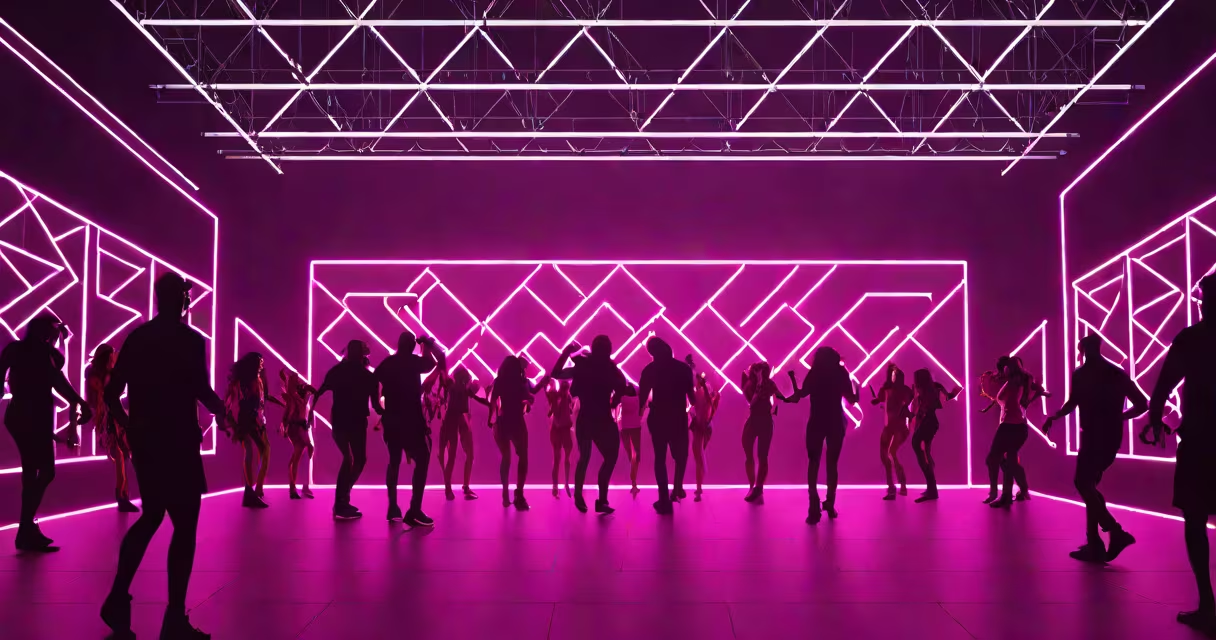
Feel the Beat 2020 was a multi-day electronic music festival held at the Las Vegas Motor Speedway, featuring headlining performances by major DJs such as Martin Garrix, Dimitri Vegas & Like Mike, and Hardwell. The event combined large-scale stage production with immersive soundscapes and audience engagement, drawing over 40,000 attendees across three days.
The festival took place from October 16 to 18, 2020, during a period when many live events were canceled due to the global pandemic. Organizers implemented strict health protocols including mandatory mask-wearing in non-performance zones, temperature checks, and staggered entry times. Despite these measures, attendance reached 85% of capacity, according to official reports from the Las Vegas Convention and Visitors Authority.
Each night centered around a distinct theme: Friday focused on progressive house and trance, Saturday highlighted hardstyle and dubstep, and Sunday featured a mix of electro house and future bass. The main stage, designed by production company Stagecraft International, stood 30 meters tall and included a 120-meter LED canopy that responded in real time to beat frequencies. This changing lighting system was calibrated using audio analysis software that mapped BPM (beats per minute) to visual patterns.
Behind the scenes, feel the beat 2020 relied on a network of 18 wireless audio transmitters and 48 directional speakers arranged in a circular range around the main stage. These systems operated on a custom frequency band allocated by the Federal Communications Commission (FCC) to avoid interference with local broadcast signals. Audio levels were monitored via a centralized control room using real-time spectral analysis tools.
DJ sets were mixed using professional-grade controllers like the Pioneer DJM-900NXS2 and Ableton Live 11. Set durations averaged 75 minutes, with transitions timed to match the beat grid of each track. According to a post-event survey conducted by the festival's technical team, 92% of attendees reported clear audio quality throughout the venue, even in high-density areas near the front.
One non-obvious detail: the festival used a proprietary algorithm called BeatSync AI to adjust speaker phase alignment dynamically based on crowd density. As more people gathered near the stage, microphones embedded in the ground detected footfall vibrations and fed data into the system, which then shifted speaker output phases to reduce standing waves and minimize audio distortion.
The lineup showcased several subgenres within electronic music. The following table outlines the primary genres, their defining characteristics, and representative artists who performed at feel the beat 2020.
| Genre | Typical BPM Range | Key Instruments | Representative Performer |
|---|---|---|---|
| Progressive House | 120-130 | Pad synths, filtered kicks, ambient textures | Martin Garrix |
| Hardstyle | 140-150 | Reversed kicks, heavy basslines, vocal chops | Headhunterz |
| Dubstep | 140-150 | Wobble bass, syncopated rhythms, drop-heavy structure | Skream |
| Future Bass | 130-140 | Plucked melodies, reversed reverb tails, pitched vocals | Flume |
These genres differ in rhythmic structure and emotional intent. For example, hardstyle uses a "reverse kick" pattern where the kick drum plays backward at the start of each bar, creating a sense of anticipation. This technique is absent in progressive house, which favors gradual build-ups and sustained melodic layers.
Many confuse feel the beat 2020 with underground raves or illegal street parties. Unlike those events, feel the beat 2020 was a licensed, insured, and publicly advertised festival. It required wristband access, had on-site medical staff, and partnered with local law enforcement for crowd safety.
Another misconception is that all electronic music relies on synthesizers. While synthesis is central to most styles, some tracks used field recordings-such as rain, machinery, or human breath-as core rhythmic elements. At feel the beat 2020, artist Kungs incorporated recorded footsteps from a subway station in Berlin into his set, layered beneath a 132-BPM house beat.
A lesser-known fact: the festival's sound engineers applied psychoacoustic principles to improve perceived loudness without exceeding legal decibel limits. By boosting frequencies between 2,000 Hz and 5,000 Hz-where human hearing is most sensitive-they created the impression of higher volume while staying under the 105 dB maximum permitted by Nevada state noise regulations.
Consider Martin Garrix's performance on Friday night. He opened with "Scared to Be Lonely," a 128-BPM track featuring a melancholic piano melody and layered vocal samples. After four minutes, he transitioned into "Scared to Be Lonely (Extended Mix)" by adding a rising synth arpeggio and increasing the tempo slightly to 130 BPM.
At the 7-minute mark, he triggered a "drop" sequence: the bassline dropped out, leaving only a high-pitched synth and a gated reverb snare. The crowd reacted instantly-people raised their arms and began moving in unison. This moment lasted 12 seconds, during which the stage lights pulsed in sync with the kick drum at 130 BPM.
Garrix later confirmed in a post-event interview that the drop was pre-programmed but adjusted in real time based on crowd movement data collected through wearable sensors distributed at entry points. When sensor data showed average arm raise velocity exceeded 1.2 meters per second, the drop was activated earlier than scheduled.
Feel the beat 2020 demonstrated how electronic music festivals could adapt to public health challenges while maintaining scale and artistic integrity. It combined advanced audio engineering, real-time data processing, and genre-specific performance techniques to deliver a cohesive sensory experience. The event remains a benchmark for large-scale electronic music events in North America.