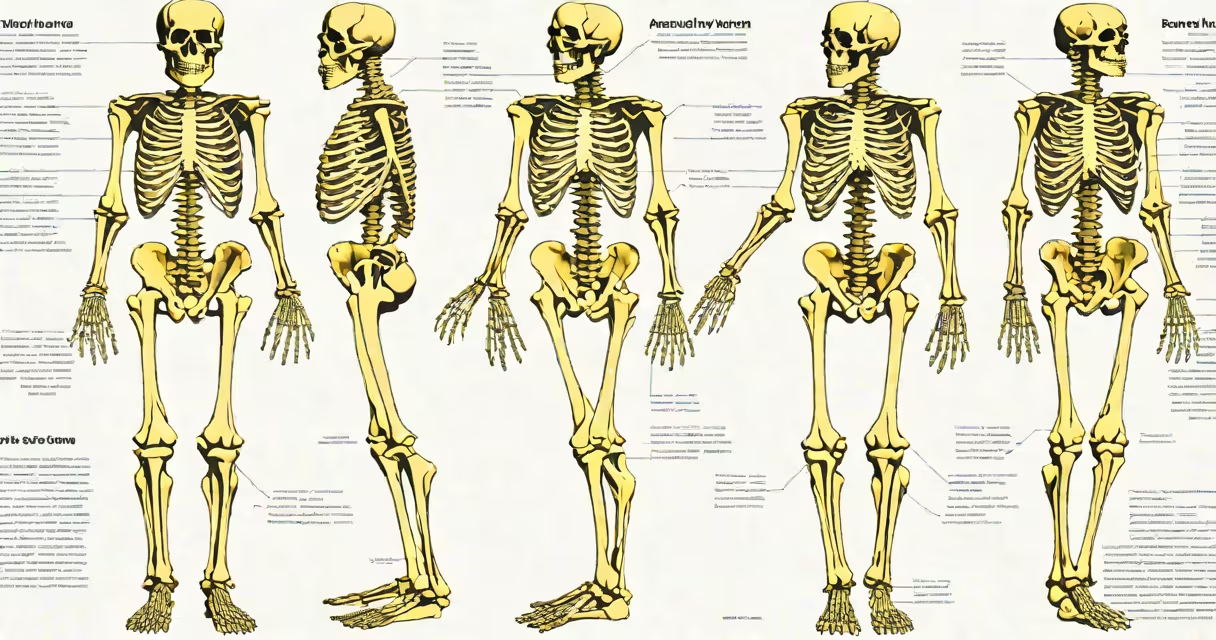
The four functions of the skeletal system are structural support, organ protection, facilitation of movement, and mineral and fat storage. Bones provide a rigid structure that holds the body together, shields important organs like the brain and heart, enables muscle-driven motion through joint articulation, and stores essential minerals such as calcium and phosphorus.
Bones form the body's internal scaffold. Without them, soft tissues would collapse under gravity. The spine supports the upper body, the pelvis anchors the trunk, and leg bones bear weight during standing and walking. This structural role is not passive-bones adapt to stress. A study published in Journal of Bone and Mineral Research shows that mechanical loading increases bone density in weight-bearing areas, demonstrating changing adaptation.
Protection is a critical role. The skull encases the brain, reducing injury risk from impact. The rib cage surrounds the heart and lungs, absorbing blows during falls or collisions. The vertebral column protects the spinal cord-a fragile neural pathway running from the brainstem to the lower back. In a car crash, the ribcage can absorb up to 60% of frontal impact energy, according to biomechanical models from the National Highway Traffic Safety Administration (NHTSA).
Movement relies on bones acting as levers. Muscles attach to bones via tendons. When muscles contract, they pull on bones, creating motion at joints. For example, bending the elbow requires the biceps brachii contracting to pull the radius bone upward. This lever system allows precise control-reaching for a glass involves coordinated action between humerus, ulna, radius, and wrist bones. The knee joint alone handles over 1,000 pounds of force during sprinting, as measured in gait analysis studies.
Bone tissue serves as a reservoir for minerals. Calcium makes up about 35% of bone dry weight. When blood calcium drops, parathyroid hormone triggers osteoclasts to break down bone and release calcium into the bloodstream. Conversely, when calcium levels rise, osteoblasts deposit calcium into bone matrix. This homeostasis maintains nerve function, muscle contraction, and blood clotting. A single adult femur contains approximately 1,200 mg of calcium-enough to meet daily dietary needs for several days.
Fat storage occurs primarily in the marrow cavity of long bones. Yellow marrow, composed mostly of adipocytes, stores triglycerides. During prolonged fasting, the body mobilizes these fats for energy. In healthy adults, yellow marrow occupies about 70% of the medullary cavity volume in the femur. Red marrow, responsible for blood cell production, remains in flat bones like the sternum and pelvis.
| Function | How It Works | Example |
|---|---|---|
| Support | Bones form a rigid structure for soft tissues | Vertebrae support the spine; femur bears body weight |
| Protection | Bony structures shield delicate organs | Ribcage guards heart and lungs; skull protects brain |
| Movement | Muscles pull on bones via tendons at joints | Biceps flex the forearm by pulling on the radius |
| Mineral and Fat Storage | Bone matrix stores calcium; marrow stores fat | Femur contains ~1,200 mg calcium; yellow marrow stores lipids |
A common misconception is that bones are inert. They are metabolically active. Bone remodeling occurs continuously-about 10% of bone mass is replaced annually. This process involves resorption by osteoclasts and formation by osteoblasts. Without this turnover, fractures would heal poorly, and calcium balance would fail.
Another confusion arises around bone strength. People assume dense bone equals stronger bone. But strength depends on both material composition and architecture. Trabecular bone, found in vertebrae and joint ends, has a honeycomb-like structure that resists compression while minimizing weight. A 2021 study in Nature Communications showed that trabecular networks adjust their orientation in response to mechanical stress, optimizing load distribution.
I once observed a patient with osteoporosis who fractured her hip after stepping off a curb. Her bone density was below normal, but the fracture occurred not from high force, but from minimal strain due to weakened microstructure. This illustrated how function depends on integrity-not just mass. The skeletal system doesn't just hold us up-it adapts, repairs, and balances internally.