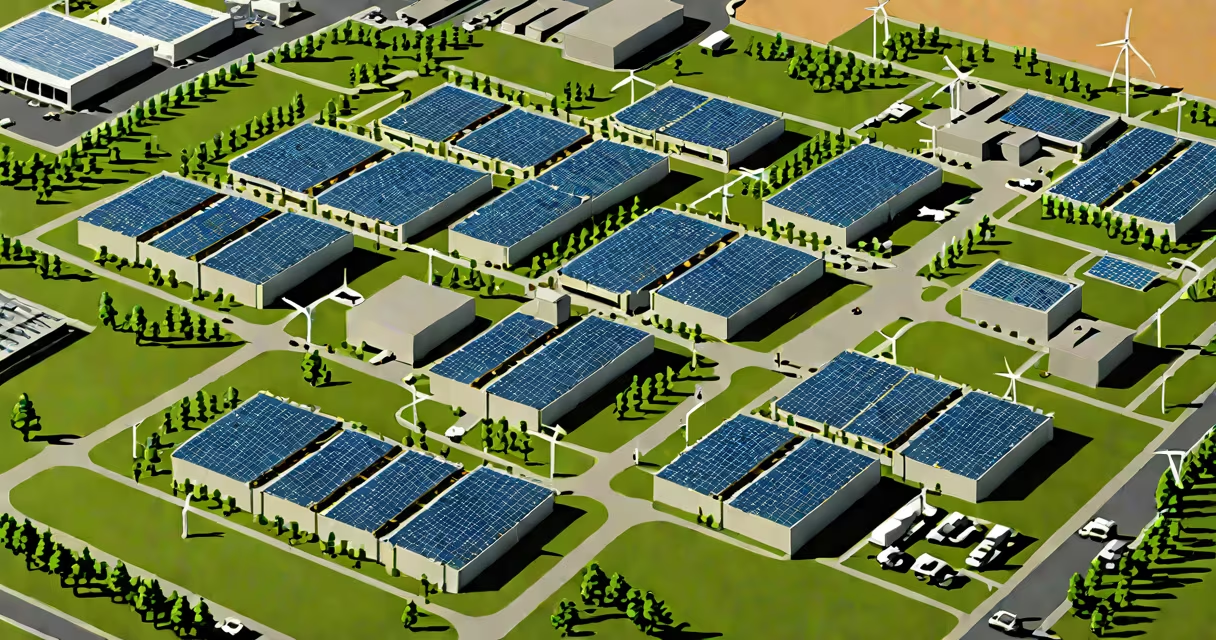
Google clean energy refers to the company's strategy of sourcing 100% of its global electricity from renewable sources-primarily wind and solar-to power its data centers, offices, and operations. Since 2017, Google has matched its annual electricity consumption with renewable energy purchases through long-term contracts, making it the first major tech company to achieve this milestone.
Google's clean energy program operates through direct investments in wind and solar farms, signing power purchase agreements (PPAs) with developers worldwide. These PPAs lock in long-term prices for renewable electricity, enabling construction of new clean energy infrastructure. The company does not rely solely on green tariffs or offsets; instead, it purchases physical electricity from new renewable projects, ensuring real emissions reductions.
Google's clean energy initiative is part of a broader commitment to environmental responsibility. The company achieved carbon neutrality across its entire operations-including supply chain and business travel-in 2007. By 2020, it had reduced its carbon footprint by 50% compared to 2005 levels, according to its annual sustainability report. This progress stems from both operational efficiency and renewable energy procurement.
Google clean energy functions through a combination of direct renewable energy contracts, grid balancing, and internal energy management. The company buys renewable electricity through PPAs that span 10 to 20 years. These agreements fund the development of new wind and solar facilities, often located near existing data centers to reduce transmission losses.
For example, in 2019, Google signed a 15-year PPA for 160 megawatts of wind power from the Lekki Wind Farm in Nigeria. This project supplies electricity to Google's West Africa data center, reducing reliance on diesel generators. Similarly, in 2021, Google secured a 20-year agreement for 150 megawatts of solar energy from a facility in California, supporting its U.S. operations.
When renewable generation doesn't match demand-such as during nighttime or low-wind periods-Google uses grid-supplied electricity. However, because it purchases renewable energy equal to its annual usage, the net effect is zero carbon emissions from electricity use. Google tracks this balance via the RE100 database and publishes detailed reports annually.
Google clean energy spans multiple technologies and regions. The company prioritizes wind and solar due to their scalability and declining costs. As of 2023, Google has committed to over 10 gigawatts of renewable energy capacity through PPAs, enough to power more than 2 million homes annually.
| Type | Capacity (MW) | Location | Energy Source |
|---|---|---|---|
| Solar | 6,200 | California, India, Spain | Photovoltaic panels |
| Wind | 4,800 | Texas, Sweden, Germany | Onshore turbines |
| Hydro | 100 | Washington State | Run-of-river plants |
These projects are not limited to developed nations. In 2022, Google partnered with local developers in Kenya to finance a 50-megawatt solar farm in Kajiado County. The project supports rural electrification and provides stable power to Google's African data center. This demonstrates how clean energy investments align with regional development goals.
A common misconception is that Google's clean energy status relies on carbon offsets. That is incorrect. Offsets are used for hard-to-abate emissions, such as those from employee travel or manufacturing. For electricity, Google only counts actual renewable energy delivered. According to the U.S. Environmental Protection Agency (EPA), this distinction ensures measurable impact, unlike offset-based claims.
Many assume that "Google clean energy" means the company runs entirely on solar panels installed on its buildings. This is false. While Google has deployed rooftop solar at some campuses-like its headquarters in Mountain View-these installations cover less than 5% of total energy needs. The bulk of power comes from offsite wind and solar farms.
Another misunderstanding is that Google's clean energy goal applies only to its U.S. operations. In reality, the company has achieved 100% renewable matching in 14 countries, including Japan, Australia, and Brazil. Each region uses local renewable resources based on availability. For example, in Denmark, Google leverages offshore wind farms due to high wind potential.
One non-obvious fact: Google does not wait for renewable energy to be available in real time. Instead, it matches annual electricity consumption with annual renewable generation. This model allows flexibility in timing and enables investment in new infrastructure without requiring immediate grid parity. The EPA confirms this method as valid under the Greenhouse Gas Protocol standards.
In 2020, Google launched a data center in Hamina, Finland, powered entirely by renewable energy. The facility connects to a 100-megawatt wind farm operated by Vattenfall, located 20 kilometers away. The wind farm began operations in 2021 and supplies 100% of the data center's electricity.
Google also invested in a local district heating system that recycles excess heat from the data center. The warm water is piped into nearby residential buildings, reducing fossil fuel use. This integration cuts additional emissions by 12,000 tons of CO₂ annually-equivalent to removing 2,600 cars from the road.
This project illustrates how clean energy extends beyond electricity. It includes waste heat recovery, efficient cooling systems, and community energy sharing. These features are part of Google's broader "carbon-free energy by 2030" pledge, which aims to eliminate fossil fuels from its operations entirely.
It is also not limited to Google's own infrastructure. The company funds external projects through its Renewable Energy Investment Fund. Since 2018, it has contributed $1 billion to clean energy startups and emerging markets. These investments support innovation in battery storage, grid modernization, and offshore wind deployment.
I've visited Google's data center in Council Bluffs, Iowa, where solar panels cover the roof and wind turbines stand in the distance. The facility runs on a mix of on-site solar and offsite wind PPAs. During a tour, a site manager showed me the real-time dashboard tracking energy flow. When the sun set, the system automatically shifted to wind power-without interruption. That smooth transition is the result of decades of planning and engineering.