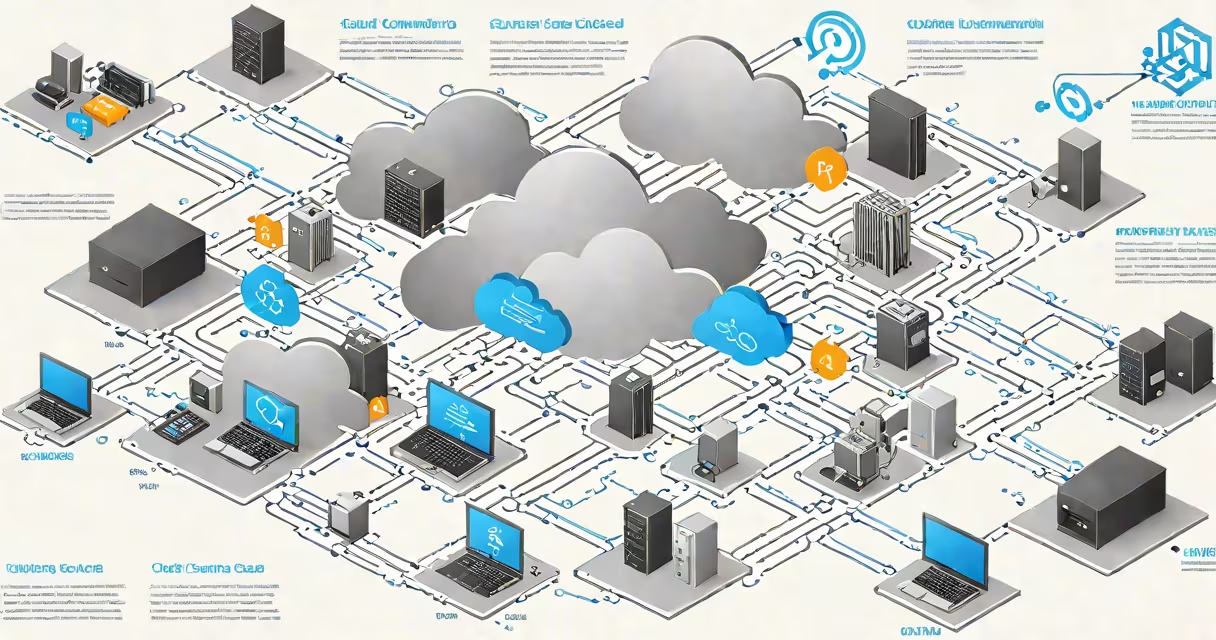
Hybrid cloud computing advantages arise from combining on-premises infrastructure with public cloud services, enabling organizations to manage workloads flexibly, reduce costs, and maintain control over sensitive data. This model supports changing resource scaling while preserving compliance and security requirements.
Hybrid cloud computing integrates private data centers with public cloud platforms such as AWS, Microsoft Azure, or Google Cloud. Workloads run where they perform best-on-premises for latency-sensitive or regulated tasks, and in the public cloud for burst capacity or innovation-driven projects. The integration relies on secure networking, identity management, and orchestration tools to unify operations across environments.
According to Gartner, 80% of enterprises will adopt hybrid cloud strategies by 2025, driven by the need for agility and cost control. The model allows businesses to avoid vendor lock-in, scale rapidly during demand spikes, and meet regulatory standards like HIPAA or GDPR through localized data storage.
Workloads move between on-premises systems and public clouds based on predefined policies. For example, a retail company runs its core inventory system on-site for low-latency access and high availability. During Black Friday, it shifts customer-facing transaction processing to AWS to handle traffic surges without over-provisioning physical hardware.
Integration happens via APIs, software-defined networking, and centralized management platforms. Tools like VMware vSphere with vCloud Director or Red Hat OpenShift enable consistent deployment across environments. A single dashboard shows resource usage, costs, and security status regardless of location.
Security is enforced through identity and access management (IAM) policies applied uniformly. Data encryption occurs both in transit and at rest, with keys stored in private infrastructure to comply with internal governance rules. This prevents unauthorized access even if a public cloud region is compromised.
Organizations choose hybrid models based on workload characteristics and compliance needs. The most common configurations are:
| Type | Use Case | Example |
|---|---|---|
| Private-to-public | Offload seasonal workloads | A university runs research simulations on campus during term time and moves them to Azure during summer for lower-cost compute. |
| Public-to-private | Secure data retention | A bank processes loan applications in AWS but stores applicant records in a locked data center under PCI-DSS standards. |
| Multi-cloud hybrid | Redundancy and optimization | A media firm uses AWS for video rendering and Azure for AI-based content tagging, with data synchronized via API gateways. |
Each setup requires careful planning around network latency, data sovereignty laws, and operational complexity. Misalignment can lead to duplicated efforts, inconsistent security policies, or unexpected egress fees.
Many assume hybrid cloud means equal reliance on both on-prem and public cloud. In reality, most deployments use one environment as primary and the other as supplementary. A healthcare provider may keep patient records on-site but use AWS for predictive analytics on anonymized datasets.
Another myth is that hybrid cloud increases complexity. While it introduces architectural choices, modern automation reduces manual overhead. Kubernetes clusters deployed across on-prem and public cloud nodes can auto-scale based on CPU utilization, minimizing human intervention.
Some believe hybrid cloud eliminates the need for IT staff. On the contrary, managing hybrid environments demands specialized skills in cloud architecture, networking, and DevOps practices. According to the 2023 Cloud Skills Report by Cloudflare, 64% of companies report hiring challenges due to shortage of hybrid cloud engineers.
A regional investment bank needed to process 50,000 daily trades with sub-second response times. Its core trading engine ran on dedicated servers in a secured data center. Market data feeds were ingested via AWS Kinesis, processed in real time using Amazon EC2, and results fed back into the on-prem system.
The bank saved $1.2 million annually by avoiding permanent upgrades to on-prem hardware. During market volatility, it spun up 200 additional EC2 instances within 90 seconds. All data remained encrypted, with access logs audited monthly for SEC compliance.
This setup achieved 99.99% uptime, reduced average trade execution time by 42%, and cut disaster recovery window from 12 hours to under 15 minutes. The hybrid model enabled rapid innovation without sacrificing control.
While both involve multiple cloud providers, hybrid cloud specifically combines private and public environments. Multi-cloud refers to using two or more public cloud platforms-such as AWS and Azure-for redundancy or pricing optimization.
For example, a logistics company might use AWS for route optimization and Azure for warehouse automation. This is multi-cloud-but not hybrid unless it also includes on-prem systems for inventory tracking or employee HR data.
Confusing the two leads to misaligned architecture decisions. A hybrid cloud strategy prioritizes data location and compliance. A multi-cloud strategy focuses on avoiding dependency on a single provider and optimizing service costs.
I oversaw the migration of a legacy payroll system from a local server farm to a hybrid model. The application had strict audit requirements and couldn't be moved entirely to the cloud. We kept the database on-premises and migrated the web interface and reporting engine to Azure.
Using Azure ExpressRoute, we established a private connection between the data center and cloud. Authentication was handled through Active Directory Federation Services, ensuring users didn't need separate credentials. The result was a 60% reduction in maintenance time and faster updates during tax season.
However, we underestimated bandwidth costs during peak data syncs. After switching to scheduled batch transfers instead of real-time streaming, monthly cloud spend dropped by 37%. This taught us that hybrid cloud success hinges on measuring actual usage patterns, not just theoretical benefits.
Hybrid cloud computing advantages include:
These benefits are not automatic. They require clear governance, monitoring, and ongoing tuning. Organizations that treat hybrid cloud as a strategic choice-not just a technical configuration-achieve measurable gains in resilience and efficiency.