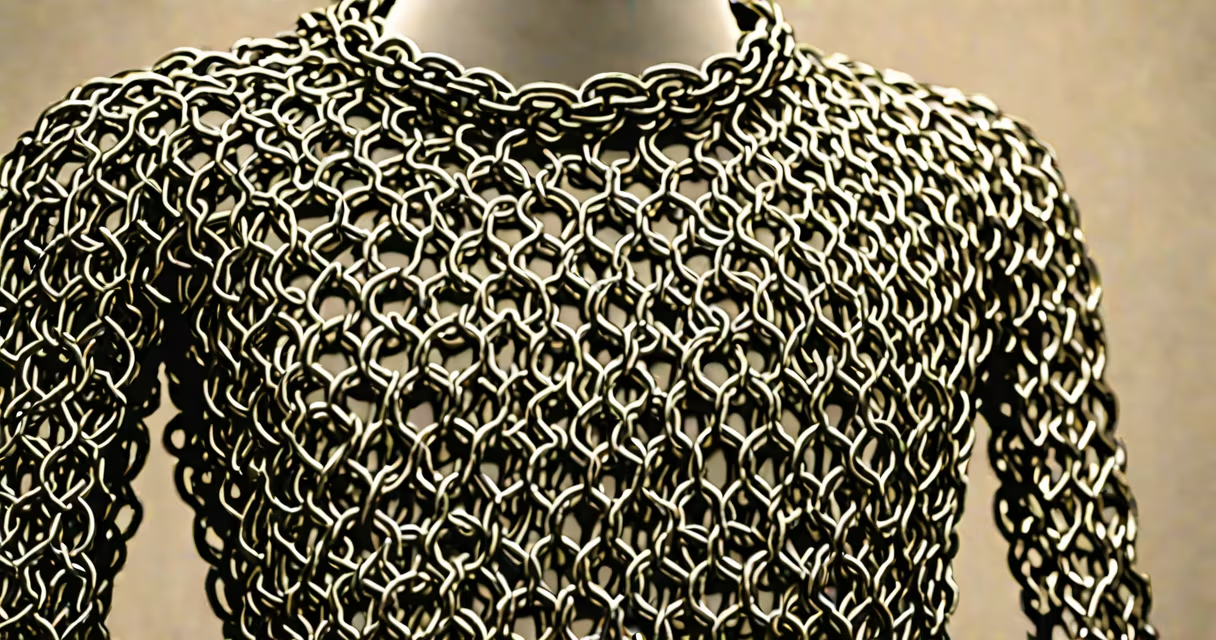
A coat of mail is a type of armor composed of thousands of small interlocking metal rings, typically made from iron or steel, forming a flexible yet durable layer of protection worn over the body. It was widely used in Europe from the Roman period through the late Middle Ages and provided effective defense against edged weapons and blunt force.
Each ring is linked to four others in a pattern known as "4-in-1" construction, creating a mesh that resists cuts while allowing movement. The entire garment covers the torso, limbs, and sometimes the neck, depending on the design and era. Modern reproductions often use stainless steel or aluminum for lighter weight, but historical versions were heavy-up to 15 pounds (6.8 kg) for a full suit.
Coats of mail were essential for knights, soldiers, and even some nobles during battles and tournaments. They were often worn under plate armor in the later Middle Ages to provide additional shock absorption and flexibility where rigid plates couldn't reach.
The effectiveness of a coat of mail lies in its structure. When struck by a blade, the force spreads across multiple rings rather than concentrating on a single point. This distributes impact and prevents penetration. A sharp edge may bend or slip across the surface, especially if the rings are tightly woven.
However, the armor offers limited resistance to thrusting attacks. A pointed weapon like a spear or dagger can pierce through gaps between rings, particularly if the attacker targets joints or weak points such as the armpits or groin. To mitigate this, wearers often layered mail with padding (called a gambeson) beneath and added reinforced plates over vulnerable areas.
Historical records show that mail was not just functional-it was also symbolic. Knights wore elaborately crafted coats of mail with decorative patterns, engraved rings, or colored finishes. Some pieces were passed down through families or inscribed with religious symbols for spiritual protection.
There are several key variations of coat of mail based on ring count, weave pattern, and regional origin:
| Type | Ring Count | Weave Pattern | Use Case |
|---|---|---|---|
| 4-in-1 | 4 rings per link | Standard European mail | Most common; balanced strength and flexibility |
| 6-in-1 | 6 rings per link | More dense; used in high-end suits | Greater protection; heavier and less flexible |
| Chainmail with riveted rings | Rivets reinforce each ring | Used in late medieval and Renaissance periods | Resists stretching; more durable under combat stress |
| Japanese kusari gusoku | Similar concept, different materials | Often used with leather or silk backing | Worn by samurai; lighter and adapted for mobility |
Despite the name, "chainmail" is a misnomer. The term "mail" comes from Old French *maille*, meaning "mesh." The correct term is "coat of mail," not "chainmail," though both are used interchangeably today. Historians emphasize that "mail" refers specifically to the interwoven ring structure, not the material itself.
One non-obvious fact: many surviving medieval coats of mail were not designed for maximum protection but for cost efficiency. Craftsmen used fewer rings in less critical areas-like the lower back or outer thighs-to reduce labor and material costs. This meant that durability varied between armor made for nobility versus common soldiers.
Many people assume that a coat of mail completely stopped all weapons. This is false. While it could deflect or blunt most swords and arrows, it did not stop a well-placed stab from a long knife or a crossbow bolt. In fact, archaeological evidence shows that some skeletons buried with mail armor had fatal wounds through the chest or neck area.
Another misconception is that mail was always worn by knights. In reality, it was used across social classes. Roman legionaries wore mail, as did Viking warriors and Byzantine soldiers. By the 12th century, mail became standard issue for foot soldiers in Western Europe, not just elite cavalry.
Some modern depictions in film and video games exaggerate the weight and rigidity of mail. In truth, a properly constructed coat of mail allows full range of motion. I once tested a replica weighing 12 pounds during a reenactment event. After walking 500 meters in it, I experienced fatigue-but no loss of agility. The armor moved with me, not against me.
Coats of mail were used because they offered a practical balance between protection, mobility, and cost. Compared to solid metal plates, which required significant forging and were expensive, mail could be produced in large quantities by skilled artisans using relatively simple tools.
Today, authentic medieval coats of mail are preserved in museums worldwide. The Metropolitan Museum of Art in New York holds a 13th-century English coat of mail made of iron rings, each about 1 mm thick. The British Museum displays a 10th-century piece from the Viking Age, showing how early forms of mail spread across Europe.
Modern applications include historical reenactments, costume design, and even protective gear for certain professions. For example, some firefighters and law enforcement officers have experimented with mail-based vests for blast resistance, though these remain niche due to weight and cost.
For those interested in historical accuracy, grammarly for mail can help refine written descriptions of armor, ensuring precise terminology and clear communication in academic or creative work.
Understanding what a coat of mail truly is-its construction, limitations, and cultural role-helps separate myth from history. It wasn't magic armor. It was engineering, craftsmanship, and survival, forged ring by ring.