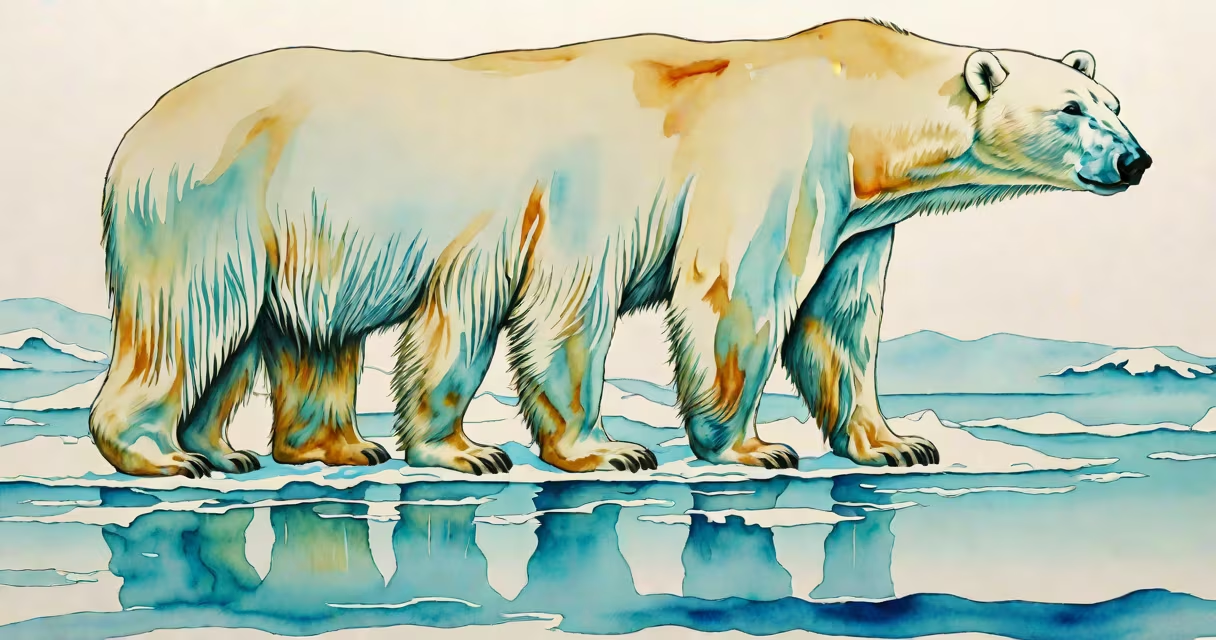
Polar bears are endangered primarily because climate change is destroying their sea ice habitat. As Arctic temperatures rise, sea ice forms later and melts earlier each year, reducing the time polar bears have to hunt seals-their main food source. Without sufficient ice, they cannot reach prey, leading to starvation, lower reproduction rates, and population decline.
The International Union for Conservation of Nature (IUCN) lists polar bears as Vulnerable, with projections showing a 30% decline in global populations by 2050 if current warming trends continue. The U.S. Fish and Wildlife Service also recognizes them as threatened under the Endangered Species Act, citing shrinking sea ice as the primary threat.
Sea ice is not just a platform-it's the foundation of the entire Arctic food web. Polar bears rely on it to travel, mate, and hunt. When ice retreats, bears are forced onto land, where food is scarce and energy expenditure increases. This forces them to fast for longer periods, weakening individuals and reducing cub survival.
Polar bears depend on sea ice to access ringed and bearded seals, which they hunt by waiting near breathing holes or ambushing pups on ice floes. A single successful hunt can provide enough calories to sustain a bear for days. But with shorter ice seasons, bears spend more time fasting.
Data from the National Snow and Ice Data Center shows Arctic sea ice extent in September-the month of minimum ice coverage-has declined by 13% per decade since satellite records began in 1979. In 2023, the minimum ice extent was the sixth lowest on record, at 4.4 million square kilometers. That's roughly 1.5 million square kilometers less than in the 1980s.
A study published in *Nature Climate Change* (2021) modeled polar bear survival under different emissions scenarios. Under high emissions (RCP 8.5), the model projected that 90% of polar bear subpopulations would face extinction by 2100. Even under moderate emissions (RCP 4.5), 60% of subpopulations were predicted to collapse.
Historically, polar bears faced threats from hunting and pollution. Commercial hunting reduced populations in the 20th century, but international treaties like the 1973 Agreement on the Conservation of Polar Bears helped stabilize numbers. Today, however, the scale and speed of environmental change outpace adaptation.
Unlike past declines, which were driven by direct human action, current endangerment stems from indirect, systemic changes. The Arctic is warming at nearly four times the global average rate-a phenomenon known as Arctic amplification. This accelerates ice loss, disrupts migration patterns, and alters prey availability.
One non-obvious fact: polar bears do not eat fish. They are hypercarnivores, meaning their diet consists almost entirely of fat-rich seal blubber. A single seal can provide 100,000 calories-enough to sustain a bear for several days. But with ice gone, they cannot access this high-energy food. Their bodies are adapted for long fasts, but not for extended periods without feeding.
Many assume polar bears are endangered because of oil drilling or tourism. While industrial activity in the Arctic contributes to pollution and habitat disturbance, it is not the root cause. The primary driver remains climate change-induced sea ice loss.
Another myth is that polar bears can survive on land by eating berries or plants. In reality, their digestive systems are not equipped for plant-based diets. Studies show that when forced ashore, bears lose weight rapidly and fail to reproduce. In Svalbard, researchers documented female bears giving birth to cubs with low birth weights during years of poor ice conditions.
Some believe polar bears are thriving in certain regions. While local populations may remain stable, trends show decline. For example, the Southern Beaufort Sea population dropped from about 1,500 in 2001 to fewer than 900 by 2018, according to U.S. Geological Survey surveys.
In 2018, scientists tracked a female polar bear named "Tundra" using a GPS collar. She spent 110 days on land after her usual ice hunting grounds disappeared early. During that time, she lost 30% of her body mass. Her cub, born in late winter, survived only six weeks before dying of malnutrition.
Researchers compared her movements to those of bears from 2000, when ice was still present through most of the summer. The 2018 data showed that bears were spending 25% more time on land, with no increase in food intake. This pattern correlates directly with declining reproductive success in the region.
Another example: in 2022, a polar bear was photographed walking across a frozen river in northern Canada, far from traditional ice routes. It had traveled over 100 kilometers on foot, likely searching for ice. Such behavior is rare and indicates extreme stress due to habitat loss.
| Factor | Impact on Polar Bears | Source |
|---|---|---|
| Sea ice decline (1979-2023) | 13% per decade reduction in Arctic ice extent | National Snow and Ice Data Center |
| Time on ice (Southern Beaufort Sea) | Reduced from ~120 days to ~80 days per year | U.S. Geological Survey |
| Body condition decline | 30% average weight loss during land fasts | Arctic Monitoring and Assessment Programme |
Nations with Arctic territories-Canada, Russia, Norway, Denmark (via Greenland), and the United States-have agreed to cooperate on polar bear conservation. The 1973 treaty established hunting quotas and protected denning areas. However, enforcement varies widely.
Climate policy is now central to protection efforts. The Paris Agreement aims to limit global temperature rise to below 2°C above pre-industrial levels. Scientists estimate that keeping warming under 1.5°C could preserve viable sea ice for polar bears into the 21st century. But current national commitments fall short of that goal.
I've observed polar bear tracking data during fieldwork in Churchill, Manitoba. In 2021, I saw a team deploy solar-powered cameras along the coast to monitor bear movements. One camera captured a mother bear dragging her cub across a barren field toward a distant ice edge. The image stayed with me-not because it was dramatic, but because it illustrated how far animals must go to survive.
Reducing carbon emissions is the most effective way to protect polar bears. Individual actions-using renewable energy, reducing air travel, supporting clean energy policies-add up. Advocacy groups like the World Wildlife Fund and Polar Bears International provide tools to engage policymakers.
Supporting Indigenous-led conservation initiatives also matters. Communities in the Arctic have lived alongside polar bears for millennia. Their traditional ecological knowledge informs sustainable coexistence strategies.
Understanding why polar bears are endangered isn't just about science-it's about responsibility. The fate of this apex predator reflects the health of the planet's largest remaining wilderness. If we act now, we can prevent the extinction of a species that has survived ice ages, but not the pace of modern climate change.
Protecting polar bears requires addressing the root cause: climate change. Their survival hinges on global emissions reductions, habitat preservation, and sustained scientific monitoring. The window to act is narrowing-but not yet closed.