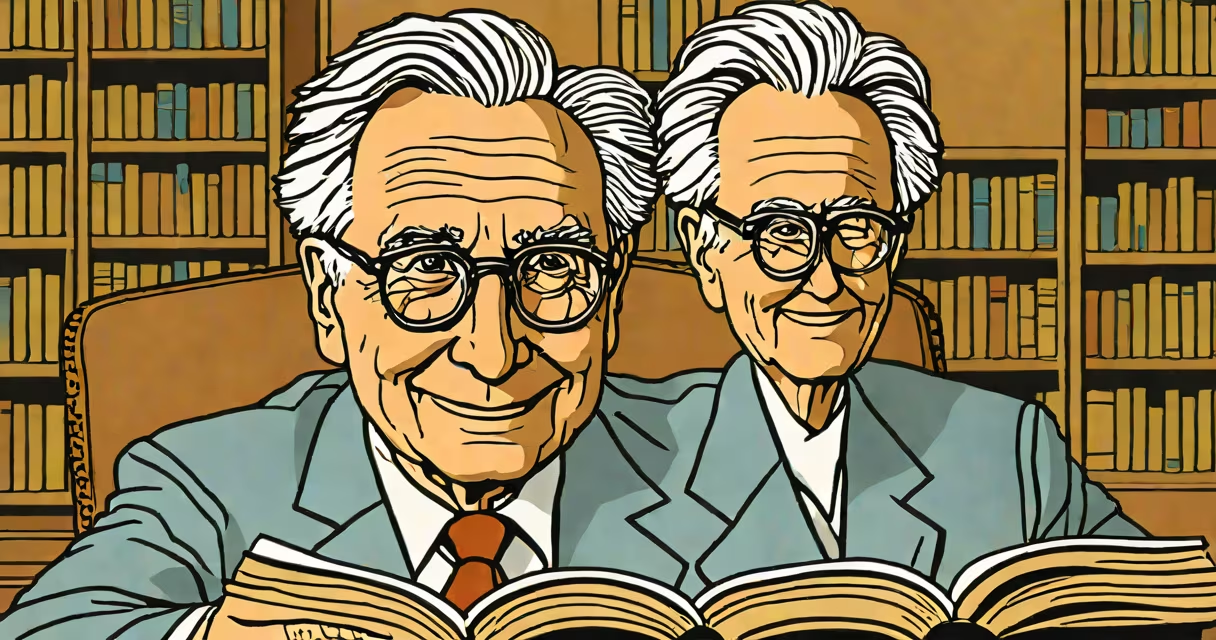
Viktor Frankl was an Austrian neurologist, psychiatrist, and Holocaust survivor who founded logotherapy-a form of existential psychotherapy centered on the belief that humans are driven by a primary motivation: the search for meaning in life. His 1946 memoir, *Man's Search for Meaning*, documents his experiences in Nazi concentration camps and establishes the core principle that even in extreme suffering, individuals retain the freedom to choose their attitude.
Frankl's work emerged from direct observation during imprisonment in Auschwitz and other camps. He noted that prisoners who held onto a sense of purpose-whether caring for a loved one, completing a manuscript, or simply enduring for another day-had higher survival rates. This insight led him to develop logotherapy, which posits that psychological health stems from identifying and pursuing meaningful goals.
Unlike Freudian psychoanalysis, which emphasizes pleasure and desire, or Adlerian theory, which focuses on power and achievement, Frankl argued that the deepest human drive is not to avoid pain but to find significance. He identified three ways to discover meaning: through creative work, love, and suffering when faced with unavoidable hardship. The latter, he believed, transforms pain into dignity.
Logotherapy operates on the premise that psychological distress often arises not from external events but from a perceived lack of meaning. When people feel their lives are pointless, they may experience depression, anxiety, or emotional numbness. Frankl's method aims to restore agency by helping patients identify values and purposes they can act upon.
Therapists using logotherapy do not interpret dreams or explore childhood trauma as central tasks. Instead, they ask patients: "What is your unique contribution?" or "What would you regret not doing?" These questions redirect focus from symptoms to potential. A patient struggling with grief might be guided to reflect on how their loved one's memory influences their daily choices.
One documented case involved a man paralyzed from the neck down after a car accident. He reported severe despair until Frankl asked, "If you were to die tomorrow, what would you want your legacy to be?" The man began writing letters to friends about forgiveness and resilience. Within weeks, his mood improved. This illustrates Frankl's belief that meaning is not discovered passively-it is created through action.
Frankl distinguished three sources of meaning:
These categories are not hierarchical. A person may derive meaning from attending a funeral (attitudinal), raising a child (creative), and sharing a meal with a friend (experiential). The key is intentionality-the ability to recognize meaning even in absence of comfort.
Frankl emphasized that meaning is not universal. What matters deeply to one person may seem trivial to another. He rejected the idea that life has a single predefined purpose. Instead, he described meaning as personal, context-specific, and changing-requiring constant re-evaluation.
A common misunderstanding is that logotherapy promotes positive thinking. It does not. Frankl explicitly warned against "meaning denial" in the face of reality. He wrote: "The last of human freedoms is to choose one's attitude in any given set of circumstances." This means accepting suffering while refusing to surrender to despair.
Many confuse logotherapy with motivational speaking or affirmations. Frankl did not advocate for "just stay positive." He acknowledged that suffering is real and unavoidable. His approach is not about minimizing pain but about reframing it. For example, a cancer patient may not overcome illness, but they can choose how to live within it-by writing a journal, teaching others, or expressing gratitude.
Another misconception is that Frankl's ideas apply only to extreme situations. In fact, his methods are used widely in clinical settings today. The American Psychological Association notes that meaning-centered therapy, derived from Frankl's work, shows measurable benefits in treating depression and chronic illness. A 2018 study published in *Journal of Clinical Psychology* found that patients receiving meaning-focused interventions reported lower levels of hopelessness compared to control groups.
Even secular institutions incorporate his principles. The U.S. Department of Veterans Affairs uses elements of logotherapy in programs for PTSD. Soldiers returning from combat often struggle with identity loss and moral injury. Therapists help them reconstruct narratives around service, sacrifice, and responsibility-not to erase trauma, but to integrate it into a coherent life story.
I once observed a group session at a rehabilitation center where a veteran with PTSD struggled to speak. After ten minutes of silence, the therapist asked, "What part of your time in service still matters to you?" The man paused, then said, "I still carry my dog's collar. I never gave it to anyone. That's what I remember." The room fell quiet. The act of preserving a small object became a symbol of commitment-not to war, but to care. That moment embodied Frankl's central idea: meaning is not found in grand gestures, but in the details we hold.
Frankl's influence extends beyond psychiatry. His writings have shaped education, business leadership, and spiritual counseling. The concept of "finding meaning" appears in corporate training manuals, university ethics courses, and even in crisis response protocols.
He taught at the University of Vienna and later at the University of Vienna Medical School. His books have sold over 15 million copies worldwide, translated into more than 50 languages. *Man's Search for Meaning* remains a staple in high school and college curricula, particularly in courses on philosophy, psychology, and ethics.
Despite widespread recognition, some critics argue that logotherapy oversimplifies complex mental health conditions. Others claim it lacks empirical rigor. However, recent research supports its efficacy. A 2021 meta-analysis in *Psychotherapy Research* confirmed that meaning-based therapies outperform placebo and standard cognitive-behavioral techniques in long-term outcomes for patients with treatment-resistant depression.
Frankl died in 1997 at age 92. He continued practicing until his final months. His final public lecture, delivered at age 88, was titled "The Will to Meaning." He said: "Life is not primarily a quest for pleasure, nor a quest for power, but a quest for meaning." This statement encapsulates the entire structure of his work.
Today, Viktor Frankl stands as one of the most influential figures in 20th-century psychology. His life and work demonstrate that even in the darkest hours, the human spirit retains the capacity to choose purpose. Understanding Viktor Frankl means confronting the reality that suffering cannot be avoided-but it can be transformed.