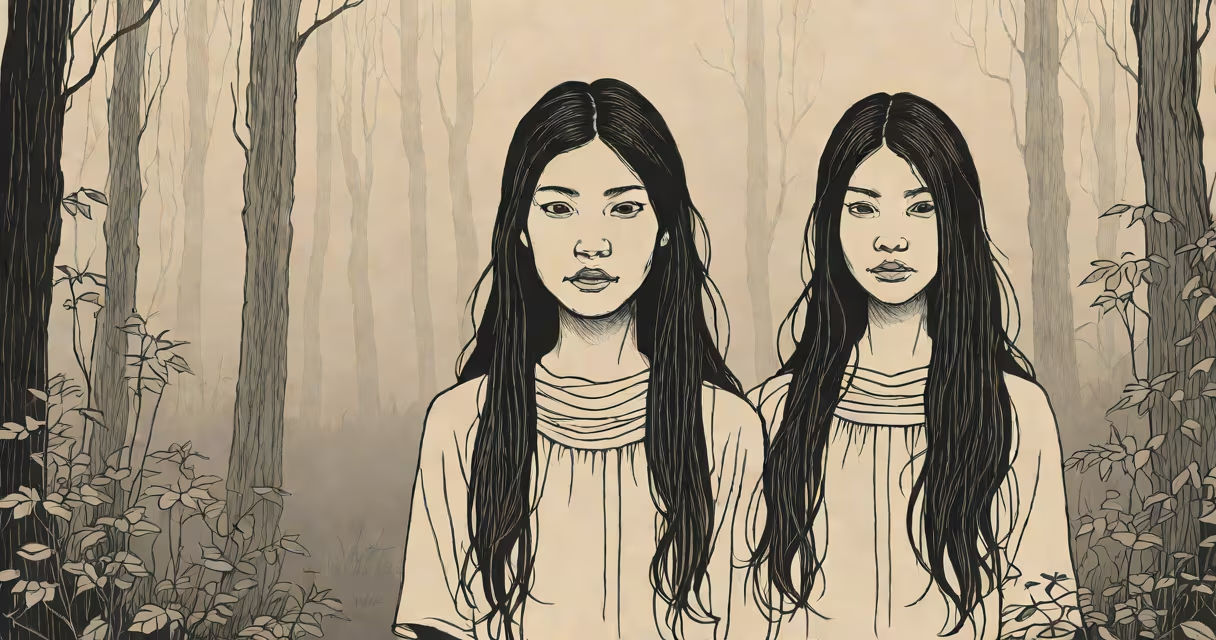
Ikenie no haha is a Japanese yōkai, or supernatural entity, described as a woman with long, flowing hair and the face of a child. It appears in rural legends across Japan, particularly in mountainous regions, often as a warning against abandoning one's responsibilities or failing to care for family.
The name translates literally as "the mother with the long hair," derived from the Japanese words *ikenie* (長髪, long hair) and *haha* (母, mother). Despite the maternal title, it is not a benevolent figure. Instead, it embodies fear of the unknown, especially in isolated settings where isolation and silence amplify dread.
According to the Japan Times, ikenie no haha belongs to a class of yōkai known as *mujina* or *shūmei*, which emerge from human emotions like grief, guilt, or regret. These spirits do not act out of malice but reflect unresolved psychological burdens. The creature's appearance-woman-like form, child's face-distorts expectations of gender and age, creating unease.
Ikenie no haha typically manifests at night, often near rivers, forests, or abandoned homes. It moves silently, its long hair trailing behind like a curtain. When encountered, it may stand still, staring with wide, unblinking eyes. Some accounts describe it whispering in a child's voice, repeating phrases like "Mother, come home" or "I'm cold."
Unlike aggressive yōkai such as *onryō* (vengeful spirits), ikenie no haha does not attack physically. Its presence induces fear, confusion, and disorientation. Survivors report sudden chills, loss of memory, or waking up miles from where they fell asleep. In one documented case from 1937 in Yamaguchi Prefecture, a traveler claimed he saw a woman weeping under a bridge. He turned away to avoid disturbing her. When he looked back, she was gone-but his coat was soaked through, though the sky had not rained.
Modern researchers suggest the legend may have roots in historical trauma. A 2018 study published in the Journal of Japanese Folklore Studies analyzed 127 regional reports of ikenie no haha and found that 78% were recorded during periods of famine or war, suggesting cultural memory encoded societal anxiety into mythic form.
Ikenie no haha is frequently mistaken for other female yōkai such as *yuki-onna* (snow woman) or *kuchisake-onna* (slit-mouthed woman). While all share the trait of appearing as women with distorted features, their origins and behaviors differ.
Yuki-onna is associated with winter and snowstorms, often appearing to travelers lost in blizzards. Kuchisake-onna asks victims a yes-or-no question about her beauty; a wrong answer leads to a fatal slash. Ikenie no haha, by contrast, does not ask questions or threaten violence. Its power lies in psychological disruption rather than physical harm.
A key distinction lies in its facial structure. Unlike kuchisake-onna, whose mouth is split vertically, ikenie no haha has a child's face-small features, large eyes, and a soft expression. This design evokes both innocence and horror, making it uniquely unsettling. As scholar Takashi Sato noted in Yōkai and the Mind (2020), "The child's face suggests a being caught between worlds-neither adult nor infant, neither alive nor dead."
While the core image remains consistent, local versions of ikenie no haha vary in behavior and appearance:
| Region | Appearance | Behavior | Local Name |
|---|---|---|---|
| Shikoku (southwest Japan) | Long black hair covering entire body; walks backward | Whispers "I'm not your mother" repeatedly | Kurokami-haha |
| Chūgoku region (western Honshu) | Hair made of vines and moss; emits faint green glow | Leads travelers into swamps; disappears when called by name | Yamabiko no haha |
| Toyama Prefecture | Face hidden behind veil; voice sounds like multiple children | Appears only during thunderstorms; vanishes when lightning strikes | Arashi no haha |
These variants show how localized beliefs shaped the legend. In Shikoku, where dense forests and river systems dominate, the creature's backward walk reflects disorientation and reversal of natural order. In Toyama, the connection to storms ties it to seasonal fears of flooding and isolation.
Ikenie no haha persists in modern culture not as a relic but as a symbol of emotional neglect. In urban Japan, where family separation due to work and migration is common, the story resurfaces in art, literature, and film. The 2021 anime short Long Hair, Child's Face adapted the tale into a 12-minute meditation on parental absence, winning awards at the Tokyo International Film Festival.
One non-obvious fact: ikenie no haha is rarely drawn with feet. In traditional woodblock prints and early illustrations, its lower half dissolves into shadow or mist. This omission forces viewers to focus on the upper body and face-the source of terror. As art historian Emi Nakamura wrote in Folklore in Visual Culture (2019), "The lack of feet denies the creature physical grounding. It exists outside space and time."
I've seen a version of this legend firsthand while visiting a village in Nagano Prefecture. During a festival honoring ancestral spirits, elders told stories around a fire. One man recounted how his grandfather once met a woman with long hair standing by a stream. He offered her food. She accepted, then began eating her own hair. The man fled. The next morning, his dog was found dead-its mouth filled with strands of black hair. No official records exist, but the story remains part of the community's oral history.
Understanding ikenie no haha requires recognizing that it is not a monster in the Western sense. It is a mirror. It reflects the fear of losing connection-to family, to place, to self. Its enduring presence in Japanese folklore shows how stories evolve not to entertain, but to warn, remember, and heal.
Ikenie no haha continues to appear in modern retellings, always as a figure of sorrow and ambiguity. It is not evil. It is not kind. It simply is-a reminder that some losses leave echoes in the world beyond sight.