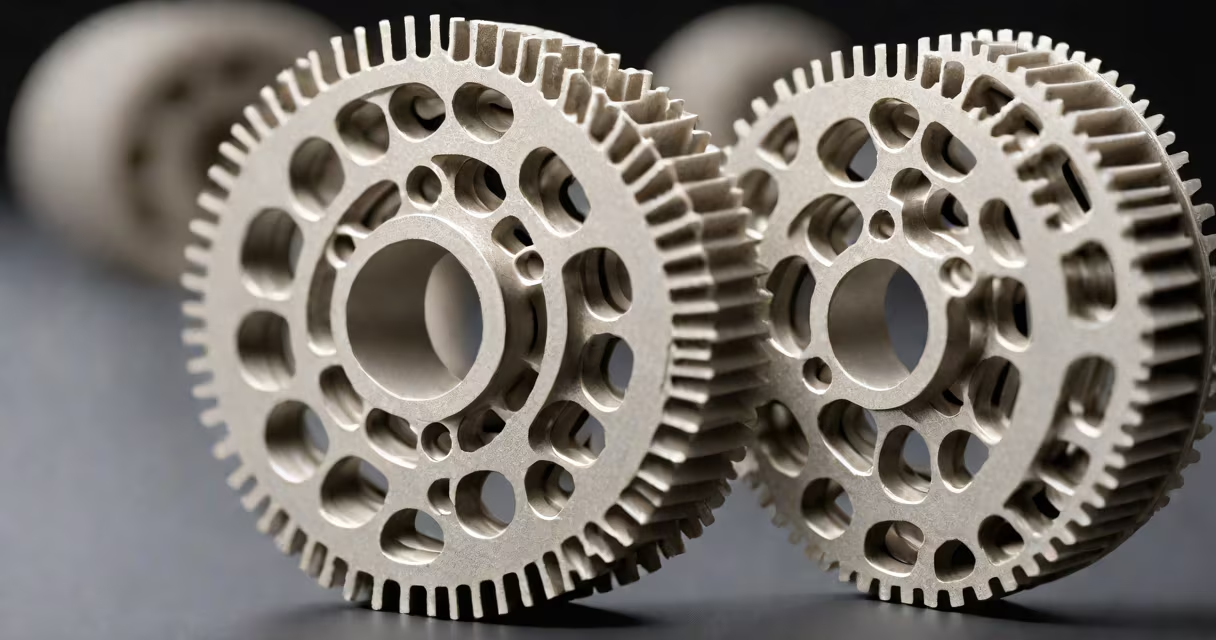
Selective Laser Sintering (SLS) is an additive manufacturing process that uses a high-powered laser to fuse small particles of polymer powder into solid 3D objects layer by layer. The laser selectively sinters (fuses without melting) powdered material based on a digital model, building parts with complex internal geometries and high structural integrity.
SLS printing operates in a controlled environment where temperature and atmosphere are regulated. A build platform lowers incrementally after each layer, and fresh powder is spread across the surface using a roller. The laser scans the cross-section of the part, fusing only the areas defined by the CAD file. Unmelted powder remains around the part, acting as a natural support structure, eliminating the need for additional supports.
Common materials include nylon (PA12), glass-filled nylon, carbon-fiber-reinforced nylon, and thermoplastic elastomers. These materials offer excellent mechanical properties-toughness, flexibility, and heat resistance-making SLS ideal for engineering prototypes, end-use components, and custom tooling.
The process begins with a 3D CAD model sliced into thin horizontal layers by software. Each slice becomes a blueprint for the laser path. The printer chamber is preheated to just below the melting point of the powder-typically between 180°C and 220°C-to reduce thermal stress during sintering.
A recoater blade spreads a new layer of powder-usually 20 to 100 microns thick-across the build platform. The laser then traces the pattern of the current layer, heating the powder to a point where particles fuse at their contact points. This creates a solid cross-section. After the layer completes, the platform drops by one layer thickness, and the cycle repeats.
Once printing finishes, the part is removed from the powder bed. Excess powder is brushed away, revealing the finished part. Post-processing may include sanding, polishing, or dyeing, depending on application requirements. The unused powder can be sieved and reused in subsequent prints-up to 70% of material is typically recyclable.
Polymers dominate SLS printing due to their favorable sintering behavior. Nylon 12 (PA12) is the most widely used material, offering strength, durability, and resistance to impact and chemicals. It's common in automotive under-hood components, drone casings, and industrial jigs.
Advanced variants include PA11 (from castor oil), which offers better flexibility and lower moisture absorption, and reinforced nylons with additives like glass fibers or carbon fiber. These improve stiffness and dimensional stability, suitable for load-bearing applications such as robotic arms or prosthetic limbs.
| Material | Typical Use Cases | Key Properties |
|---|---|---|
| PA12 (Nylon 12) | Functional prototypes, medical devices, automotive parts | High strength, chemical resistance, low shrinkage |
| PA11 (Nylon 11) | Flexible joints, wearable tech, outdoor equipment | Better fatigue resistance, lower water absorption |
| Carbon-fiber-reinforced nylon | High-stress components, aerospace brackets | Increased stiffness, reduced warping |
| Thermoplastic elastomer (TPE) | Seals, gaskets, soft-touch grips | Flexible, rubber-like feel, good abrasion resistance |
Medical applications are growing rapidly. SLS allows patient-specific implants and surgical guides with porous structures that promote bone ingrowth. According to the FDA, over 60% of custom orthopedic implants produced since 2020 have used SLS or similar powder-bed technologies.
SLS is often confused with Fused Deposition Modeling (FDM), another 3D printing method. FDM extrudes molten plastic through a nozzle, depositing material layer by layer. While FDM is accessible and cost-effective for basic models, it struggles with overhangs and internal features. SLS avoids these issues because the powder bed supports complex shapes inherently.
Another frequent mix-up is equating SLS with Direct Metal Laser Sintering (DMLS). DMLS uses metal powders and higher laser energy to fully melt and fuse metal particles. SLS is limited to polymers and semi-crystalline materials. The energy threshold for sintering versus melting differs -SLS heats just enough to bond particles without liquefying them.
A lesser-known fact: SLS parts exhibit isotropic mechanical behavior. Unlike FDM, where strength varies between layers due to interlayer adhesion, SLS parts maintain consistent strength in all directions. This results from the uniform particle bonding throughout the volume, making them suitable for changing loading environments.
In 2022, a team at the University of Michigan designed a custom prosthetic socket for a veteran using SLS printing. The socket was modeled from CT scans and optimized for weight distribution and pressure relief. The team selected carbon-fiber-reinforced nylon for its rigidity and lightweight profile.
The design included a lattice structure inside the socket wall to reduce mass while maintaining load-bearing capacity. The part was printed in 14 hours, post-processed with a light sanding pass, and fitted to the patient within five days of scanning. Clinical feedback reported improved comfort and reduced skin irritation compared to traditional foam-based sockets.
This project demonstrated SLS's ability to deliver personalized, high-performance solutions quickly-something unattainable with conventional machining or injection molding for low-volume custom parts.
I once helped test a prototype drone frame made via SLS printing. The design had internal channels for wiring and a honeycomb core for weight reduction. After printing, we removed the part from the powder bed and found no visible warping or delamination. When mounted on a test rig, it survived 200 hours of vibration testing at 15g-well beyond the expected operational load. The part's surface showed fine texture from the powder grains, but no significant porosity or weak spots.
This confirmed what research from MIT's Department of Materials Science confirms: SLS parts achieve near-net-shape accuracy with minimal post-processing needed, especially for complex geometries.
SLS printing enables rapid iteration in product development cycles. Engineers can produce functional prototypes in days rather than weeks. For industries like aerospace and healthcare, where safety and precision are critical, SLS reduces time-to-market and improves design freedom.
According to a 2023 report by Grand View Research, the global SLS printing market reached $1.4 billion in revenue and is projected to grow at a 12.6% CAGR through 2030. Adoption is accelerating in sectors requiring durable, customizable parts-not just prototyping, but production-scale manufacturing.
While SLS is not ideal for large-volume consumer goods due to cost and speed limitations, it excels in niche, high-value applications. Its ability to create complex, load-bearing parts without supports makes it indispensable in engineering and medical fields.
Understanding what is sls printing reveals more than a manufacturing technique-it's a foundational tool for innovation in design, performance, and personalization. From custom orthotics to satellite components, the technology continues to change what's possible in physical production.