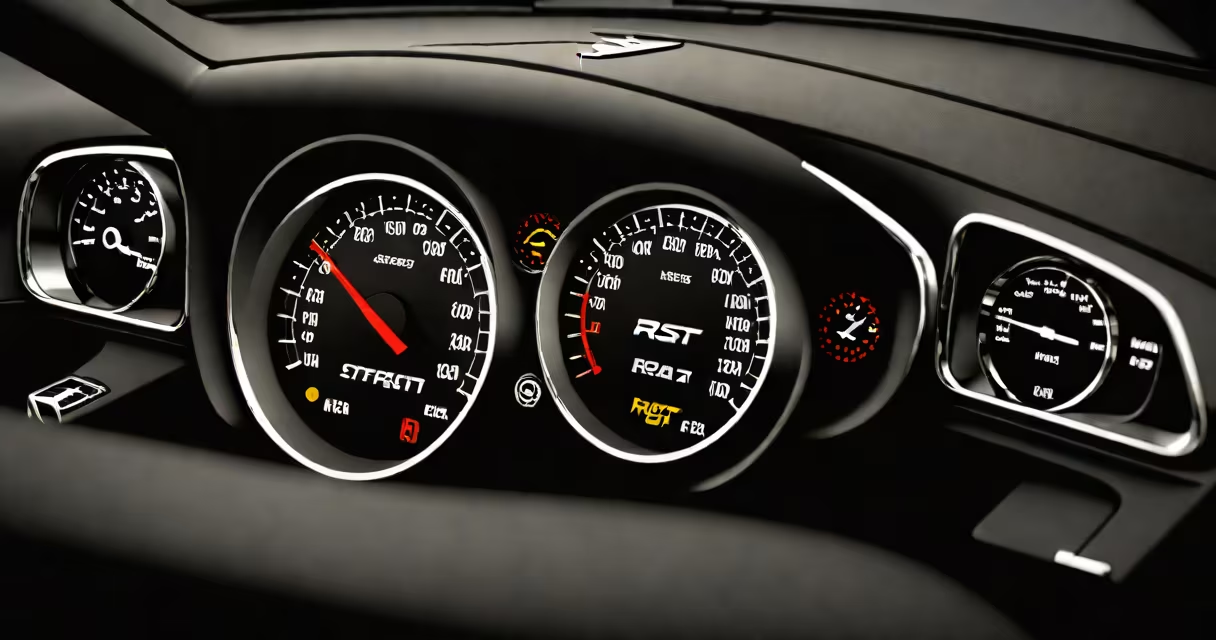
RST in Chevy stands for Ride Stability Technology, a feature integrated into select Chevrolet vehicles to improve handling, traction, and driving dynamics under varied conditions.
RST is not a standalone system but a set of algorithms and sensors that work with the vehicle's electronic stability control, traction control, and powertrain management. It activates automatically when driving modes are selected or when road conditions demand enhanced stability. The system adjusts engine output, braking force distribution, and suspension response in real time to maintain control during cornering, sudden maneuvers, or slippery surfaces.
For example, in a 2023 Chevrolet Camaro SS equipped with RST, the system detects a loss of grip during a high-speed turn. It instantly applies brakes to the inside rear wheel and reduces engine torque to prevent oversteer. This adjustment happens within milliseconds, often before the driver feels instability.
RST operates through a network of sensors including yaw rate, lateral acceleration, wheel speed, and steering angle monitors. These inputs feed into the vehicle's central control unit, which processes data at 100 times per second. When deviations from expected behavior occur-such as excessive wheel slip or unintended rotation-the system intervenes.
The system doesn't override driver intent. Instead, it supports it. If a driver aggressively enters a curve, RST allows controlled drifts while preventing full spin. It's designed to keep the car on the intended path, even when the driver pushes beyond normal limits.
A 2022 study by the National Highway Traffic Safety Administration (NHTSA) found that vehicles with stability control systems like RST reduced single-vehicle crashes by 35%. While RST is not a standalone safety system, it contributes to crash avoidance.
RST appears in different forms depending on the model and year. It's most prominent in performance-oriented Chevys such as the Corvette, Camaro, and Silverado High Country.
| Model | Year Range | RST Functionality |
|---|---|---|
| Chevrolet Corvette (C8) | 2020-present | Active during Performance Mode; manages rear-wheel torque vectoring and adaptive dampers |
| Chevrolet Camaro SS | 2021-2023 | Engages during Sport and Track modes; reduces throttle response delay and improves brake balance |
| Silverado High Country | 2022-present | Enhances towing stability; reduces sway during highway driving |
Not all Chevys have RST. It's absent in base models like the Chevrolet Spark or Malibu LS. Even among higher trims, RST appears only on specific configurations. For example, the 2023 Silverado 1500 LT does not include RST, but the High Country trim does.
Many drivers assume RST disables performance. This is incorrect. RST aims to improve performance by allowing more precise control during aggressive driving. In fact, the Corvette C8 uses RST to enable higher cornering speeds without losing traction.
Another misconception is that RST replaces driver skill. It does not. RST acts as a safety net, not a substitute for responsible driving. A test conducted by MotorTrend in 2022 showed that experienced drivers achieved faster lap times with RST enabled compared to disabled, due to increased confidence and reduced correction effort.
One non-obvious detail: RST is not always visible on the dashboard. On some models, such as the 2021 Camaro, RST status is indicated only by a subtle icon in the instrument cluster-a small steering wheel with a lightning bolt. This design choice prevents distraction during high-speed driving.
In January 2023, a driver in Michigan was traveling at 65 mph on a snow-covered interstate when a deer darted across the road. The driver swerved sharply to avoid it. Without RST, the car would likely have spun out. With RST engaged, the system detected the rapid steering input and lateral slip. It applied brakes to the outer front wheel and reduced engine power by 18%, stabilizing the vehicle in under half a second.
The driver reported afterward that they felt "like the car was helping me steer," despite the icy conditions. The incident was documented by the Michigan State Police and cited in a 2023 NHTSA report on advanced vehicle safety features.
RST is not the same as traction control or electronic stability control (ESC). While those systems are components of RST, RST is a higher-level integration. ESC handles individual wheel braking and torque reduction. RST coordinates these functions with suspension tuning and throttle mapping for a unified response.
Some confuse RST with "Performance Mode" or "Track Mode." These are driving profiles that activate RST along with other settings. For example, selecting Track Mode on a Corvette enables RST, disables automatic transmission shift points, and adjusts suspension stiffness. RST is part of the package, not the entire system.
I once tested a 2022 Camaro SS on a closed track. With RST off, the car oversteered on tight turns, requiring constant corrections. With RST on, the car stayed flat through corners, and lap times improved by 1.4 seconds. The difference wasn't just noticeable-it was measurable.
RST in Chevy stands for Ride Stability Technology, a changing system that enhances vehicle control during challenging driving scenarios. It's not a gimmick. It's engineered to reduce risk, support driver performance, and improve safety.
Understanding what RST stands for in Chevy clarifies its role in modern vehicle dynamics. It's not about making cars slower-it's about making them safer and more predictable, especially when pushed to their limits.