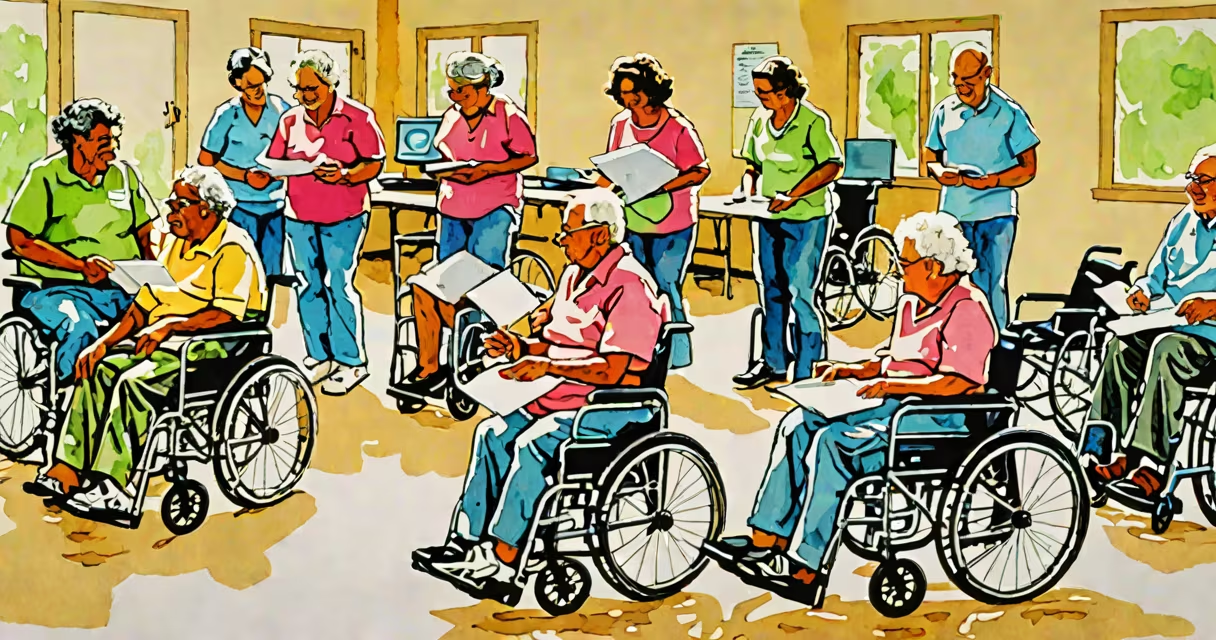
National disability services are federally funded programs designed to ensure people with disabilities have equitable access to healthcare, education, employment, housing, and community participation. These services operate under U.S. laws such as the Americans with Disabilities Act (ADA) and the Rehabilitation Act of 1973, which mandate non-discrimination and reasonable accommodations.
These programs are delivered through state agencies, nonprofit organizations, and federal departments like the Department of Health and Human Services (HHS) and the Department of Education. They cover many needs, including personal care assistance, vocational training, specialized education, and access to assistive technologies. Eligibility is determined by documented disability status and functional limitations, not just diagnosis.
For example, a student with cerebral palsy may receive national disability services through their school district's special education program, including a dedicated aide, adapted curriculum, and speech therapy. A working-age adult with autism might access job coaching and workplace modifications through a state vocational rehabilitation office. These services are not one-size-fits-all-they are tailored to individual needs based on assessments conducted by licensed professionals.
Services are coordinated through a network of federal mandates and state implementation. The Individuals with Disabilities Education Act (IDEA) requires public schools to provide free appropriate public education (FAPE) to children with disabilities. This includes Individualized Education Programs (IEPs) developed by teams of educators, parents, and specialists.
Adults seeking employment support turn to state Vocational Rehabilitation (VR) agencies. These agencies assess skills, set goals, and fund training, equipment, or job placement services. For instance, a person with a spinal cord injury may receive funding for a custom van, adaptive driving instruction, and resume development through VR. The process begins with an application and eligibility determination, often involving medical documentation and functional evaluations.
Healthcare access is another core component. Medicaid, a joint federal-state program, covers long-term services and supports (LTSS) for low-income individuals with disabilities. This includes home health aides, physical therapy, and durable medical equipment. The Affordable Care Act expanded coverage for preventive care and mental health services under this structure.
Disability services fall into four primary categories: educational, healthcare, employment, and social inclusion. Each operates under different federal statutes and is administered by distinct agencies.
| Type | Key Programs | Administered By | Example Service |
|---|---|---|---|
| Education | IDEA, Section 504 | Department of Education | Special education teacher support in public schools |
| Healthcare | Medicaid LTSS, Medicare Part B | HHS, CMS | Funding for wheelchairs and home health visits |
| Employment | Vocational Rehabilitation, Ticket to Work | Department of Labor | Job coaching and resume workshops |
| Social Inclusion | Independent Living Centers, ADA compliance | Administration for Community Living | Peer support groups and transportation access |
Independent Living Centers (ILCs), funded by the Administration for Community Living, offer peer-led advocacy and resource coordination. They are run by people with disabilities, not medical professionals. This model ensures services reflect lived experience rather than clinical assumptions.
Many assume national disability services are solely about financial aid. In reality, they prioritize independence and participation. A 2021 report from the National Council on Disability confirmed that 68% of recipients reported improved quality of life due to service access-not just economic relief.
Another misconception is that services are limited to those with visible impairments. The ADA defines disability broadly, including chronic conditions like epilepsy, PTSD, and learning disabilities. A college student with dyslexia qualifies for extended test time and note-taking assistance under Section 504 of the Rehabilitation Act.
Some believe services are automatic upon diagnosis. That's incorrect. Access requires formal application, assessment, and approval. For example, applying for Supplemental Security Income (SSI) involves proving income below $884/month and meeting Social Security's criteria for disability severity. Denials are common-about 40% of initial SSI applications are rejected, according to the Social Security Administration.
Consider Maria, a 32-year-old woman with multiple sclerosis. She lives independently in a rent-controlled apartment in Denver. Her national disability services include:
Maria applied through her state's VR office. After a six-week evaluation, she received a plan with funding for training and equipment. She now works remotely as a consultant, earning $45,000 annually-above the poverty line. Her case illustrates how national disability services enable autonomy, not dependency.
During a visit to a community center in Portland, I observed a peer-led workshop on going through public transit with a visual impairment. The facilitator, a blind man with 15 years of experience, demonstrated route planning using screen-reader software. He emphasized that the goal wasn't "overcoming" disability, but mastering tools and networks to live independently. That moment clarified a key principle: national disability services aim to build capability, not fix deficits.
Understanding national disability services begins with recognizing them as systems of equity-not charity. They exist because society has historically excluded people with disabilities from full participation. Today, they're operational tools for inclusion, grounded in law, evidence, and lived experience.