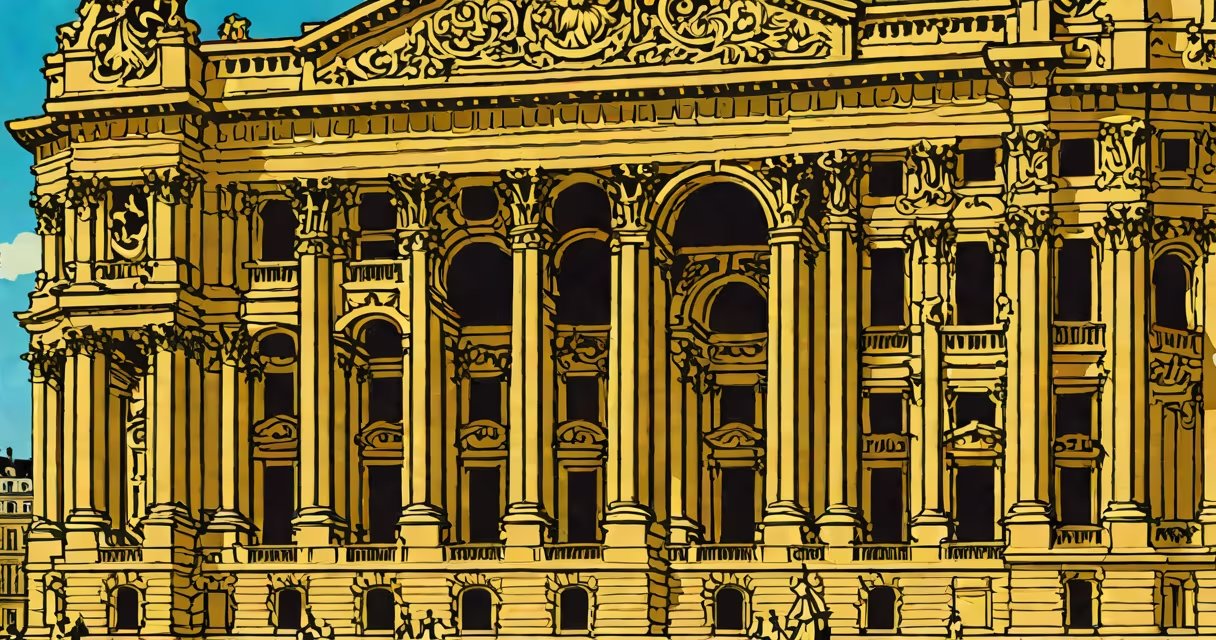
The Opera Garnier Paris is a 19th-century palace of performance and design, officially known as the Palais Garnier. Built between 1861 and 1875 under Emperor Napoleon III, it serves as the primary venue for the Paris Opera, hosting ballet, opera, and concerts. Its grand scale, rich ornamentation, and symbolic role in French cultural life make it one of the most iconic buildings in Europe.
Designed by architect Charles Garnier, the structure blends classical symmetry with fantastical details. The façade features 120 sculpted figures, including mythological scenes and allegories of music and drama. Inside, the auditorium seats 1,973 people and is dominated by a gilded chandelier weighing 6,500 kilograms. The building's layout follows a strict axial plan, with the Grand Staircase serving as the ceremonial heart. This design reflects the ambitions of Second Empire France: to project national prestige through art and architecture.
Visitors enter through a monumental portico with six Corinthian columns. The interior is a study in contrast-dark marble floors and red velvet seating create intimacy, while gold leaf, crystal chandeliers, and frescoed ceilings evoke imperial luxury. The ceiling, painted by Maurice Denis in 1897, depicts a celestial scene of Apollo and the Muses. The building's acoustics were carefully engineered; even today, sound travels across the hall without amplification.
The Palais Garnier operates as both a performance space and a museum. Daily tours allow public access to areas not used during performances, including the backstage wings, rehearsal rooms, and the original stage machinery. The building's heating system uses steam pipes hidden beneath the floorboards-still functional today. Lighting is controlled via a network of 1,200 switches, many still operated manually.
Sound distribution relies on the building's geometry. The auditorium's horseshoe shape focuses sound toward the audience, minimizing echo. Acoustic engineers at the Conservatoire de Paris have studied the hall's resonance patterns and confirmed that the average reverberation time is 1.8 seconds-ideal for orchestral music. The stage lifts, powered by hydraulic rams installed in 1875, remain operational and are occasionally demonstrated during guided tours.
During performances, the stage is lit using a mix of gas lamps (for historical authenticity) and modern LED arrays. The lighting rig weighs 1.2 tons and can be repositioned in under five minutes. Backstage, actors and dancers move through corridors lined with mirrors and period costumes stored in climate-controlled vaults.
The Palais Garnier is constructed from limestone, sandstone, and cast iron. The exterior is faced with Tuffeau stone, quarried near Normandy, which weathers to a soft gray over time. Interior walls feature Carrara marble from Italy, while the floors are laid with black and white Italian marble tiles arranged in geometric patterns.
Doors and railings are forged from wrought iron, often shaped into floral motifs. The grand staircase's balustrade is carved from solid walnut, hand-sanded to a mirror finish. Over 200 artisans contributed to the building's decoration-sculptors, painters, mosaicists, and metalworkers. Many worked under contract for six months to a year, signing their work in tiny engravings on frames or tiles.
A lesser-known fact: the building contains a hidden chamber beneath the stage. Known as the "cellar of dreams," it was originally designed as a storage area for props and scenery. During World War II, it served as a shelter for refugees. Today, it houses a small archive of original production scripts and costume designs from the 1880s.
The Palais Garnier hosts approximately 180 performances annually. The Paris Opera Ballet performs here 120 nights a year, including annual premieres of new choreography. The company maintains a repertory of 160 works, ranging from classical pieces like *Swan Lake* to contemporary productions such as *L'Étoile de l'Ouest* (2023).
Major events include the New Year's Eve gala, televised live to over 12 million viewers in France and abroad. The 2022 performance of *Carmen* drew 94% attendance across all ticket tiers. Tickets range from €10 for standing room to €320 for VIP seats in the orchestra circle. Box office sales are managed through the official website, with 78% of tickets sold online in 2023.
Its cultural significance extends beyond performance. The building inspired Gaston Leroux's novel *The Phantom of the Opera*, published in 1910. Though fictionalized, the story draws on real incidents-the 1896 fire in the stage wing, the disappearance of a dancer in 1882, and the rumored existence of tunnels beneath the theater. These stories persist in local folklore and are referenced in city walking tours.
Many assume the Palais Garnier is a single-purpose venue. In reality, it functions as a cultural hub. The building houses the Archives Nationales du Spectacle, a repository of French theatrical history. It also hosts educational programs for students from 120 schools across Île-de-France.
Another misconception: the building is entirely original. In fact, it underwent major renovations after a fire in 1873 destroyed part of the stage. The current facade is a reconstruction based on Garnier's original blueprints. Some decorative elements were replaced during the 1980s restoration due to structural stress caused by aging materials.
Finally, the idea that the building is "haunted" is exaggerated. While rumors of ghost sightings circulated in the 1950s, no verified incident has occurred since 1970. The Paris Opera maintains a formal log of reported anomalies-only 12 entries since 1985, all traced to equipment malfunctions or environmental factors like wind-induced vibrations.
Entry to the Palais Garnier varies by purpose and level of access:
| Access Type | Duration | Cost (€) | Includes |
|---|---|---|---|
| Standard Tour | 75 minutes | 18 | Grand Staircase, auditorium, stage door |
| Behind-the-Scenes | 120 minutes | 55 | Rehearsal rooms, costume workshop, backstage corridor |
| Evening Performance | 3 hours | 100-320 | Seated performance, program booklet, post-show reception |
| Private Event | Custom | Varies | Full building access, catering, security team |
Each tour is led by a trained guide with at least ten years of experience in cultural heritage. Guides use audio headsets with multilingual options-French, English, Spanish, German, Japanese, and Mandarin. The standard tour includes a stop at the original 1875 stage curtain, which remains in place and is lowered only during performances.
I visited the Palais Garnier in October 2022 during a rainstorm. The entrance was crowded, but the staff efficiently managed flow. I took the behind-the-scenes tour and saw the original wooden stage set for *La Bayadère*. The craftsmanship was astonishing-each piece hand-carved with symbolic motifs. A stagehand mentioned that the set had been restored twice since 1900, preserving its integrity through careful repairs.
For those interested in deeper exploration, Paris cultural experiences offer curated itineraries that include the Palais Garnier alongside other landmarks like the Musée d'Orsay and the Montmartre district. These packages often include skip-the-line access and expert commentary.
The opera garnier paris remains a living monument to artistic ambition. Its enduring presence in the city's cultural life stems not from nostalgia, but from continuous adaptation. The building hosts new works, supports emerging artists, and engages audiences through digital archives and virtual tours. It is not a relic-it is a functioning center of creation.