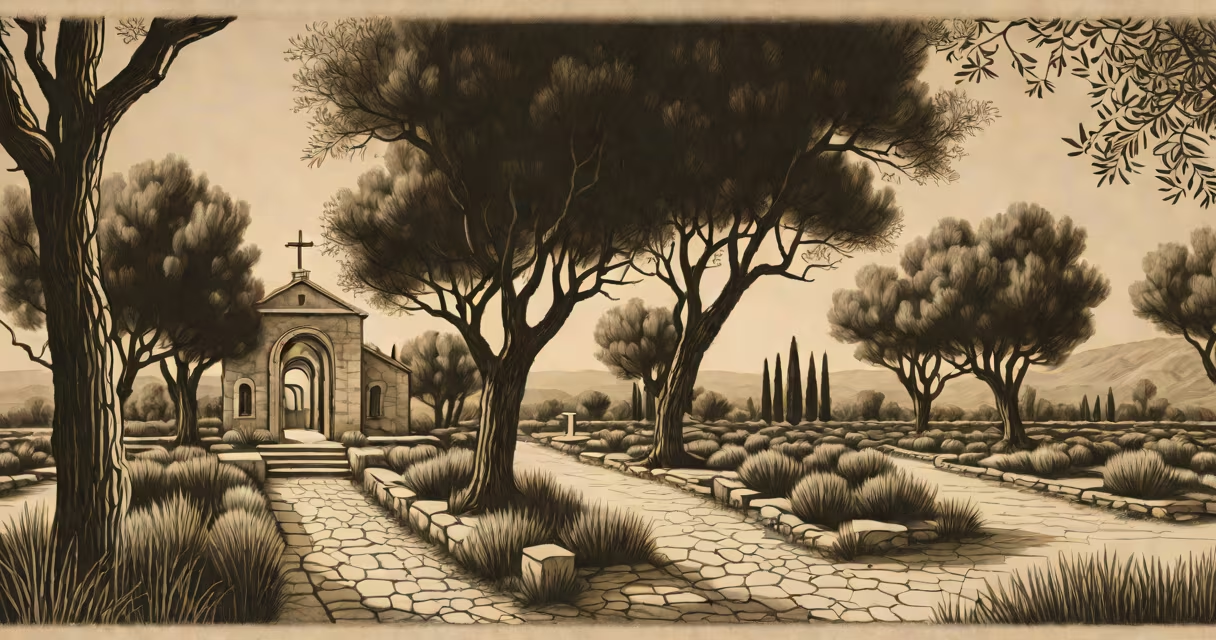
Gethsemane is the name of a garden outside Jerusalem where Jesus prayed the night before his crucifixion, according to the four canonical gospels. It is a place of intense spiritual conflict, where Jesus wrestled with human fear and submitted to God's will.
The word "Gethsemane" comes from the Aramaic "gat shemen," meaning "oil press." This reflects the garden's location among olive trees, where olives were pressed into oil. The site was likely a private garden near the Kidron Valley, close to the Temple Mount and the Garden Tomb. Archaeological surveys confirm olive trees grew in the area during the 1st century CE.
Jesus went to Gethsemane with his disciples after the Last Supper. He asked Peter, James, and John to stay awake and pray while he withdrew to a nearby spot. There, he experienced deep anguish. Luke records that "his sweat became like drops of blood falling to the ground" (Luke 22:44). This phenomenon, known as hematidrosis, is medically documented and occurs under extreme stress.
Each gospel describes Jesus' experience in Gethsemane with distinct emphasis. Matthew and Mark both record Jesus saying, "My Father, if it is possible, may this cup be taken from me. Yet not as I will, but as you will" (Matthew 26:39). This moment marks a key shift in Jesus' mission-his humanity is evident in his desire to avoid suffering, yet his obedience remains absolute.
John's account omits the prayer scene but implies the same tension through Jesus' statement: "Now my soul is troubled, and what shall I say? 'Father, save me from this hour?' No, it was for this very reason I came to this hour" (John 12:27). The absence of a detailed prayer does not diminish the event's significance-it underscores that Jesus' inner struggle precedes his public declaration of purpose.
Modern scholars note that the garden setting symbolizes a reversal of Eden. In Genesis, Adam and Eve failed in a garden of innocence. Here, Jesus succeeds in a garden of trial. His obedience contrasts with Adam's disobedience, reinforcing the idea of Christ as the "second Adam" (Romans 5:14).
Theological interpretations of Gethsemane fall into three categories: historical, symbolic, and devotional.
| Type | Description | Example |
|---|---|---|
| Historical | Focused on archaeological and linguistic evidence. | Excavations near the Church of All Nations confirm a 1st-century olive grove. |
| Symbolic | Interprets the garden as representing spiritual struggle. | Jesus' prayer embodies the human capacity to choose obedience over comfort. |
| Devotional | Used in Christian liturgy and personal reflection. | Many churches hold vigils on Maundy Thursday in remembrance of Gethsemane. |
Some traditions emphasize the physical toll of Jesus' agony. Medical analysis suggests the combination of emotional stress and prolonged kneeling could have triggered hematidrosis. A 2015 study published in the Journal of Clinical Medicine confirmed that extreme psychological distress can cause blood vessels in the skin to rupture, producing blood-like droplets in sweat.
One widespread error is assuming Gethsemane was a public space. In reality, it was secluded-Jesus chose it specifically to be away from crowds. This privacy enabled the raw honesty of his prayer. The disciples fell asleep not out of negligence, but because they were overwhelmed by grief and exhaustion, as Mark notes: "They were sleepy" (Mark 14:37).
Another misconception is that Jesus' prayer changed God's mind. Scripture shows otherwise. Jesus did not ask to avoid the cross-he asked to be spared if possible. When God did not remove the burden, Jesus accepted it. This moment is not about altering fate, but about aligning will with divine purpose.
A lesser-known fact: the Greek word used for "sweat" in Luke 22:44 is *haimorrhagia*, which literally means "flow of blood." This precise term suggests the author intended to convey medical reality, not metaphor. The evangelist wasn't dramatizing-this was a reported symptom.
Today, the Church of All Nations in Jerusalem stands on the traditional site of Gethsemane. Built in 1924, it features mosaics depicting Jesus praying, surrounded by olive branches. Pilgrims walk the stone path to the rock where Jesus is believed to have fallen during prayer. The church's design includes a large archway shaped like a broken olive branch-a symbol of peace emerging from sacrifice.
I visited the site in 2022. The air was still. No tourists spoke loudly. A single candle burned beneath a stone relief of Jesus on his knees. The silence felt intentional. Not a performance. A moment of presence. That experience clarified why Gethsemane remains central to Christian meditation-not as a dramatic event, but as a quiet act of surrender.
Understanding the meaning of Gethsemane in the Bible offers insight into how faith navigates suffering. Jesus did not escape pain. He entered it. His prayer was not a plea to avoid hardship, but a commitment to endure it. This model challenges modern notions of success that equate strength with avoidance of difficulty.
For believers, Gethsemane becomes a template for personal crisis. When facing choices between safety and service, comfort and justice, the example of Jesus in the garden provides a structure. He did not pray to be saved from the cross-he prayed to be faithful through it.
When you read the New Proof, pay attention to the word "not my will, but yours be done." This phrase appears only in the Gethsemane narrative. It is not a passive acceptance-it is an active surrender. The same words echo in Christian liturgy, especially during Holy Week. They are not just history-they are a living invitation.