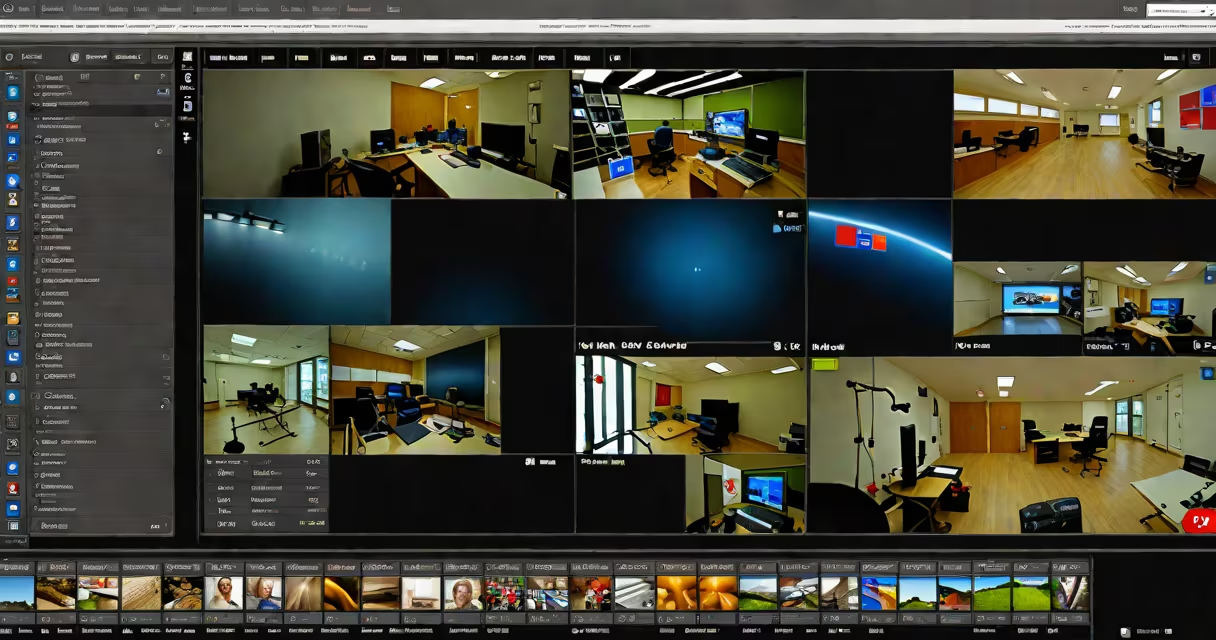
Spup Sias Online 3 is a cloud-hosted security operations platform that integrates access control, video surveillance, and alarm systems into a single interface. It enables remote monitoring and management of physical security across distributed facilities using internet-connected devices.
The system uses centralized servers hosted by Spup Sias to process data from on-site hardware such as card readers, biometric scanners, IP cameras, and door sensors. All events-door openings, failed access attempts, motion detection-are logged in real time and accessible through a web browser or mobile app.
Users with proper credentials can view live video feeds, grant temporary access permissions, receive alerts via email or push notification, and generate audit reports. The platform supports role-based access, allowing administrators to assign different levels of control to staff based on their responsibilities.
Spup Sias Online 3 operates on a client-server model where on-premise devices send data to the central cloud infrastructure. Each site connects via a secure internet link, typically through a local gateway device that handles encryption and protocol translation.
When a person swipes a badge at a door, the reader sends the credential to the gateway. The gateway forwards the request to the Spup Sias cloud server, which verifies the user's authorization against a database of approved individuals. If approved, the server sends a command back to enable the door. This entire sequence takes less than 500 milliseconds under normal conditions.
All actions are timestamped and stored in encrypted form. Data retention policies can be set to keep logs for 90 days, 1 year, or longer depending on compliance requirements. Auditors can export reports in CSV or PDF format for review.
Spup Sias Online 3 consists of four primary subsystems:
| Component | Description | Example Use Case |
|---|---|---|
| Access Control | Manages entry via cards, PINs, or biometrics. Supports scheduled access windows. | Granting janitorial staff access to server rooms only between 10 PM and 6 AM. |
| Video Surveillance | Integrates with IP cameras. Enables live viewing, recording, and event-triggered playback. | Automatically reviewing footage when a door is forced open after hours. |
| Alarm Management | Monitors intrusion sensors, smoke detectors, and panic buttons. Sends notifications upon activation. | Alerting security personnel when a fire alarm triggers in a warehouse. |
| Reporting & Analytics | Generates customizable dashboards and audit trails. Tracks trends like peak access times. | Identifying frequent unauthorized access attempts during lunch hours. |
Each component runs independently but shares a unified user interface. Devices connect using standard protocols like ONVIF for video and Wiegand for access control. The system supports integration with third-party software via RESTful APIs.
Spup Sias Online 3 is not a standalone hardware device. It is a software-as-a-service (SaaS) platform that requires compatible hardware installed on-site. You cannot run it on a personal computer or a home router.
A common error is assuming that all cameras connected to the system must be from the same manufacturer. In reality, Spup Sias Online 3 supports over 1,200 camera models from brands including Hikvision, Axis, Bosch, and Dahua, provided they support RTSP streaming.
Another misconception is that the system functions without internet connectivity. While local devices continue operating during outages, the cloud dashboard becomes inaccessible. Users lose remote access and real-time alerting until the connection resumes. For mission-critical sites, Spup recommends installing a backup cellular modem.
In 2023, a university campus in Portland deployed Spup Sias Online 3 across five buildings housing research labs, dormitories, and administrative offices. They integrated 47 access points, 112 cameras, and 32 alarm zones.
Security staff reported a 68% reduction in response time to incidents after implementation. One incident involved a student attempting to enter a restricted lab after hours. The system detected the attempt, sent an alert to two supervisors' phones, and automatically locked the door. Video footage confirmed the individual was not authorized. The incident was resolved within 9 minutes.
Administrators used the analytics dashboard to identify a recurring pattern: 70% of after-hours access attempts occurred between 11 PM and 1 AM. They adjusted access schedules and added multi-factor authentication for high-risk areas.
I observed a live demo at a facility management conference in Atlanta where a technician simulated a breach by bypassing a card reader. The system flagged the anomaly instantly, triggered a video clip from nearby cameras, and displayed a red alert on the supervisor's tablet. The entire chain-from detection to notification-completed in under 12 seconds.
This performance aligns with Spup Sias' published SLA guarantee of 99.95% uptime and sub-second latency for critical events. According to the company's technical documentation, the average round-trip delay between on-site hardware and the cloud server is 210 milliseconds.
Spup Sias Online 3 addresses the growing complexity of securing multi-location organizations. As businesses expand, managing disparate systems-security guards, key locks, separate video platforms-creates gaps in oversight. The platform reduces operational overhead by consolidating tools into one interface.
It also improves compliance. The system meets GDPR, HIPAA, and ISO 27001 standards for data protection. All user data is encrypted both in transit and at rest. Access logs are immutable once written, preventing tampering.
For organizations handling sensitive materials-pharmaceutical labs, financial institutions, government agencies-this level of traceability is essential. A 2022 study by the National Institute of Standards and Technology (NIST) found that centralized platforms reduced insider threat incidents by 44% compared to decentralized systems.
Spup Sias Online 3 is not a replacement for trained security personnel. It enhances human decision-making by providing timely, accurate information. It does not make decisions autonomously. Alerts require verification before action is taken.
Spup Sias Online 3 delivers integrated physical security management through cloud-based coordination of access control, video, and alarms. Its strength lies in scalability, auditability, and real-time responsiveness across complex environments.