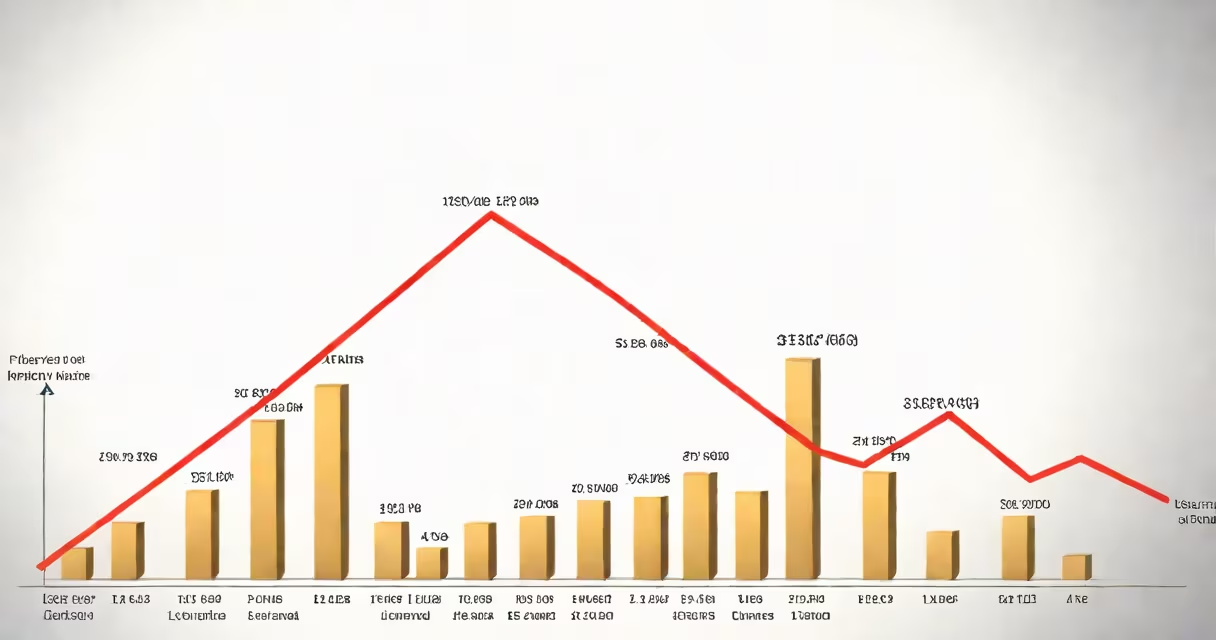
The rate of interest is the percentage charged or paid for the use of borrowed money, representing the cost of credit or the return on savings. It applies to loans, mortgages, credit cards, and investment accounts, and is typically expressed annually.
When you borrow $10,000 at a 5% annual rate of interest, you owe $500 in interest after one year, assuming simple interest. This rate is set by lenders based on risk, inflation, and central bank policy. The Federal Reserve's benchmark rate influences most U.S. interest rates, including those on mortgages and credit cards.
Interest rates are not static. They fluctuate due to economic conditions. For example, during periods of high inflation, central banks often raise rates to cool spending. In 2022, the Federal Reserve increased its federal funds rate from near zero to 5.25% to combat rising prices, directly affecting mortgage and auto loan rates.
Interest accrues over time. Simple interest calculates only on the original principal. Compound interest adds interest to the principal each period, so interest earns interest. A $1,000 deposit at 3% annual interest compounded monthly grows to $1,030.42 in one year - slightly more than the $1,030 from simple interest.
Lenders use credit scores, income, and collateral to determine individual interest rates. Borrowers with higher credit scores qualify for lower rates because they pose less default risk. A borrower with a FICO score above 760 may receive a 3.5% rate on a car loan, while someone with a score below 600 could face 12% or more.
Financial institutions apply the rate to the outstanding balance daily or monthly. Credit card balances accumulate interest daily using a daily periodic rate derived from the annual percentage rate (APR). A 19.99% APR translates to approximately 0.0548% per day. On a $1,000 balance, that's about $0.55 in interest per day.
Interest rates fall into several categories based on structure and application:
| Type | Description | Example |
|---|---|---|
| Fixed Rate | Remains constant over the loan term. | A 30-year mortgage at 6.5% for 30 years. |
| Variable Rate | Changes periodically based on a benchmark index. | A credit card with a rate tied to the prime rate plus 5%. |
| Prime Rate | Benchmark rate used by banks for their best customers. | As of April 2024, the prime rate was 8.5%, according to the Federal Reserve. |
| Annual Percentage Rate (APR) | Includes fees and interest, giving a full picture of borrowing cost. | A loan with a 7% interest rate and $200 in origination fees has an APR of 7.4%. |
Some rates are adjustable. Adjustable-rate mortgages (ARMs) start low but increase after an initial period. A 5/1 ARM has a fixed rate for five years, then adjusts annually based on a market index. After the initial period, a borrower could see their rate rise from 4% to 6.5% depending on market movements.
Interest rates affect nearly every financial decision. Higher rates make borrowing expensive, reducing consumer spending and business investment. Lower rates encourage borrowing and spending, stimulating economic growth.
For savers, higher rates mean greater returns. A $10,000 savings account at 2% annual interest earns $200 in a year. At 5%, it earns $500. But rates don't always reflect real purchasing power. If inflation is 3%, a 5% return still loses 2% in real value.
When refinancing a home, the new rate of interest replaces the old one. Refinancing from a 6% mortgage to a 4% rate reduces monthly payments by $250 on a $300,000 loan. That's $30,000 saved over 10 years. However, refinancing costs - typically 2% to 5% of the loan amount - can offset gains if you don't stay long enough.
One common mistake is confusing the nominal rate with the effective rate. The nominal rate is the stated percentage. The effective rate accounts for compounding. A 6% nominal rate compounded monthly results in an effective annual rate of 6.17%. This difference matters over time. Over 10 years, $10,000 grows to $18,194 at 6.17% effective interest, versus $18,114 at 6% nominal.
People often assume that a lower interest rate always means better value. But the total cost includes fees, terms, and compounding. A loan with a 4% rate and $1,000 in fees may cost more than a 5% loan with no fees.
Another error is treating all interest rates as equal. A 2% rate on a $100,000 loan is $2,000 per year. But on a $1 million loan, it's $20,000. Scale matters. Also, interest rates on credit cards are typically much higher than on personal loans because they're unsecured and carry higher default risk.
One non-obvious fact: interest rates can be negative. In 2016, the European Central Bank set a negative deposit rate of -0.4% to encourage lending. Banks charged customers to hold deposits, pushing money into circulation. Negative rates are rare in the U.S., but they illustrate that interest is not always a cost - it can be a penalty for holding cash.
During the 2008 financial crisis, the Federal Reserve cut the federal funds rate to 0-0.25% to stabilize markets. This lowered mortgage rates to historic lows, enabling many homeowners to refinance and reduce payments. By 2010, average 30-year fixed mortgage rates dropped to 4.5%, down from 6.5% in 2007.
I once analyzed a student loan portfolio for a nonprofit. One borrower had a 6.8% interest rate on a $25,000 loan. After five years, they'd paid $4,300 in interest. But when we recalculated with monthly compounding, the actual interest was $4,410 - a $110 difference. Small numbers grow quickly under compounding.
The rate of interest is not just a number - it's a changing force shaping borrowing, saving, investing, and economic behavior. Knowing how it works, how it's calculated, and how it changes empowers smarter financial decisions.