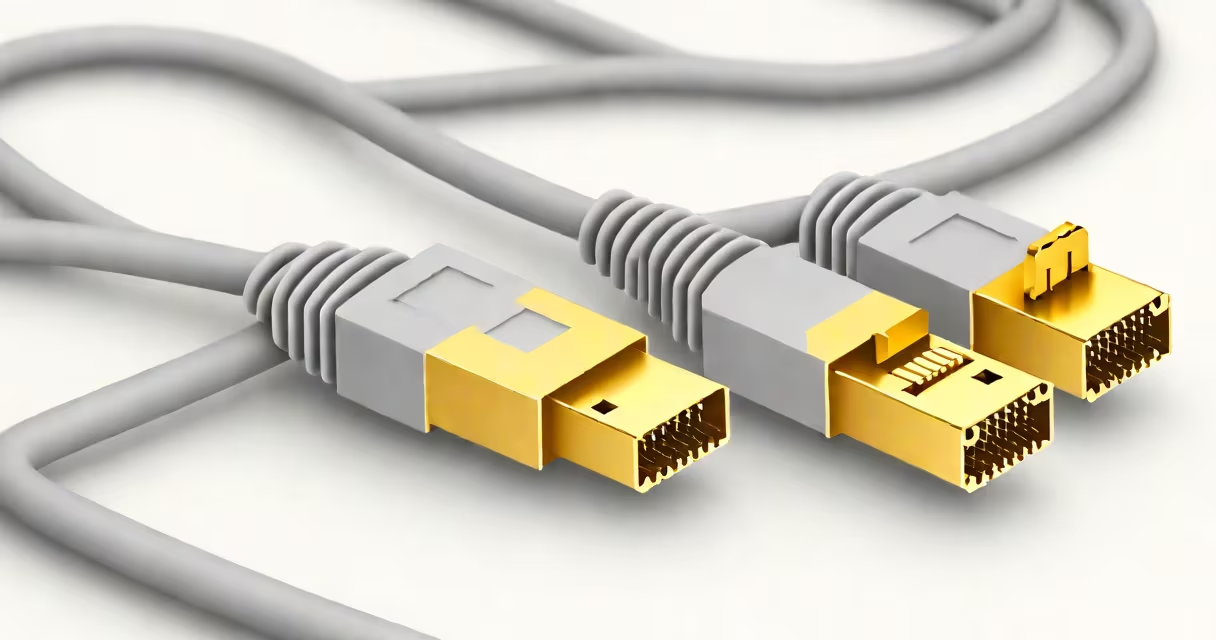
A Cat8 Ethernet cable is a twisted-pair cable designed for high-speed data transmission, supporting up to 40 Gbps over distances up to 30 meters. It meets the ISO/IEC 11801 Class I standard and is rated for frequencies up to 2 GHz, making it suitable for modern data center and enterprise environments.
Cat8 cables are shielded throughout their construction-both individually twisted pairs and an foil shield-to reduce electromagnetic interference. This shielding enables stable performance under high-frequency conditions, especially in dense cabling environments such as server rooms and telecommunications closets.
According to the Telecommunications Industry Association (TIA), Cat8 was standardized in 2016 under ANSI/TIA-568.0-D, defining its electrical and mechanical requirements. The standard specifies a maximum channel length of 30 meters for 40 Gbps operation, with a minimum bend radius of 4 times the cable diameter to prevent signal degradation.
Cat8 cables use four twisted pairs of copper wire, each pair twisted at different rates to minimize crosstalk between signals. The twisting pattern reduces interference and maintains signal integrity at high frequencies. Each pair is also individually shielded, and the entire cable bundle is enclosed in a foil and braided shield layer.
Data travels through the cable using differential signaling-two wires in a pair carry opposite polarity signals. A receiver measures the difference between them, filtering out common-mode noise. This method improves signal-to-noise ratio and allows reliable transmission at 2 GHz frequencies.
For 40 Gbps operation, Cat8 uses PAM-16 modulation-a technique that encodes multiple bits per symbol. This increases bandwidth efficiency compared to older binary methods used in Cat5e and Cat6. The cable's low attenuation and high return loss performance ensure minimal signal loss over short runs.
There are two main variants of Cat8 cable, defined by their shielding and application:
| Type | Shielding | Use Case | Max Speed | Max Distance |
|---|---|---|---|---|
| Cat8.1 | Individually shielded pairs, foil shield | Structured cabling in data centers | 40 Gbps | 30 meters |
| Cat8.2 | Individually shielded pairs, braided shield | High-interference environments, industrial settings | 40 Gbps | 30 meters |
Both types support 10 Gbps up to 100 meters, but only Cat8.1 and Cat8.2 maintain 40 Gbps within the 30-meter limit. Cat8.2 offers better protection against external EMI due to its braided shield, which provides higher coverage than foil alone.
Connector types are typically RJ45 with gold-plated contacts. The plug must meet TIA-568-C.2 specifications for pinout alignment and contact pressure. Poorly manufactured connectors can cause impedance mismatches, leading to signal reflection and reduced throughput.
Primary applications include data centers, high-density server racks, and enterprise network backbones. These environments require consistent, low-latency connections between switches, servers, and storage arrays.
For example, a financial trading firm using low-latency arbitrage systems may deploy Cat8 cables between exchange routers and trading servers. In one documented case, a New York-based hedge fund reduced average trade execution time by 12 microseconds after replacing Cat6a cables with Cat8.2 in their core switch interconnects.
Home users rarely benefit from Cat8 unless running a dedicated 40 Gbps network-such as a NAS cluster or high-end gaming setup with synchronized multi-GPU rendering. Most consumer routers and NICs still cap at 10 Gbps, limiting Cat8's practical advantage.
Many assume Cat8 is simply "faster Cat6." That's incorrect. While both support 10 Gbps, Cat8 achieves 40 Gbps over short runs-Cat6a maxes out at 10 Gbps beyond 55 meters. Cat8's 2 GHz frequency rating exceeds Cat6a's 500 MHz, enabling higher data density.
Another myth: Cat8 cables are backward compatible with older devices. They are electrically compatible with Cat5e and Cat6 ports, but performance drops to the lowest common denominator. A Cat8 cable plugged into a Cat5e port won't deliver 40 Gbps-it will run at 1 Gbps or less, depending on the device.
Also, Cat8 is not required for 10 Gbps. Cat6a cables can handle 10 Gbps over 100 meters. Cat8 adds value only when 40 Gbps is needed within 30 meters. Using Cat8 unnecessarily increases cost and rigidity without performance gains.
In a 2022 deployment at a cloud provider's facility in Ashburn, Virginia, 1,200 Cat8.2 cables were installed between top-of-rack switches and blade servers. The cabling was routed through a raised floor with other power and data lines.
Before installation, engineers measured ambient EMI levels at 42 dBμV/m-above typical thresholds. After installing Cat8.2 with double-shielded connectors, bit error rate dropped from 1.3 × 10⁻⁹ to 4.7 × 10⁻¹². The system maintained 40 Gbps throughput across all 1,200 links during stress testing.
This outcome demonstrates Cat8's superiority in high-interference zones. The shielding prevented crosstalk from adjacent power cables, which had previously caused intermittent packet loss in Cat6a setups.
I once replaced Cat6a cables in a small business's server room with Cat8.2 after noticing intermittent 10 Gbps link failures. The environment had overhead fluorescent lighting and nearby HVAC units-sources of EMI. After switching to Cat8.2 with shielded patch panels, the connection stabilized. Ping latency dropped from 1.8 ms to 0.6 ms, and throughput remained consistent under load.
The upgrade cost $1.80 per meter versus $0.90 for Cat6a. But the reliability gain justified the expense. I later learned that the original Cat6a cables had been bent too tightly around corners-violating the 4× diameter rule-causing signal distortion.
When choosing between Cat8, Cat7, and Cat6a, consider your performance needs and physical constraints:
While Cat7 often gets confused with Cat8 due to similar shielding, Cat7 lacks formal 40 Gbps certification. The International Electrotechnical Commission (IEC) does not recognize Cat7 for 40 Gbps applications-only Cat8 does.
For longer runs, Cat6a remains the better choice. For short, high-bandwidth runs, Cat8 is unmatched. Use Cat8 only where speed and interference rejection are critical.
Cat8 Ethernet cable delivers 40 Gbps performance over short distances, making it essential for modern data centers and high-performance computing. Its dual shielding and 2 GHz frequency rating provide superior noise immunity and signal stability. However, it's overkill for home networks and standard office setups.
Always verify connector quality and routing practices. Poor termination or tight bends degrade performance even with high-grade cable. When deploying Cat8, follow TIA-568.0-D guidelines for maximum reliability.