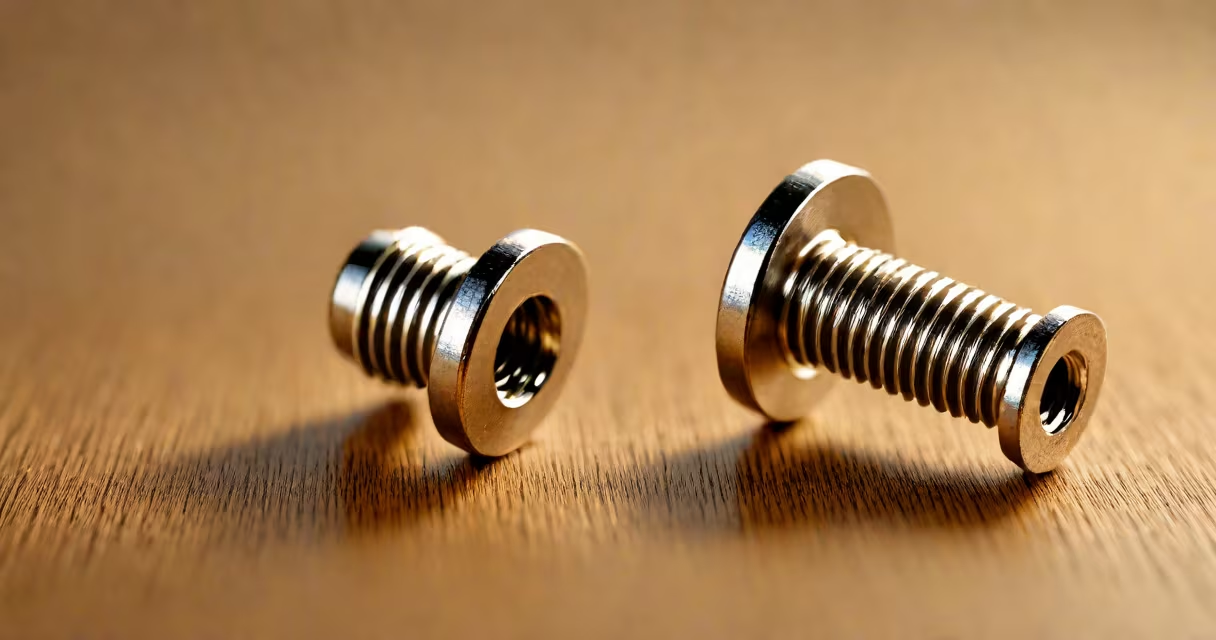
Countersunk means shaping a hole or surface so a screw's head sits flush or slightly below the material's surface, eliminating protrusion. This creates a smooth finish and prevents snagging.
A countersunk feature is common in cabinetry, furniture, and precision machining. The term applies to both the hole shape and the screw design. When a screw is countersunk, its tapered head fits into a matching conical hole, allowing the surface to remain level.
For example, a #8 flathead screw with a 90-degree point angle requires a 90-degree countersink hole. If the hole is too shallow, the screw head sticks out. If too deep, the head sits below the surface, risking damage to the material or poor grip.
Countersinking uses a specialized drill bit called a countersink bit. This tool cuts a conical recess at the top of a pilot hole. The angle of the bit must match the screw's head angle-commonly 82°, 90°, or 100°.
After drilling the pilot hole, the countersink bit is inserted and rotated to form the cone-shaped depression. The screw is then driven in until the head sits flush. This process ensures the screw doesn't interfere with adjacent surfaces or tools.
Without countersinking, screws can catch on clothing, tools, or other objects. In high-traffic areas like countertops or door frames, protruding heads create safety hazards and wear quickly.
Countersunk features come in different forms based on application and material. The most common types are:
| Type | Angle | Common Use | Material Suitability |
|---|---|---|---|
| Standard countersink | 82° | Woodworking, general fastening | Wood, plastic, soft metals |
| Flat-bottom countersink | 90° | Furniture, cabinetry | Hardwood, MDF, aluminum |
| Large-angle countersink | 100° | Sheet metal, thin materials | Steel, brass, aluminum sheet |
Each angle aims to match specific screw standards. For example, ISO 1478 specifies 82° for machine screws, while ANSI B18.6.1 defines 90° for flathead screws in structural applications.
Using the wrong angle causes misalignment. A 90° screw in an 82° hole won't seat properly, leading to wobbling or stripped threads. Always verify the screw's head angle before selecting a countersink bit.
Countersinking appears in construction, manufacturing, and DIY projects. In cabinetmaking, it keeps drawer fronts smooth. In automotive trim, it hides fasteners under panels.
Industrial applications include aircraft assembly, where even minor protrusions disrupt airflow. NASA's Apollo program used countersunk bolts in spacecraft components to reduce drag and prevent debris accumulation.
In electronics, countersunk screws secure circuit boards inside enclosures. The flush fit prevents interference with cooling fans or internal wiring.
Many assume "countersunk" means "flathead." That's incorrect. Flathead refers to the screw's shape-its rounded top and tapered shaft. Countersunk describes the hole or recess that accommodates the screw.
Some confuse countersunk with countersunk socket. The latter is a screw with a recessed drive (like a hex socket), not a shape for seating. A countersunk screw may have a Phillips or Allen drive, but the countersink refers only to the mating geometry.
Another mistake: using a standard drill bit to create a countersink. This fails because the bit lacks the conical angle. A countersink bit has a chisel-like edge that removes material at a precise slope. Using a regular bit results in a flat-bottomed hole that won't accept a tapered head.
One non-obvious fact: countersinking can weaken thin materials. Drilling a deep countersink removes structural integrity. In thin aluminum sheets, a 0.1-inch-deep countersink reduces strength by up to 18%, according to ASME B18.6.1-2021.
To install a shelf, you drill a 3/32-inch pilot hole through the shelf board. Then, using a 90° countersink bit, you create a 0.25-inch-deep conical hole. You insert a #8 × 1-inch flathead screw and drive it in with a screwdriver.
The screw head seats perfectly into the recess. The surface remains smooth. No part of the screw sticks out. When you place books on the shelf, nothing catches on the fasteners.
If you skipped the countersink step, the screw heads would protrude. They'd scratch hands, catch on fabric, and look unprofessional. The shelf would feel rough and unsafe.
Understanding how countersunk works helps avoid mistakes in fastening. If you're working with hardware, knowing the difference between countersunk and flathead saves time and materials.