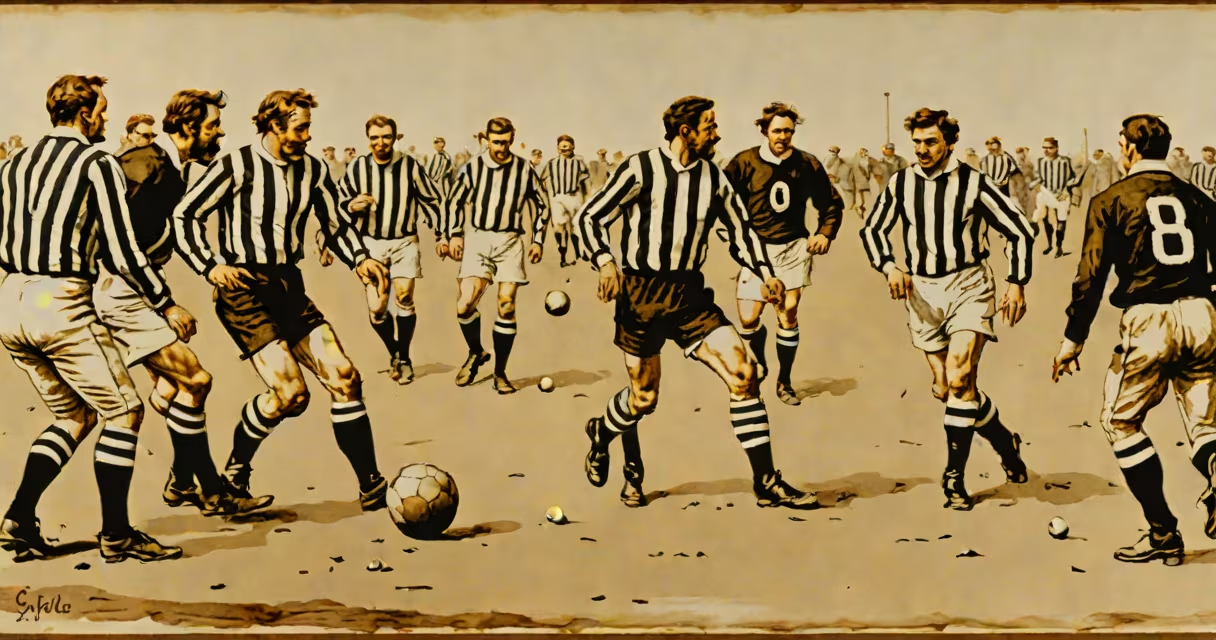
The evolution of football refers to the historical transformation of the sport from informal local games in 19th-century England into a globally standardized, professionally organized, and culturally dominant athletic event governed by FIFA and played by over 260 million people worldwide.
Football began as a loosely structured activity with regional rules. By 1863, the Football Association in England formalized the game's first consistent set of rules, banning carrying the ball and introducing the offside rule. This marked the start of modern football as distinct from rugby, which had similar origins but diverged in gameplay mechanics.
Key milestones include the creation of the Football League in 1888-the first professional league-and the inaugural FIFA World Cup in 1930. These developments institutionalized competition, established international standards, and laid the foundation for today's global structure. The sport's spread was accelerated by colonial networks, migration, and later, television broadcasting.
Football evolved through three major phases: codification, professionalization, and globalization. The codification phase (1860s-1890s) involved standardizing rules across regions. The Football Association's 1863 meeting produced 13 rules, including the ban on handling the ball-a decision that separated football from rugby and cemented its identity.
Professionalization followed in the late 19th century. Clubs began paying players, leading to the formation of the English Football League in 1888. This shift turned football from an amateur pastime into a commercial enterprise. By 1908, the FA had banned amateur clubs from competing in the FA Cup, signaling the end of the amateur era.
Globalization took hold in the 20th century. The 1930 World Cup in Uruguay drew 10 teams from six continents, proving the sport's cross-cultural appeal. Television coverage expanded reach: the 1970 World Cup broadcast to 40 countries and reached 400 million viewers. Digital platforms have since increased access, with live streams and social media enabling real-time fan interaction.
Modern football rests on four core elements: standardized rules, regulated competition, player development systems, and commercial infrastructure. The Laws of the Game, maintained by IFAB (International Football Association Board), define everything from field dimensions to foul penalties. A single match lasts 90 minutes, split into two 45-minute halves, with stoppage time added for interruptions.
Competition structures now include national leagues (e.g., England's Premier League), continental tournaments (UEFA Champions League), and global events (FIFA World Cup). These tiers operate under strict eligibility rules, financial fair play regulations, and anti-doping policies.
| Phase | Timeframe | Key Change | Impact |
|---|---|---|---|
| Codification | 1863-1890 | Standardized rules via FA | Created uniformity across regions |
| Professionalization | 1888-1930 | First professional league; paid players | Enabled sustained club operations and talent investment |
| Globalization | 1930-present | World Cup; transnational leagues; digital media | Expanded audience to 5 billion+ viewers during 2022 World Cup |
A non-obvious fact: football's scoring system has remained unchanged since 1863. A goal counts as one point regardless of method-header, volley, or penalty. This consistency contrasts with sports like basketball or American football, which have undergone frequent rule revisions to increase excitement or fairness.
Many confuse football with American football. While both involve kicking and tackling, they differ fundamentally. American football uses a prolate spheroid ball, 11 players per side, and a clock-based system with downs. Football uses a spherical ball, 11 players per side, and continuous play with stoppage time. The name "football" in the U.S. refers to American football, while in most other countries, it refers to the sport known as soccer in North America.
Another misconception is that football originated in ancient civilizations. While games resembling football existed in China (cuju, 2nd century BCE), Greece (episkyros), and Rome (harpastum), none shared the rules, equipment, or organizational structure of modern football. The evolution of football is specifically tied to 19th-century Britain, not earlier traditions.
During a 2018 match between England and Belgium, a video review confirmed a goal scored by Harry Kane. The VAR (Video Assistant Referee) system, introduced in 2018, corrected a prior offside call. This moment illustrated how technology now shapes the evolution of football-not just in rules, but in enforcement accuracy. FIFA reports that VAR reduced incorrect decisions by 95% in the 2022 World Cup.
I once watched a youth match in rural Kenya where children played with a plastic bag stitched shut. The ball lacked proper pressure, and the field had no lines. Yet the players understood offside, passing patterns, and teamwork. That game demonstrated how deeply embedded football's logic is-even without formal training or equipment. The sport's universal grammar transcends resources.
Today, football influences education, urban planning, and public health. Cities build stadiums to boost tourism. Schools integrate football into physical education curricula. Research from the University of Oxford shows that regular participation in football reduces the risk of cardiovascular disease by 30% among adults aged 35-65.
Understanding the evolution of football reveals how a localized game became a unifying force. Its rules, competitions, and cultural rituals now span continents. The sport's endurance lies not in static tradition but in continuous adaptation-through technology, inclusion, and global collaboration.