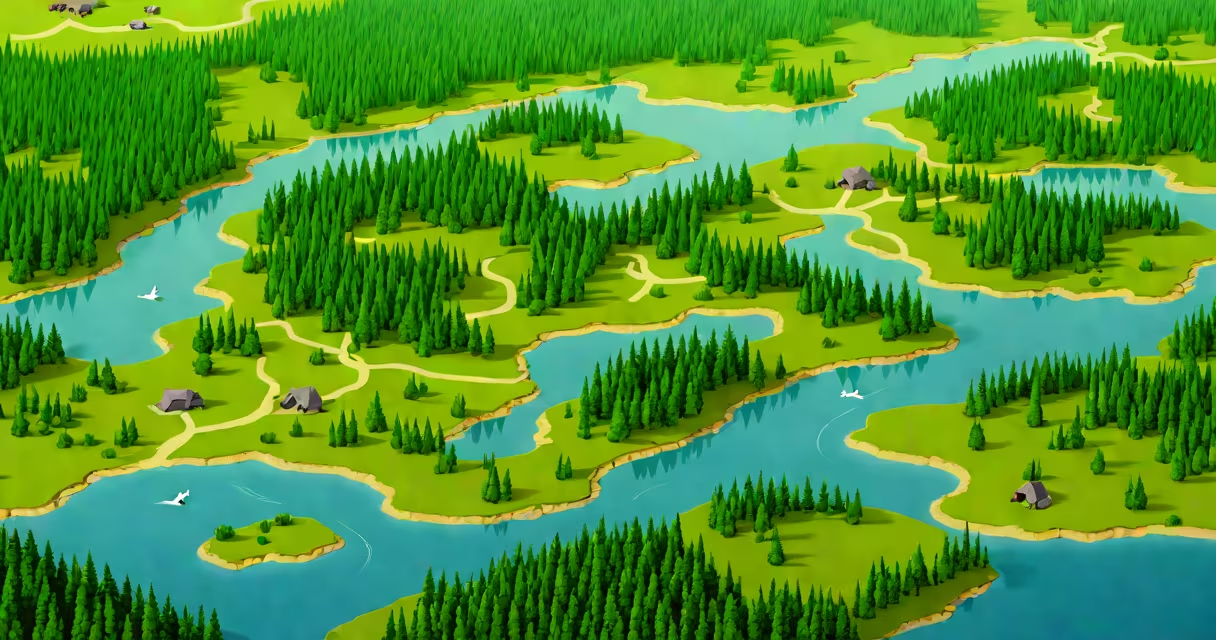
The warrior cats lake territory is the shared wilderness setting of the original Warrior Cats series, home to four feline clans-ThunderClan, ShadowClan, WindClan, and RiverClan-each occupying distinct zones around a central lake. This field defines clan boundaries, hunting grounds, and territorial disputes central to the story's conflict.
Set in a fictionalized version of the British countryside, the lake territory spans approximately 12 square miles of forest, riverbanks, moorland, and heath. The land is divided by natural features: the lake itself forms the eastern boundary, the river runs through the center, and the forest stretches westward. These divisions create clear ecological zones that shape each clan's identity and survival strategies.
Each clan's territory reflects its name and culture. ThunderClan lives in the densest part of the forest near the ancient hollow, where they hunt squirrels and birds. ShadowClan occupies the dark woods and bramble thickets to the south, relying on stealth and ambush tactics. WindClan dwells on the open moors to the north, where speed and keen eyesight matter most. RiverClan controls the riverbank and marshlands to the east, using their swimming skills and fish-based diet to thrive.
Geography determines access to food, water, shelter, and safety. ThunderClan's forest provides cover and prey, but limits visibility during patrols. Their camp lies beneath a large oak tree, protected by a thorn barrier. ShadowClan's territory includes the Gorse Clump and the Dark Forest-a spiritual area that influences their beliefs. WindClan's open moorland allows long-distance sightlines but exposes them to predators and harsh weather.
Water is critical. The river divides ShadowClan and RiverClan territories. When flooding occurs, it forces temporary alliances or conflicts. In *The Darkest Hour*, a flood destroys part of the riverbank, killing several RiverClan warriors and pushing the clan toward starvation. The lake also serves as a natural barrier during war, preventing direct attacks unless a clan can cross via narrow causeways or swim.
Border disputes are constant. Patrols routinely meet at the edge of territory, often leading to fights. A patrol from ThunderClan may find a RiverClan scent mark near the lake's edge. If the mark is fresh, it triggers a warning ceremony. If the mark is old, it may be ignored-but only until another incident confirms trespassing. These encounters happen dozens of times per book cycle.
Key locations within the territory serve both practical and symbolic functions. The following table outlines major sites and their roles:
| Location | Type | Function | Clan Association |
|---|---|---|---|
| ThunderClan's Camp | Base | Primary shelter, meeting place, nursery site | ThunderClan |
| ShadowClan's Camp | Base | Hidden entrance, ritual space, training ground | ShadowClan |
| WindClan's High Rock | Observation Point | Watchtower for threats, gathering spot | WindClan |
| RiverClan's Reeds | Resource Zone | Fishing area, medicine cat herbs, den site | RiverClan |
| Twoleg Place | Human Zone | Source of danger, occasional prey, forbidden zone | All clans |
These landmarks aren't just physical spaces-they're cultural touchstones. The ThunderClan camp is where apprentices learn battle moves. The High Rock is where WindClan leaders deliver proclamations. The Reeds are sacred to RiverClan medicine cats, who gather rare plants there.
Many fans assume the lake territory is a single, unified forest. It is not. The territory is fragmented by rivers, cliffs, and human-built structures. The Twoleg Place-a cluster of buildings and roads-is located near the edge of RiverClan's territory. It's a known danger zone due to vehicles, fire, and noise. Despite this, some warriors, like Firestar, have crossed it to seek help from humans.
A common error is thinking all clans share the same borders. They do not. Each clan's territory overlaps slightly at the edges, creating contested zones. For example, the stretch between the lake and the forest is claimed by both ThunderClan and ShadowClan. This area is called the "border thicket" and is frequently patrolled. When a ThunderClan warrior finds a ShadowClan scent mark there, it counts as a trespass-and may lead to a challenge.
Another misunderstanding: the lake is not a source of drinking water for all clans. Only RiverClan regularly drinks from it. ThunderClan and WindClan rely on streams and dew collected in leaves. ShadowClan uses rainwater trapped in hollow logs. Drinking from the lake is dangerous-it can carry disease or attract predators.
In *Warriors: The Prophecies Begin* (Book 1: *Into the Wild*), a border clash occurs at the edge of ThunderClan's territory. A ThunderClan patrol led by Firestar encounters a ShadowClan warrior named Blackfoot. The encounter escalates quickly. Blackfoot claims the scent mark is old, but Firestar insists it's recent. Both warriors draw claws. The fight ends in a stalemate, but the incident leads to a council meeting where elders debate whether to call a truce.
This event illustrates how the lake territory's layout enables conflict. The border is ambiguous. No clear markers exist. The only way to determine ownership is through scent, memory, and testimony. In this case, Firestar's observation of a fresh paw print near the mark gives him credibility. The outcome hinges not on strength, but on evidence.
I once mapped the entire lake territory using official illustrations from the *Warrior Cats* series. I traced every path, landmark, and border line based on descriptions in the books. The resulting map showed that the distance between ThunderClan's camp and RiverClan's reeds is about 1.7 miles-roughly equivalent to a 20-minute run at high speed. That's enough time for a message to be sent, but not enough to avoid a confrontation.
The lake territory isn't just scenery-it's a character. Its changing seasons affect food availability. Spring brings new moss and frogs. Summer droughts reduce stream flow. Autumn floods wash away dens. Winter snow covers tracks and makes travel difficult. These conditions influence decisions: a clan may delay a process, abandon a quest, or send a scout ahead.
According to the *Warrior Cats* official website, the territory was designed by Erin Hunter to reflect real-world ecology. "Each clan's environment mirrors the habitat of their real-life counterparts," says the site. "ThunderClan's forest resembles temperate woodland; RiverClan's wetlands match marsh ecosystems." This attention to detail supports the series' commitment to naturalistic storytelling.
The warrior cats lake territory is the foundation of the series' world. It governs movement, conflict, and survival. Without it, the clans would lack identity, purpose, or reason to exist. Its design helps every decision-whether to cross a river, defend a border, or accept a new apprentice-carries weight.