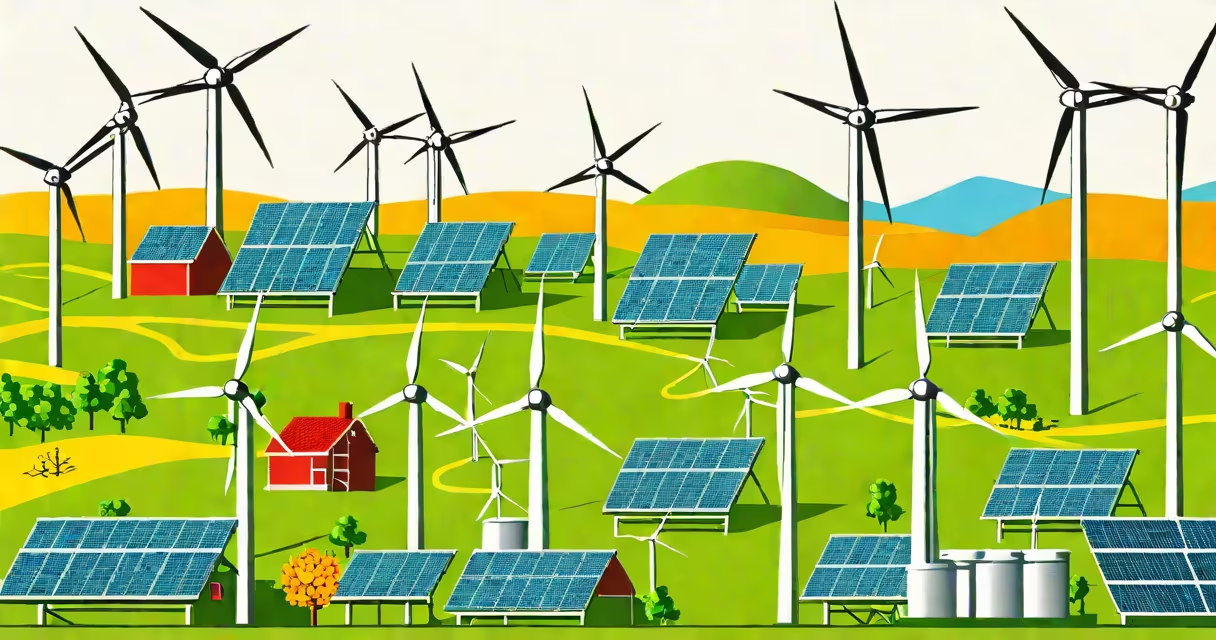
Other energy sources refer to forms of power generation that do not rely on burning fossil fuels like coal, oil, or natural gas. These include renewables such as solar, wind, hydroelectric, geothermal, and biomass, as well as secondary sources like electricity and hydrogen derived from various inputs.
These sources are increasingly central to global efforts to reduce greenhouse gas emissions and combat climate change. Unlike fossil fuels, which release carbon dioxide when burned, most other energy sources produce little to no direct emissions during operation. The International Energy Agency (IEA) reports that renewable energy accounted for nearly 30% of global electricity generation in 2023, up from 20% in 2015.
Other energy sources are not a single category but a group of distinct technologies and systems. They fall into two broad groups: primary sources, which come directly from natural flows (like sunlight or wind), and secondary sources, which are derived from primary ones through conversion processes (like electricity from solar panels).
Primary energy sources convert natural phenomena into usable power. Solar panels use photovoltaic cells to turn sunlight directly into electricity. Wind turbines capture kinetic energy from moving air and convert it into rotational motion, which drives generators. Hydroelectric dams channel flowing water to spin turbines, while geothermal plants tap underground heat to produce steam that turns turbines.
Secondary energy sources require transformation. Electricity, for example, is rarely produced directly from nature-it's generated by converting primary sources. When sunlight hits a solar panel, the resulting electrical current is a secondary form of energy. Similarly, hydrogen fuel is not found in nature in usable quantities; it must be produced via electrolysis using electricity, often from renewables.
A key distinction is that secondary sources are carriers-they store or transport energy rather than being original sources. This makes them flexible but dependent on the efficiency and sustainability of their input. For example, green hydrogen made with solar-powered electrolysis emits no CO₂ during use, but if the electricity comes from coal, the environmental benefit vanishes.
The following table outlines major categories of other energy sources, their characteristics, and real-world examples.
| Type | Source | Conversion Process | Example Application |
|---|---|---|---|
| Solar | Direct sunlight | Photovoltaic effect | Residential rooftop panels in California generate ~6 kW per system |
| Wind | Atmospheric movement | Turbine rotation → generator | Offshore wind farms in Denmark supply 50% of national electricity |
| Hydroelectric | Flowing water | Dammed reservoir → turbine | Three Gorges Dam in China produces 22.5 GW annually |
| Geothermal | Earth's internal heat | Steam extraction → turbine | Iceland uses geothermal for 25% of its electricity and 90% of heating |
| Biomass | Organic matter | Combustion or gasification | Wood pellets burn in UK power plants, replacing coal |
| Hydrogen (green) | Water + renewable electricity | Electrolysis | Hydrogen buses in Oslo run on green hydrogen from wind-powered electrolyzers |
Each type has trade-offs. Solar and wind are variable-dependent on weather and time of day. Hydroelectric projects can disrupt ecosystems. Geothermal is location-specific. Biomass combustion releases CO₂ unless paired with carbon capture. Green hydrogen remains expensive, costing $3-$6 per kilogram globally, compared to $1-$2 for gray hydrogen from natural gas.
Nations are adopting other energy sources to meet climate commitments under the Paris Agreement. The European Union aims for 42.5% renewable electricity by 2030. The United States plans to achieve 100% clean electricity by 2035, according to the U.S. Department of Energy.
Developing countries are also deploying these sources. Kenya generates over 70% of its electricity from geothermal and wind, reducing reliance on imported diesel. India's National Solar Mission targets 500 GW of solar capacity by 2030, a move driven by energy security and air quality concerns.
One common misconception is that other energy sources are always cheaper than fossil fuels. While levelized cost of electricity (LCOE) for utility-scale solar and onshore wind has dropped below $30/MWh in many regions-lower than new coal plants-the full picture includes grid integration, storage, and transmission costs. A 2022 study by the National Renewable Energy Laboratory (NREL) found that integrating high shares of variable renewables increases system costs by 15-25% without sufficient storage or demand management.
Many people assume all "alternative" energy sources are renewable. That's not true. Nuclear power is often grouped with renewables in policy discussions because it produces low emissions, but it relies on uranium mining and enrichment-processes with environmental impacts. Nuclear is a non-fossil, low-carbon source, but not renewable.
Another error is equating "other energy sources" with "clean energy." While most are cleaner than fossil fuels, not all are zero-emission. Biomass combustion releases CO₂, and if trees are harvested faster than they regrow, it contributes to net carbon emissions. The IPCC notes that biomass energy with carbon capture and storage (BECCS) is only carbon-neutral if sustainably managed.
There's also confusion between primary and secondary sources. Electricity is a secondary source-it's not extracted from nature but generated from others. You cannot "mine" electricity. It must be produced from solar, wind, or another input. This matters because the environmental footprint of electricity depends entirely on how it was made.
When I installed solar panels on my home in Portland, Oregon, I expected immediate savings. The system produced 8,200 kWh annually-enough to cover 70% of our usage. But the real impact came when I added a battery. During winter months, when sun hours drop, the stored energy kept lights on and the refrigerator running. Without the battery, we'd have relied on the grid, which still runs on fossil fuels in that region.
Other energy sources encompass many technologies that reduce dependence on fossil fuels. They include both primary sources like wind and solar and secondary ones like electricity and hydrogen. Their deployment varies by geography, resource availability, and infrastructure.
Understanding the difference between primary and secondary sources prevents misjudgment. A wind farm produces primary energy. The electricity it sends to homes is secondary. The same applies to hydrogen: green hydrogen is a secondary carrier, not a primary source.