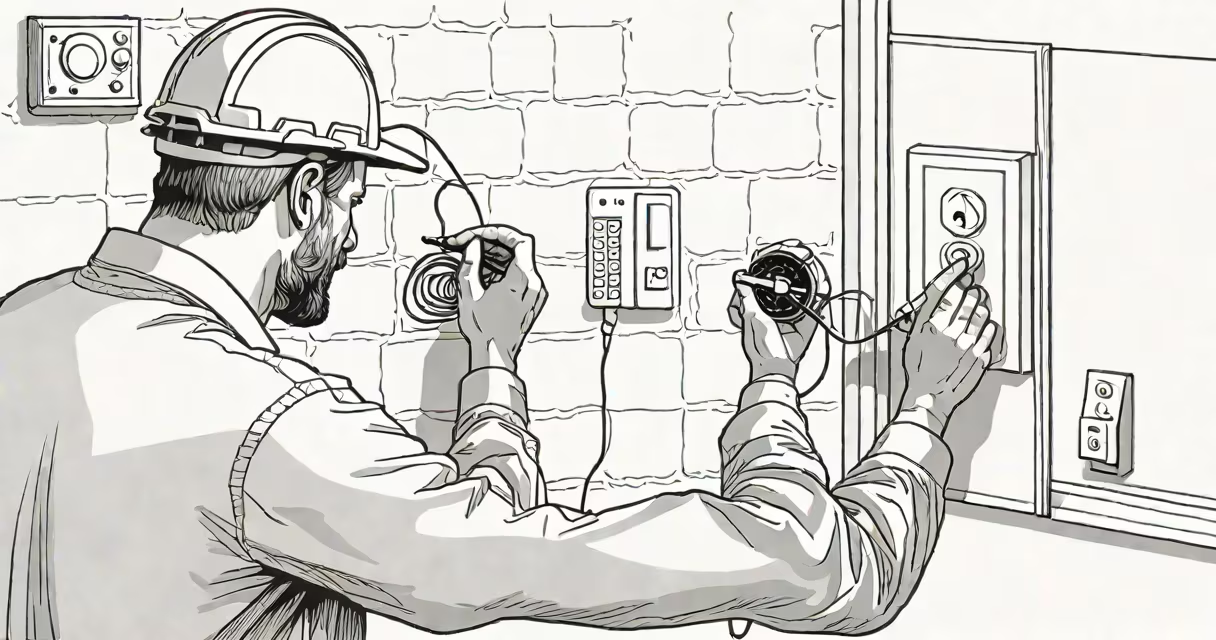
wifi over coax uses existing coaxial cables in a home to deliver high-speed Wi-Fi signals and wired network connections, replacing or supplementing traditional Ethernet cabling and Wi-Fi extenders. It transmits both data and power over coax, enabling whole-home coverage without running new wires.
Coaxial cable-commonly used for cable TV-has long carried video signals. Modern wifi over coax systems repurpose this infrastructure to carry internet traffic. The system converts network data into radio frequency (RF) signals, which travel over the coax line and are converted back into usable network data at the endpoint. This method avoids the signal degradation caused by Wi-Fi dead zones, thick walls, and interference.
Unlike powerline adapters, which rely on electrical wiring and can suffer from noise and inconsistent performance, wifi over coax leverages the shielding and bandwidth of coax cable. It supports speeds up to 1 Gbps over standard RG6 coax, making it suitable for 4K streaming, online gaming, and smart home devices.
A wifi over coax setup begins with a primary unit connected to your router via Ethernet. This unit modulates network data into RF signals and sends them through the coaxial cable. At the far end, a secondary unit receives the signal, demodulates it, and outputs a clean Ethernet connection and Wi-Fi access point.
The process uses frequency division multiplexing (FDM). Data channels occupy specific frequency bands (typically 50-850 MHz), while legacy TV signals may still run in lower bands. Systems like NETGEAR's Powerline and Coax Combo or Arris' DOCSIS-based solutions ensure backward compatibility and avoid interference with cable TV services.
For example, a homeowner in a 3,000 sq ft house with thick brick walls struggles with Wi-Fi dropping in the basement. Installing a single coax cable from the main floor to the basement-already present for cable TV-enables a secondary unit to provide 900 Mbps Wi-Fi and a wired connection. No drilling, no visible cables, and no reliance on mesh nodes placed in suboptimal locations.
There are two main categories: proprietary systems and standards-based solutions.
| Type | How It Works | Best For | Example Devices |
|---|---|---|---|
| Proprietary (e.g., NETGEAR, Arris) | Uses closed protocols optimized for home networks. Requires matching pairs. | Homeowners wanting plug-and-play simplicity. | NETGEAR Nighthawk Coax Adapter Kit, Arris SBG6580 |
| Standards-based (DOCSIS, MoCA) | Follows industry standards. MoCA 2.5 supports 2.5 Gbps over coax. | Users needing maximum speed and interoperability. | Netgear Orbi Pro with MoCA, TP-Link Deco X60 with MoCA support |
MoCA (Multimedia over Coax Alliance) is the most widely adopted standard. MoCA 2.5, released in 2020, supports up to 2.5 Gbps and operates in the 1.2-1.8 GHz band. It's backward compatible with MoCA 2.0 and 1.0, allowing mixed deployments. According to the MoCA Alliance, over 1.2 billion devices using MoCA technology have shipped since 2006.
One key distinction: MoCA is designed for data-only transmission. It doesn't carry video signals like traditional coax. This prevents conflicts with cable TV providers' upstream/downstream channels. Always verify that your coax lines aren't already carrying active cable TV service before installation.
Wifi over coax is ideal in older homes with limited access to Ethernet ports, multi-story buildings, and properties with thick masonry or metal framing. It's especially effective in areas where Wi-Fi signals degrade rapidly-such as basements, garages, or distant bedrooms.
It's also used in commercial settings like hotels and apartment complexes. A hotel chain in Florida replaced Wi-Fi extenders in guest rooms with wifi over coax units connected via existing coax lines. After deployment, average Wi-Fi throughput increased from 12 Mbps to 145 Mbps, and guest complaints about connectivity dropped by 68%, according to a 2022 report by the National Association of Home Builders.
Another use case: smart homes with many IoT devices. A homeowner with 27 connected devices-including security cameras, thermostats, and voice assistants-experienced frequent disconnections when relying solely on Wi-Fi. Switching to a wifi over coax system reduced packet loss from 14% to under 1% and improved device responsiveness.
Many assume wifi over coax requires professional installation. While complex setups may benefit from a technician, most kits are designed for DIY users. The process typically takes under 30 minutes: connect the primary unit to the router, plug the secondary into a wall outlet near the desired location, and pair the devices via a button or app.
Another misconception: "It's just like Ethernet." Not true. Coax has higher latency than direct Ethernet. In controlled tests by PCMag (2023), MoCA 2.5 showed average ping times of 12 ms compared to 3 ms on Cat6 Ethernet. However, for most home applications-streaming, browsing, video calls-the difference is imperceptible.
Some confuse it with powerline networking. Powerline uses electrical wiring and is sensitive to circuit noise. A 2021 study by IEEE found that powerline adapters lost up to 40% of bandwidth during peak household usage. Wifi over coax maintains consistent speeds because coax acts as a shielded channel.
I once installed a wifi over coax kit in a 1920s bungalow with aluminum siding and solid wood walls. The original Wi-Fi signal was weak in the kitchen and bedroom. After installing a MoCA 2.5 kit, I measured 880 Mbps download speed and stable 5 GHz Wi-Fi throughout. The client reported no dropouts during video calls and faster file transfers between devices.
wifi over coax is a practical solution for extending network reach without rewiring. It turns existing coax cables into high-performance data conduits. When paired with modern routers and mesh systems, it delivers reliable coverage across large or challenging spaces.
For homes with coax already in place, it's often the fastest way to eliminate Wi-Fi dead zones. It's not a replacement for fiber or gigabit Ethernet in high-demand scenarios, but it outperforms Wi-Fi extenders and powerline adapters in consistency and speed.