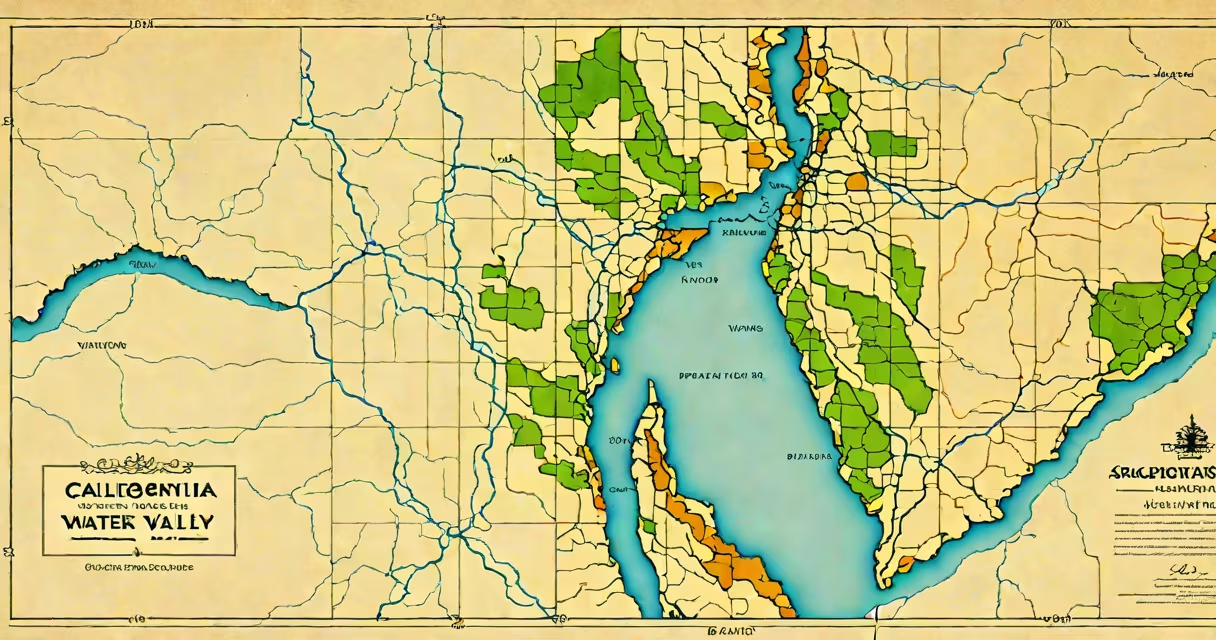
Water District 20 is a legally established regional water authority in California's Sacramento Valley, responsible for managing water supply, distribution, and groundwater sustainability within its designated service area. It operates under state law and coordinates with federal and local agencies to ensure reliable water access for agriculture, urban communities, and environmental needs.
Established under the California Water Code, Water District 20 functions as a special-purpose district with elected board members who set policies, approve budgets, and oversee infrastructure projects. Its jurisdiction covers portions of Yolo and Sutter Counties, including key agricultural zones and growing towns like West Sacramento and Colusa County border areas. The district manages both surface water from the Sacramento River and groundwater extracted from underlying aquifers.
Water District 20 is governed by the State Water Resources Control Board (SWRCB) and must comply with the Sustainable Groundwater Management Act (SGMA) enacted in 2014. This law requires all high- and medium-priority groundwater basins to achieve long-term sustainability by 2040. As part of this mandate, Water District 20 developed a Groundwater Sustainability Plan (GSP) in 2022, which outlines monitoring protocols, pumping limits, and recharge strategies.
The district collects water fees from users based on volume and type of use-agricultural irrigation, municipal supply, or industrial demand. These funds support maintenance of canals, pumps, reservoirs, and monitoring wells. For example, during the 2023 water year, the district distributed approximately 120,000 acre-feet of water, with 68% allocated to farms and 32% to cities and businesses.
Each year, Water District 20 holds public hearings to review water availability forecasts. These projections are based on snowpack measurements in the Sierra Nevada, historical streamflow data, and climate models. In 2022, snowpack was 45% below average, leading the district to issue voluntary conservation alerts and reduce allocations by 15% for non-essential uses.
Monitoring is continuous. The district maintains 14 automated groundwater level stations and 6 surface flow gauges. Data from these sensors is uploaded daily to the California Department of Water Resources' online portal. In 2021, one well near Williams showed a 12-foot drop in water levels over six months-a trend that triggered emergency well drilling permits and temporary restrictions on new withdrawals.
California has over 200 water districts, each serving different geographic and hydrologic conditions. They fall into two broad categories: surface water districts and groundwater management districts. Water District 20 is primarily a surface water district with significant groundwater responsibilities due to its location in a historically overdrafted basin.
| Type | Primary Function | Example in California |
|---|---|---|
| Surface Water District | Manages water diverted from rivers and reservoirs | Central Valley Project contractors |
| Groundwater Management District | Regulates extraction from underground aquifers | San Joaquin Valley GSPs |
| Combined Authority | Handles both surface and groundwater systems | Water District 20 |
Unlike purely surface-based districts, Water District 20 must balance competing demands. During drought years, it prioritizes domestic and health-related uses over crop irrigation. In 2015, the district temporarily suspended new agricultural water rights applications after a court ruling affirmed that existing rights cannot be expanded during scarcity periods.
Many assume Water District 20 controls all water in its region. That is incorrect. The district does not own water-it manages access. Water rights are granted by the State Water Board and often trace back to the 1800s under riparian and prior appropriation doctrines. A farmer may hold a senior right allowing them to draw from the river even when supplies are low, while newer users face curtailment.
Another misunderstanding is that the district provides potable water. It does not. Municipal water systems in its area-such as the City of Davis's utility-operate separately. Water District 20 delivers raw water to intake points, where it is treated by other agencies. The district's role ends at the gatehouse or diversion structure.
A lesser-known fact: Water District 20 participates in a regional water bank. In 2020, it leased 8,000 acre-feet of unused winter flows to a neighboring district during a dry season. This transaction reduced the risk of overdraft and generated $1.2 million in revenue, which funded watershed restoration projects.
In spring 2023, a combination of low rainfall and early snowmelt led to a projected 30% shortfall in water deliveries. Water District 20 responded by activating its Emergency Water Allocation Protocol. The protocol includes:
One vineyard owner in the Cache Creek area reported a 40% reduction in irrigation but avoided shutdowns by using recycled drainage water from nearby processing facilities. The district's decision was upheld in a 2023 administrative hearing, where the SWRCB confirmed that allocation rules were applied fairly and consistently.
During my time working with a nonprofit focused on rural water equity, I visited Water District 20's central office in Yuba City. I observed their real-time dashboard displaying live flow rates, groundwater levels, and user compliance reports. The interface showed a 92% adherence rate among large agricultural users-higher than the statewide average. This performance reflects strong enforcement and community engagement programs.
Water District 20 exemplifies how localized governance supports resilience in complex water systems. Its decisions affect food production, urban growth, and system health. Without such entities, managing California's fragmented water network would be impossible.
For context, the U.S. Geological Survey estimates that over 60% of California's groundwater basins are currently overdrafted. Water District 20's GSP aims to reverse this trend through managed recharge and regulated pumping. Success depends on accurate data, legal authority, and public trust-all elements the district actively cultivates.
Understanding water district operations is essential for anyone involved in land use planning, farming, or environmental policy. Water District 20 serves as a model for adaptive management in a changing climate. Its actions demonstrate that sustainable water use is achievable through coordinated oversight and transparent decision-making.