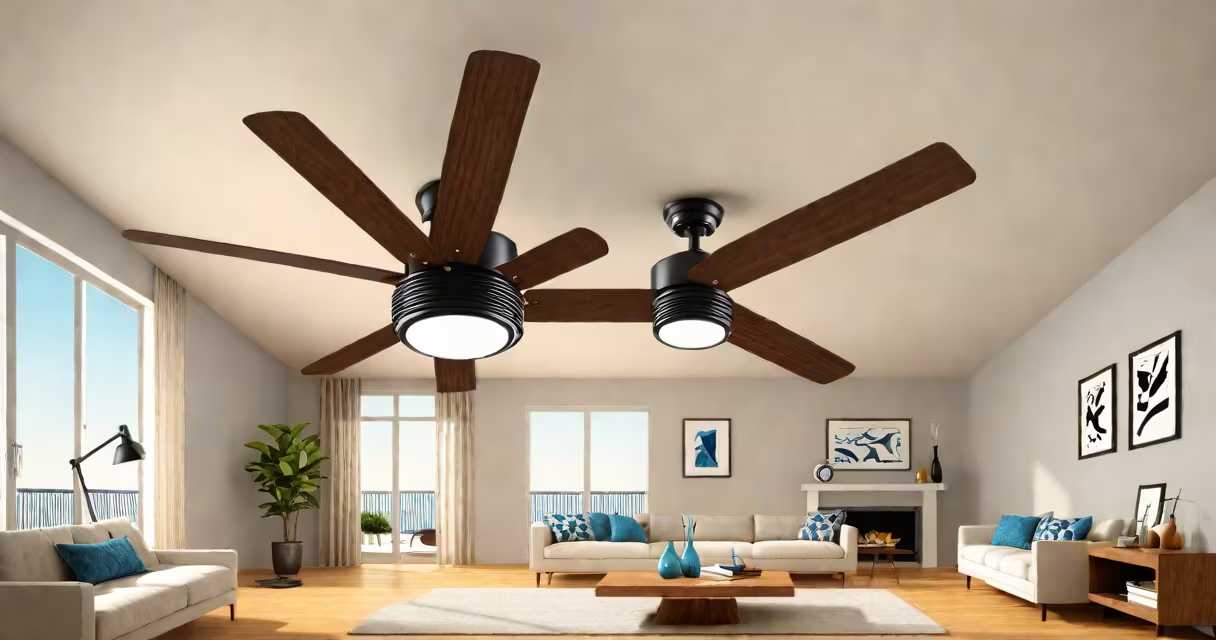
Ceiling fans should rotate counterclockwise in summer to create a downward breeze that enhances cooling, and clockwise in winter to gently redistribute warm air trapped near the ceiling. This directional shift maximizes comfort and reduces reliance on heating and cooling systems.
Most ceiling fans have a switch or remote control that toggles between forward (counterclockwise) and reverse (clockwise) modes. The correct direction depends on the season and indoor temperature. Running a fan in the wrong direction wastes energy and provides little benefit.
According to the U.S. Department of Energy, properly set ceiling fans can reduce perceived temperature by up to 4°F, allowing homeowners to raise their thermostat by 4°F in summer and lower it by 4°F in winter without sacrificing comfort. This translates to measurable energy savings over time.
When a ceiling fan spins counterclockwise, it pulls air upward and forces it down along the walls and floor. This creates a wind-chill effect that makes occupants feel cooler-even if the actual room temperature hasn't changed. The sensation mimics natural breezes and increases thermal comfort.
In contrast, when spinning clockwise at low speed, the fan draws air upward and pushes it along the ceiling's surface. Warm air rises and accumulates near the ceiling during winter. A clockwise rotation gently pushes this warm layer down toward the room's perimeter, improving heat distribution without overheating.
For optimal performance, run the fan at low to medium speed in winter. High speeds disrupt the gentle air movement needed to circulate warmth effectively. In summer, high speed enhances the cooling effect, especially when people are in the room.
Not all ceiling fans offer manual or remote-controlled reversal. Some models require a wall switch or a pull chain to change direction. Others feature automatic seasonal detection based on ambient temperature, though these are less common and typically found in smart home systems.
| Season | Recommended Rotation | Speed Setting | Effect |
|---|---|---|---|
| Summer | Counterclockwise | High or medium | Creates downward airflow, enhances cooling sensation |
| Winter | Clockwise | Low | Redistributes warm air trapped near ceiling |
Some older or basic models lack reverse functionality entirely. These fans are designed only for summer use and may cause discomfort in cold months due to constant airflow. Upgrading to a reversible model adds year-round utility.
A key distinction often missed: reversing the fan doesn't make it "cool" or "heat." It changes air movement patterns. The fan itself doesn't alter room temperature-it redistributes existing air. The cooling effect in summer is perceptual, not actual temperature reduction.
Direction matters most in rooms with high ceilings (over 8 feet). Warm air accumulates quickly in such spaces, leading to inefficient heating. A clockwise fan prevents stratification-the separation of hot and cold layers-by gently mixing air vertically.
For example, in a 10-foot-high living room with central heating, warm air can rise and stay near the ceiling, leaving the floor area chilly. Running the fan clockwise at low speed moves that warm layer down, reducing the need to increase the heater's output.
Conversely, in a 7-foot kitchen during summer, a counterclockwise fan at high speed keeps people comfortable while cooking. The downward airflow counters rising heat from appliances and maintains a consistent indoor climate.
One non-obvious fact: running a fan in reverse at high speed in winter can create a drafty feeling. The goal is subtle circulation, not strong airflow. Low speed ensures comfort without creating a chill.
Many assume that ceiling fans cool rooms directly. They do not. Fans lower perceived temperature through air movement. Turning off the fan when leaving a room saves energy-fans don't cool empty spaces.
Another misconception: fans should always run in the same direction. This leads to wasted energy and reduced efficiency. The correct direction varies by season and must be adjusted accordingly.
I once installed a ceiling fan in a client's bedroom with a single-speed, non-reversible motor. During winter, the client reported persistent cold spots near the floor. After upgrading to a reversible model and switching to clockwise mode at low speed, they noted a 3°F increase in perceived warmth without adjusting the thermostat.
Some users confuse fan direction with blade pitch. Blade tilt affects airflow volume but not rotation direction. A fan with steep blades moves more air but still requires proper rotation to function correctly.
To confirm your fan's rotation, stand under it and observe the blade motion. Counterclockwise blades move from the upper-left to lower-right as they pass the front. Clockwise blades move from upper-right to lower-left.
Use a smartphone app or a handheld fan tester to verify rotation. Alternatively, place a small piece of paper on the floor beneath the fan. When spinning counterclockwise, the paper should be pushed outward. Clockwise rotation pulls air toward the center.
Always turn off power at the circuit breaker before checking internal switches. Reversing the fan via a wall switch or remote should be done when the fan is off to avoid mechanical strain.
Adjusting ceiling fan direction is a simple step that impacts comfort and energy use. Always set counterclockwise in summer and clockwise in winter. Doing so aligns with building science principles and supports long-term energy efficiency.