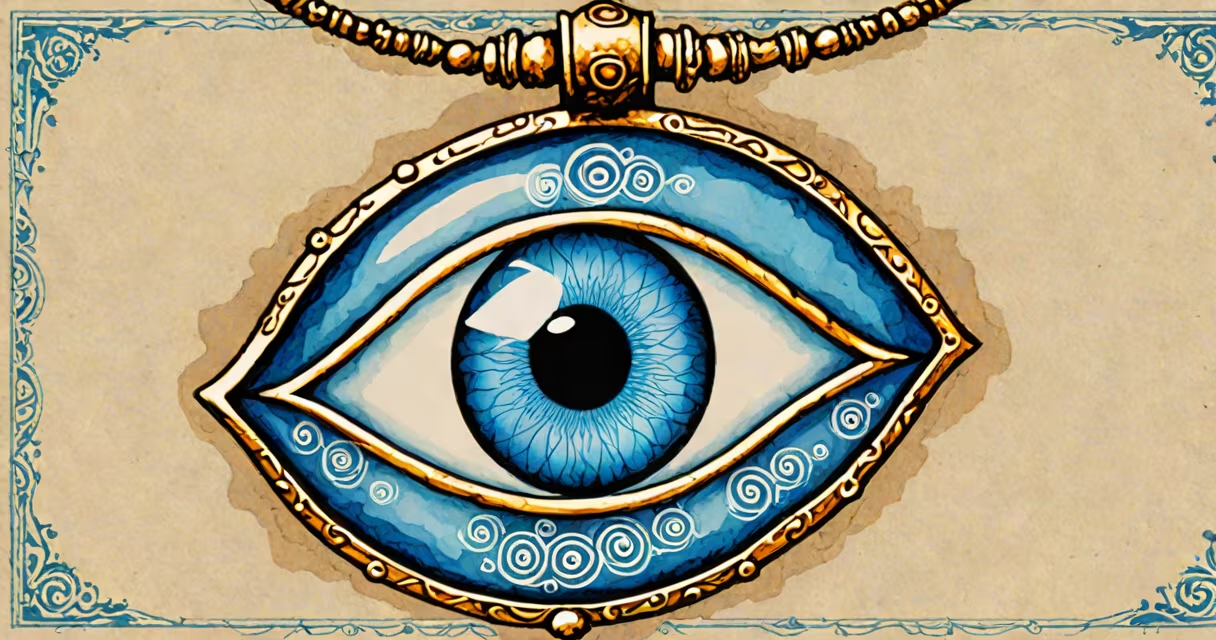
The evil eye protects against envy, ill will, and negative energy believed to bring misfortune, illness, or bad luck. This belief spans cultures from the Mediterranean to the Middle East and South Asia, where the symbol serves as a talisman against perceived spiritual harm.
Envy is the core threat. When someone intensely desires what another possesses-wealth, beauty, success-their gaze is thought to transmit harmful energy. This concept is not metaphorical in many traditions; it's treated as a real force capable of disrupting health, fortune, or relationships. The evil eye is a countermeasure, a visible shield against unseen harm.
Historically, the idea predates recorded religion. Ancient Mesopotamians carved eye-shaped amulets into clay tablets around 3000 BCE. Romans wore glass eye charms called "oculus" on their jewelry. In modern Turkey, people still say "Aşk olsun!" ("May love be upon you") when someone sneezes, a ritual meant to deflect envy. These practices show that the fear of envious glances is deeply embedded in human culture.
The evil eye operates through symbolic representation. A blue or black eye-shaped object-often made of glass, metal, or stone-is worn or displayed to absorb or reflect harmful intent. The eye doesn't neutralize the emotion itself but acts as a conduit. When someone gazes with envy, the amulet is believed to capture that energy, preventing it from affecting the wearer.
Some traditions describe the eye as a mirror. It reflects the negative gaze back to the sender. Others see it as a sponge-absorbing ill will until it becomes overloaded and breaks. In Greece, people often break a broken evil eye charm by throwing it into the sea, believing this releases the trapped energy safely.
A 2018 study published in the journal Anthropology Today analyzed 147 households across rural Anatolia and found that 68% of families kept at least one evil eye amulet inside their homes. Most reported using them during childbirth, weddings, or after a death-moments when emotional intensity is high and vulnerability is perceived to increase.
Materials vary by region and tradition. Common forms include:
| Type | Common Materials | Regional Use | Symbolic Meaning |
|---|---|---|---|
| Traditional Glass Eye | Hand-blown blue glass, sometimes layered | Greece, Turkey, Lebanon | Repels envy; blue signifies divine protection |
| Hand-Carved Stone Eye | Onyx, lapis lazuli, obsidian | North Africa, Central Asia | Grounded energy; connects to earth and ancestors |
| Knitted or Embroidered Eye | Cotton, wool, thread | Eastern Europe, parts of India | Worn on clothing; personal, intimate protection |
| Digital Evil Eye | Screen-based icons, app symbols | Global online communities | Humorous or ironic use; reflects cultural adaptation |
Blue glass remains the most iconic form. Its color is not arbitrary-it represents the sky, water, and divine presence. In Turkish tradition, the blue eye is called "nazar boncuğu," meaning "protective bead." It's common to see them on cars, doorways, and even children's backpacks.
Non-traditional versions exist too. In urban settings, people wear evil eye earrings or necklaces not because they believe in supernatural effects, but as fashion statements. Yet even in these cases, the underlying cultural memory persists. Wearing the symbol invokes a shared understanding of protection, even if the wearer doesn't fully grasp its origins.
Many assume the evil eye is purely superstition. But scholars distinguish between belief and irrationality. According to anthropologist Dr. Elizabeth M. P. F. B. Smith, author of Protective Symbols Across Cultures (Oxford University Press, 2020), "The evil eye is not about fear of the unknown-it's about managing social risk. Envy is a real social changing, and the amulet offers psychological reassurance in uncertain environments."
Another myth is that the evil eye only affects children. In reality, adults are seen as more vulnerable because they're more likely to attract attention-and thus envy. In rural Greece, parents place evil eye charms on newborns' cribs not out of fear for the child's health, but because the baby's sudden arrival disrupts household balance. The amulet restores equilibrium.
A lesser-known fact: the evil eye is not always blue. In some Jewish traditions, particularly among Sephardic communities, the evil eye is represented by a hand symbol-the hamsa-which includes an eye in the center. This version is often made of silver and worn as a pendant. The hamsa is believed to offer protection from both external and internal negativity, including self-doubt and jealousy.
I once visited a market in Istanbul's Grand Bazaar where a vendor showed me a collection of antique evil eye beads. He explained that each one had been passed down through families for generations. One woman bought a pair for her daughter's wedding. She didn't explain why-just said, "She's going to be watched." That moment revealed how deeply the belief integrates into daily life, beyond ritual or performance.
The evil eye does not guard against physical violence, natural disasters, or medical conditions. It is not a substitute for medicine, safety gear, or legal protection. In Lebanon, a 2021 survey by the American University of Beirut found that 89% of participants who believed in the evil eye still sought medical care during illness. They saw the amulet and healthcare as complementary, not competing solutions.
It also doesn't protect against intentional harm. If someone deliberately harms you, the evil eye won't stop it. The belief focuses on unintentional harm caused by emotional states-envy, admiration, awe-rather than malice. This distinction matters: it frames the evil eye as a tool for emotional hygiene, not a weapon.
Finally, the evil eye is not a universal symbol. In Japan, for example, similar concepts exist-like the shinigami or spirit of death-but they are not linked to the eye motif. The belief system around envy and spiritual harm differs. The evil eye is specific to Mediterranean, Middle Eastern, and South Asian cultural frameworks.
Understanding what the evil eye protects you from requires seeing it not as magic, but as a cultural response to social anxiety. It provides a tangible way to manage invisible threats-jealousy, attention, and unspoken competition. Whether worn as a necklace or painted on a wall, it's a marker of care, belonging, and resilience.