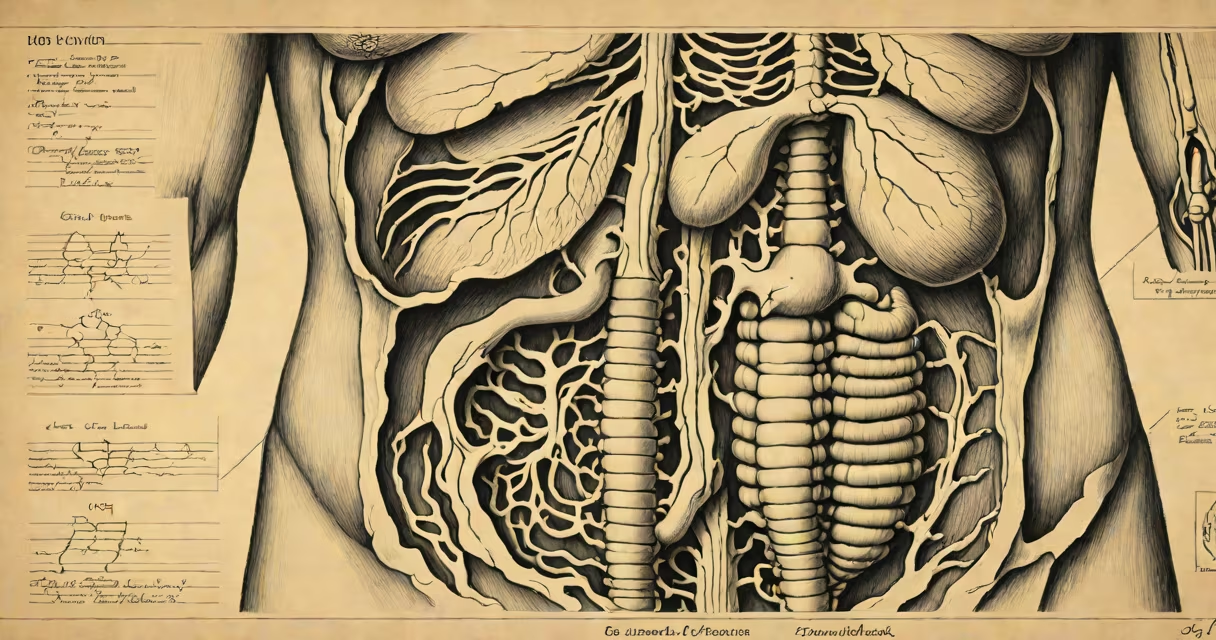
The small intestine sits directly below your belly button, forming the central pathway for nutrient absorption in the digestive tract. It extends from the stomach's outlet to the large intestine, measuring about 6 meters (20 feet) in adults.
This organ is not visible from the surface but plays a critical role in breaking down food and transferring nutrients into the bloodstream. Its inner lining features millions of tiny finger-like projections called villi, which increase surface area for efficient absorption.
When people refer to "below the belly button," they're pointing to the central lower abdomen-specifically the region known as the hypogastric or suprapubic area. This zone houses the initial segment of the small intestine, called the jejunum, and connects to the ileum, the final section before entering the large intestine.
After food leaves the stomach, it enters the duodenum-the first 25 cm (10 inches) of the small intestine-where enzymes from the pancreas and bile from the liver begin chemical digestion. The duodenum lies just below the belly button in the upper central abdomen.
As chyme (partially digested food) moves through the jejunum and ileum, specialized cells absorb glucose, amino acids, fatty acids, vitamins, and minerals. The walls contract rhythmically via peristalsis to push contents forward. Absorption occurs primarily in the jejunum, which spans the lower central abdomen.
A single meal can take 3 to 5 hours to pass through the entire small intestine. During this time, about 90% of nutrient uptake happens, making it essential for energy production and cellular repair.
While the small intestine is the primary organ located directly beneath the navel, several others occupy the lower abdominal cavity. These include parts of the large intestine, reproductive organs, and urinary structures.
| Organ | Location Relative to Navel | Primary Function |
|---|---|---|
| Jejunum (small intestine) | Directly below | Nutrient absorption |
| Ileum (small intestine) | Slightly lower, toward pelvis | Final nutrient absorption; connects to colon |
| Ascending colon (large intestine) | Right side, slightly below | Water absorption; forms stool |
| Descending colon (large intestine) | Left side, lower abdomen | Stool storage; water reabsorption |
| Bladder | Midline, deep in pelvic cavity | Stores urine until voiding |
| Reproductive organs (uterus, ovaries in women; prostate in men) | Pelvic floor, below abdominal muscles | Reproduction and hormone regulation |
Confusion often arises because pain or bloating in this area may stem from multiple systems. For example, menstrual cramps originate in the uterus, while gas buildup in the ileum causes bloating.
Many assume the appendix is located below the belly button. It is actually situated in the lower right quadrant, near the junction of the small and large intestines. The appendix is not involved in digestion but may become inflamed-a condition known as appendicitis.
Another frequent error is equating lower abdominal discomfort with intestinal blockage. While obstruction can cause pain below the navel, it typically presents with vomiting, inability to pass gas, and severe cramping-not just mild bloating.
A lesser-known fact: the small intestine is not fixed in place. It floats freely within the abdominal cavity, suspended by a membrane called the mesentery. This structure allows movement during digestion and explains why symptoms can shift position during bowel movements.
In a clinical case documented by the American College of Gastroenterology, a 32-year-old woman reported persistent dull pain below her belly button, especially after eating. She had no fever or diarrhea. Blood tests showed normal inflammation markers.
An ultrasound revealed thickening in the jejunum wall. A subsequent endoscopy confirmed Crohn's disease-a chronic inflammatory condition affecting the small intestine. Treatment with immunomodulators reduced symptoms within six weeks.
This case illustrates that pain under the belly button is rarely due to a single organ. The small intestine is often involved, but differential diagnosis requires imaging and lab work.
During a medical rotation, I observed a patient with unexplained weight loss and fatigue. Physical exam revealed tenderness in the lower central abdomen. A CT scan showed a mass in the ileum. Biopsy confirmed lymphoma. Early detection was possible only because the patient reported localized pain below the navel.
This experience underscored that even subtle symptoms in this region can signal serious conditions. Self-diagnosis is unreliable-medical evaluation is necessary.
Pain below the belly button becomes concerning if it persists beyond 24 hours, worsens with meals, or is accompanied by:
These signs may indicate obstruction, infection, or perforation-conditions requiring immediate care.
The small intestine is the key organ below your belly button. It absorbs most nutrients from food and maintains metabolic balance. Understanding its function helps distinguish normal sensations from warning signs of illness.