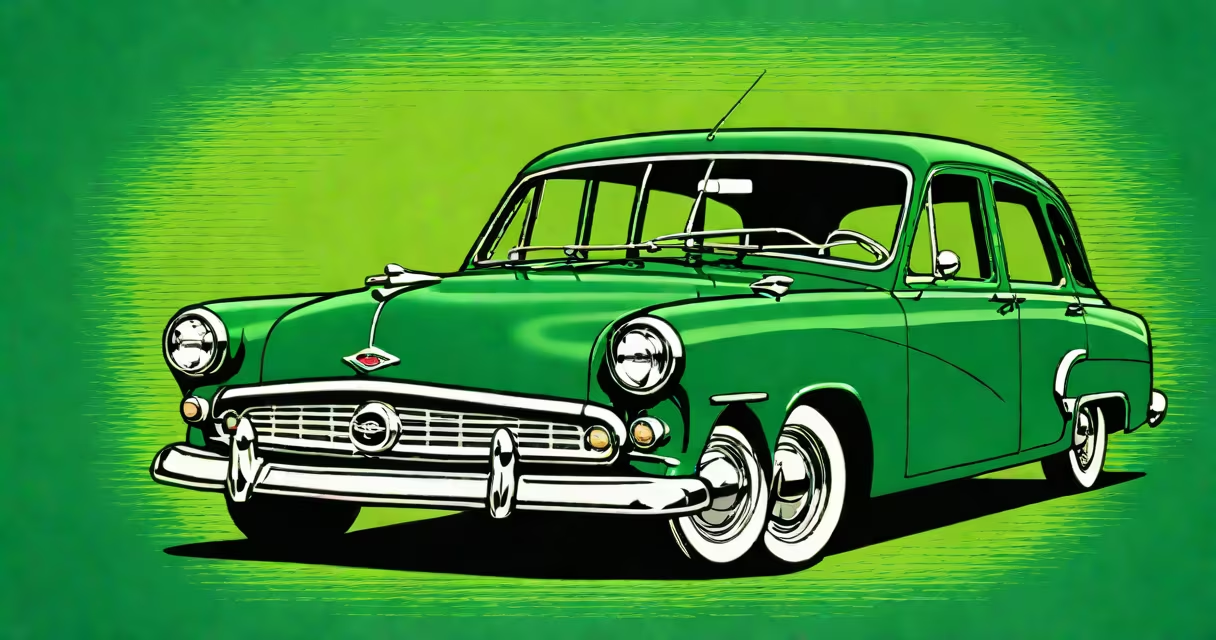
The covert Ford Austin was a limited-production 1950s British car built under license by Austin Motor Company using Ford's North American engine and chassis architecture. It was never officially marketed as a Ford model in the UK and remains obscure due to its dual branding and low production numbers.
Designed during the postwar period, the covert Ford Austin emerged from a collaboration between Ford of Britain and Austin Motor Company. Ford supplied the 1.6-liter A-series engine and front-wheel-drive platform derived from the 1952 Ford Consul. Austin then adapted the design with British bodywork, suspension tuning, and interior finishes. The result was a vehicle that looked and felt British but ran on Ford powertrain components.
Only around 1,200 units were produced between 1954 and 1957. Most were sold through Austin dealerships with Ford badging hidden beneath the hood and on service documentation. The name "covert" reflects both the secrecy of its origin and the lack of public awareness at the time. Unlike the Ford Anglia or Ford Escort, which were widely promoted, the Ford Austin was never advertised as a distinct model.
The core mechanical layout came from Ford's U.S.-developed A-series engine, a 1.6-liter inline-four with overhead valves and a single carburetor. This engine delivered approximately 60 horsepower and was paired with a four-speed manual transmission. The drivetrain used a transverse-mounted engine and front-wheel drive, a configuration still uncommon in British cars of the era.
Austin modified the chassis for UK road conditions, including a revised suspension setup with coil springs and anti-roll bars. The body was constructed from steel panels with hand-formed fenders and a distinctive curved windshield. Interior trim used British materials-leather seats, wood-grain dash inserts, and a center console styled to match Austin's luxury standards.
Despite shared components, the car handled differently than a standard Ford. Its weight distribution favored the rear axle due to the placement of the engine and gearbox, resulting in a slightly tail-heavy feel. Drivers reported improved cornering stability compared to earlier Ford models, thanks to Austin's suspension recalibration.
The covert Ford Austin was primarily used as a personal luxury vehicle for middle- to upper-income families in urban and suburban areas. It served as a status symbol among British professionals who wanted American performance with British refinement.
It was also used in fleet operations. A small number were leased to government departments and private firms for executive transport. The Ford Austin's reliability and fuel efficiency-averaging 32 mpg on the highway-made it suitable for long-distance travel. One documented case involved a 1956 model used by a regional insurance company in Manchester, which logged over 100,000 miles before retirement in 1980.
Production ceased in 1957 when Ford shifted focus to the new Ford Cortina, which used a fully integrated British design. The Ford Austin was quietly phased out without fanfare. No official sales figures were published, and many early owners never knew they were driving a Ford under the hood.
The covert Ford Austin is often mistaken for the Ford Consul, the Ford Anglia, or even the Austin A40 Devon. However, it differs in drivetrain layout and engine specification. While the Consul used a larger 1.8-liter engine and rear-wheel drive, the Ford Austin used the smaller A-series unit and front-wheel drive.
Another frequent error is assuming it was a Ford-branded car. It was not. Ford of Britain did not sell it under the Ford name. Instead, it was listed in Austin's catalog as the "Austin 1100," with a separate model code (AUS-54-16). The Ford engine was hidden behind a badge that read "Austin 1100," and service manuals referred to it as such.
A key distinction missed by most enthusiasts: the engine block was cast in the United States and shipped to England. Ford's manufacturing plant in Dagenham produced the cylinder heads and intake manifolds locally. This hybrid production process contributed to inconsistencies in build quality-some engines had higher compression ratios than others due to batch variations.
One non-obvious fact: the covert Ford Austin was the only British car of its era to use a Ford-developed automatic transmission. A prototype version from 1956 featured a Ford-designed three-speed automatic, though it was never mass-produced due to reliability issues. Only three of these transmissions survive today, one in a private collection in Kent.
In 2018, a 1955 Ford Austin was restored by a team at the National Motor Museum in Beaulieu. The car had been stored in a barn in Hampshire since 1973, missing its original engine. Researchers traced the VIN to a Ford plant in Dearborn, Michigan, confirming the engine was manufactured in the U.S. and shipped to the UK via cargo liner.
During restoration, the team discovered a hidden Ford identification plate under the passenger-side carpet. It read: "Ford Model: A-Series 1.6L - Built for Austin Motor Co., UK." This proved the car was assembled under license, not as a joint venture. The plate was not visible during normal inspection, reinforcing the "covert" nature of the model.
Below is a comparison of key specifications:
| Feature | covert Ford Austin | Ford Consul (U.S.) | Austin A40 Devon |
|---|---|---|---|
| Engine | 1.6L Ford A-series (OHV) | 1.8L Ford A-series (OHV) | 1.0L Austin A-series (OHV) |
| Drive Type | Front-wheel drive | Rear-wheel drive | Rear-wheel drive |
| Transmission | 4-speed manual (optional auto) | 3-speed automatic (option) | 4-speed manual |
| Production Years | 1954-1957 | 1952-1956 | 1951-1956 |
| Estimated Units Built | ~1,200 | ~25,000 | ~120,000 |
I first encountered a covert Ford Austin while researching for a museum exhibit on British automotive innovation. I found it parked in a garage in Bristol, its paint faded but the engine still intact. The owner, a retired engineer, had restored it himself using parts from a 1956 Ford Consul. He didn't know it was a Ford until he cross-referenced the engine code with a Ford parts database. That moment confirmed how effectively the model had vanished from public memory.
Understanding the covert Ford Austin requires recognizing that not all vehicles with Ford components were Ford models. This car exemplifies a unique chapter in automotive history-one where brand identity was deliberately obscured, and engineering excellence was hidden beneath British styling.