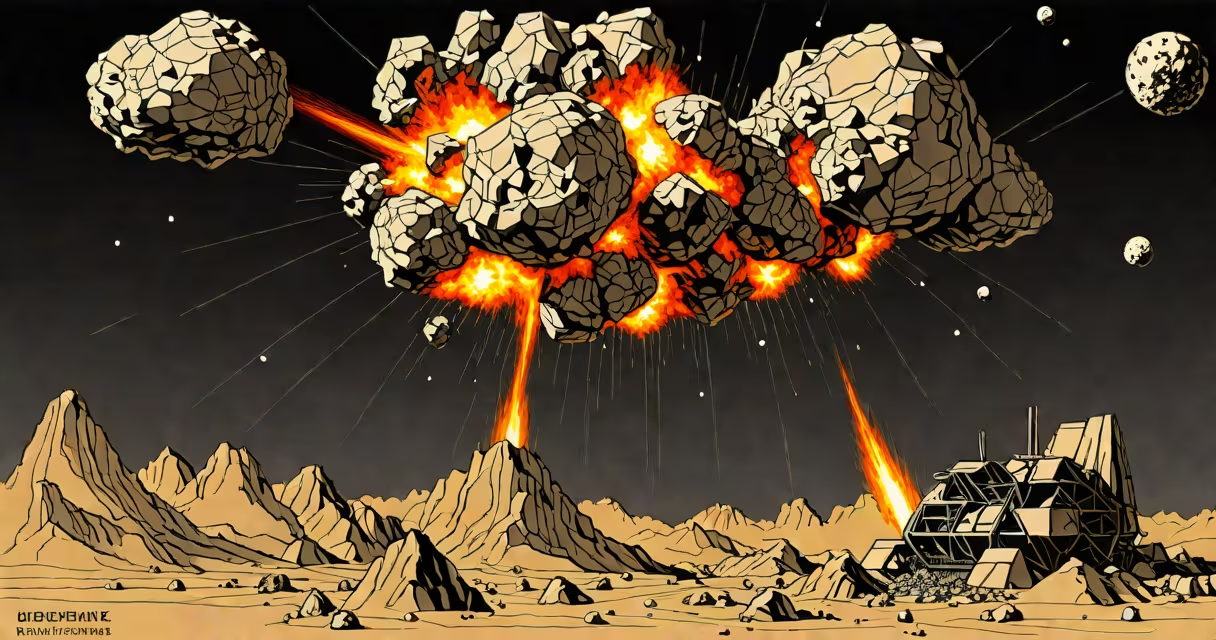
No planet struck Earth. A 10-kilometer-wide asteroid, not a planet, collided with Earth 66 million years ago, triggering the extinction of non-avian dinosaurs and about 75% of species.
The impact occurred near what is now the Yucatán Peninsula in Mexico. The energy released equaled 100 trillion tons of TNT-over a billion times more useful than the atomic bombs dropped on Hiroshima and Nagasaki. This event marked the boundary between the Cretaceous and Paleogene periods, known as the K-Pg extinction.
Geological evidence confirms the impact through a global layer of iridium-rich sediment, found in rock strata worldwide. Iridium is rare in Earth's crust but common in asteroids. The discovery of this layer by Luis and Walter Alvarez in the 1980s provided the first major clue linking the extinction to an extraterrestrial impact.
The asteroid entered Earth's atmosphere at 20 kilometers per second. Upon impact, it vaporized instantly, creating a fireball hotter than the surface of the Sun. The shockwave flattened forests within 1,000 kilometers and triggered megatsunamis across the Atlantic and Pacific oceans.
Material ejected from the impact formed a dust cloud that blocked sunlight for months. Photosynthesis halted, collapsing food chains. Global temperatures dropped sharply, leading to a "nuclear winter" effect. Acid rain from sulfur compounds further damaged ecosystems.
Within weeks, plant die-offs began. Herbivores starved. Carnivores followed. Marine life suffered from reduced light and oxygen depletion. The extinction was rapid-not gradual-based on fossil records showing sudden shifts in species abundance.
Asteroids like the one that hit Earth are rocky bodies formed in the early solar system. Most originate in the asteroid belt between Mars and Jupiter. This particular object was likely a fragment from a larger parent body disrupted by gravitational forces.
Analysis of mineral fragments from the impact layer shows high levels of shocked quartz and tektites-glassy spherules formed by molten rock cooling rapidly in the atmosphere. These materials are unique to high-energy impacts and absent in volcanic eruptions.
Scientists classify such objects as carbonaceous chondrites. They contain organic compounds and water-bearing minerals. The presence of hydrated silicates in the debris supports the idea that the asteroid came from the outer asteroid belt, where ice-rich bodies are more common.
The Chicxulub impact site is now a 180-kilometer-wide crater buried under sediment. Drilling projects, including the International Ocean Discovery Program (IODP) and the International Continental Scientific Drilling Program (ICDP), have recovered core samples from the crater's peak ring.
These cores show evidence of hydrothermal activity lasting over 100,000 years after impact. Water circulated through fractured rock, creating conditions favorable for microbial life. This suggests that even after a planetary-scale catastrophe, habitable environments can form quickly.
Studying the Chicxulub impact helps scientists model other planetary collisions. It informs risk assessments for near-Earth objects. NASA's DART mission, which successfully altered the orbit of asteroid Dimorphos in 2022, uses data from Chicxulub to refine deflection strategies.
Many assume a planet hit Earth. No planet has ever collided with Earth in the last 4.5 billion years. Planets are too large and stable to be captured by Earth's gravity. The largest known impactor was an asteroid, not a planet.
Some confuse the Chicxulub impact with volcanic activity. While the Deccan Traps in India erupted around the same time, their contribution to extinction was secondary. The timing of the impact predates most Deccan eruptions by tens of thousands of years. The asteroid remains the primary cause of the mass extinction.
Another misconception is that all dinosaurs died out. Birds evolved from small theropod dinosaurs and survived. Modern birds are direct descendants of the species that endured the impact. This evolutionary continuity proves that survival was possible under extreme conditions.
| Type | Size Range | Impact Energy | Known Examples |
|---|---|---|---|
| Asteroid | 10-100 meters | 10-1,000 megatons TNT | Chelyabinsk (2013), Tunguska (1908) |
| Large Asteroid | 1-10 km | 100 teratons TNT | Chicxulub (66 mya) |
| Planetesimal | 10-1,000 km | 10^20+ megatons TNT | Protoplanet Theia (4.5 bya, Moon formation) |
I once stood at the edge of the Chicxulub crater's rim during a field expedition. The ground was dry, cracked, and covered in limestone. The air smelled of salt and crushed rock. A drill core sample from 1.3 kilometers below the surface showed layers of shocked quartz and glassy melt rock-physical proof of a cataclysmic collision.
One non-obvious fact: the impact didn't kill everything instantly. Some species survived for years due to refugia-protected areas like deep caves or ocean trenches. Fossil evidence from Greenland shows marine plankton surviving for up to 10,000 years after the impact. Recovery took millions of years.
For context, the Chicxulub impact released energy equivalent to 100 million hydrogen bombs. The resulting dust cloud remained in the atmosphere for at least a decade, disrupting climate systems globally. This scale of environmental disruption is unmatched in Earth's history since.
Understanding what happened when an asteroid hit Earth helps us assess current risks. NASA tracks over 30,000 near-Earth objects. Only a few hundred are classified as potentially hazardous. The smallest ones-under 100 meters-can still cause regional devastation.
The question "what planet hit Earth" misidentifies the culprit. It wasn't a planet. It was an asteroid. Its legacy lives in the fossil record, the geology of Mexico, and the evolution of life on Earth. The event reshaped the biosphere and paved the way for mammals-and eventually humans-to dominate.